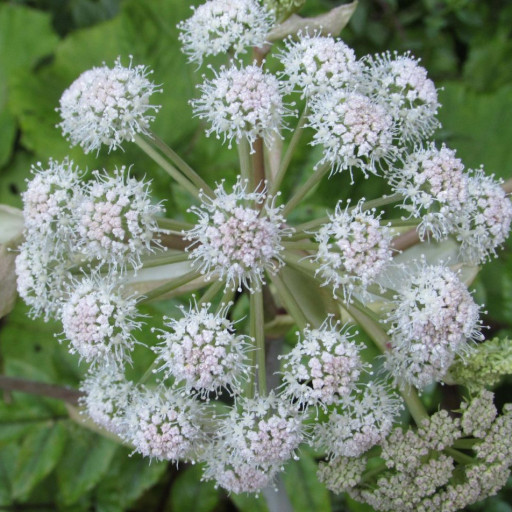
Plant Overview
Commonly known as Wild Angelica or "Holy Ghost," this architectural giant is a staple of European wetlands and damp woodlands. With its towering stems and exploding white flower "umbrellas," it acts as a natural skyscraper in the garden. Historically, it was believed to be a gift from the archangel Gabriel to cure the plague, earning it a reputation as a plant of divine protection and healing.
🔍 How to Identify
- 🌸 The Flower Umbels: It produces massive, rounded clusters (umbels) of tiny white or pale pink flowers that look like lace doilies against the sky.
- 🟣 The Stem: The stalks are stout, hollow, and often have a distinct purplish or beetroot-red tint, especially near the base.
- 🍃 The Foliage: Leaves are large, divided, and triangular in overall shape. When crushed, the foliage emits a strong, spicy, and slightly carrot-like aroma.
🏡 In Your Garden
- 💧 Thirsty Roots: Unlike many garden perennials, Wild Angelica thrives in heavy, wet soil. It is the perfect choice for "problem spots" like bog gardens, pond edges, or areas with poor drainage where other plants might rot.
- 🐝 The Pollinator Magnet: If you want to see your garden come alive, this is the plant to choose. Its flat flower heads are like landing pads for hoverflies, bees, and predatory wasps, making it a powerhouse for natural pest control.
- 🌱 Short-Lived Legacy: It is technically a monocarpic perennial or biennial. This means it often dies after flowering and setting seed. However, it usually leaves behind plenty of "babies" (self-seeding) to take its place the following year.
⚠️ Safety & Toxicity
- ☀️ Phototoxicity: The sap contains furanocoumarins. If the juice gets on your skin and is then exposed to sunlight, it can cause "phytophotodermatitis"—a nasty, blistering rash. Always wear gloves when pruning or clearing it.
- 🛑 Mistaken Identity: While Wild Angelica itself is relatively safe (historically used as a vegetable), it looks dangerously similar to Giant Hogweed and Hemlock, both of which are highly toxic or even deadly. Never forage this plant unless you are 100% certain of its identity.
✨ Fun Fact
The hollow stems of Wild Angelica were historically used by children and folk musicians to create "angelica whistles" or flutes. In some Nordic cultures, the stalks were also candied in sugar to create a sweet, emerald-green treat used to decorate cakes!

Detailed Care Instructions
To grow Angelica sylvestris, also known as wild angelica, follow these steps:
- Timing: Start planting seeds indoors 6-8 weeks before the expected last frost in your area, or sow seeds directly outdoors in early spring after the last frost.
- Location: Angelica sylvestris prefers partial shade to full sun. Choose a location with well-draining soil and good air circulation.
- Soil: Prepare the soil by removing any weeds and rocks. Angelica sylvestris prefers rich, moist soil. If your soil is poor, add compost or organic matter to improve its quality.
- Planting: Sow the seeds on the soil surface and gently press them down. The seeds need light to germinate, so do not cover them with soil. Keep the soil consistently moist until the seeds germinate.
- Watering: Angelica sylvestris requires regular watering to keep the soil consistently moist but not waterlogged. Avoid allowing the soil to dry out completely.
- Thinning: Once the seedlings have sprouted and grown a few inches tall, thin them out to give each plant enough space to grow. Space the plants about 2-3 feet apart.
- Mulching: Apply a layer of organic mulch, such as straw or wood chips, around the plants to help retain moisture and suppress weed growth.
- Fertilizing: Angelica sylvestris does not require heavy fertilizer applications. However, you can provide a light application of organic fertilizer once or twice during the growing season.
- Pruning: To encourage bushier growth, pinch back the stems when the plant is about 6-8 inches tall. This will promote branching and result in a fuller plant.
- Pests and Diseases: Angelica sylvestris is generally resistant to pests and diseases. However, keep an eye out for common garden pests like aphids, slugs, and snails. If necessary, use organic pest control methods.
- Harvesting: After about 2 years, when the plants reach maturity, you can harvest the leaves, stems, and seeds for culinary or medicinal use. Cut the stems just above the ground level.
Overall, growing Angelica sylvestris requires patience as it takes a couple of years to reach full maturity. However, with proper care and attention, you can successfully cultivate this beautiful and useful plant.

Place in a bright room that is sun drenched almost all day. Or directly in a south-facing window.

Angelica Sylvestris plant requires a generous amount of water to thrive, especially during the growing season. When watering, make sure to saturate the soil until water begins to flow out of the drainage holes at the bottom of the pot or container. Avoid letting the soil dry out completely between watering sessions, as this can cause the plant to wilt and lose its leaves.
However, it is also important not to overwater Angelica Sylvestris, as this can lead to root rot and other water-related issues. To prevent this, make sure to allow the top 1-2 inches of soil to dry out slightly before watering again. One way to check if the plant needs watering is by sticking your finger into the soil and feeling for any moisture.
It is also helpful to keep the foliage of Angelica Sylvestris dry when watering. This can be achieved by watering at the base of the plant instead of from above, or by using a watering can with a long spout to direct the water flow directly onto the soil.
Overall, providing consistent and adequate moisture is key to keeping Angelica Sylvestris healthy and thriving.
To support the growth of this plant, it is recommended to apply an organic fertilizer high in nitrogen during the early growth phase. Once the plant matures, switch to a fertilizer with a balanced ratio of nitrogen, phosphorus, and potassium. Apply the fertilizer in early spring and again in mid-summer, following the manufacturer's instructions. Avoid over-fertilization, as it can lead to plant burn and damage.
Angelica Sylvestris prefers a well-draining soil that is rich in organic matter and has a slightly acidic to neutral pH level. It can tolerate different soil types, but it is best to avoid heavy clay soils as they may hold too much water and lead to root rot. A soil mix with equal parts of loam, peat moss, and sand is suitable. Adding compost or aged manure can further improve soil quality by increasing its nutrient content. It is important to maintain consistent soil moisture to encourage healthy growth.
To propagate this plant, first gather mature seeds from the existing plant. Plant the seeds in a well-draining soil mix and keep them moist. The seeds will usually germinate within two weeks. Once the seedlings have grown to a height of about 2 inches, they can be transplanted into individual pots. Alternatively, the plant can be propagated through division. Simply dig up the existing plant and separate the root mass into smaller sections. Each section should have at least one healthy shoot and a good root system. Replant the sections in well-draining soil and keep the soil moist until new growth appears.








