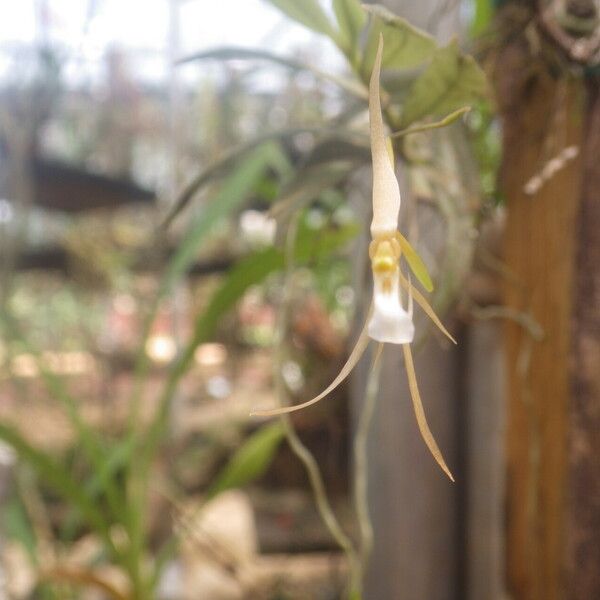
Plant Overview
Known as the "Narrow-Leaved Angraecum," this delicate orchid is a rare gem hailing from the misty, high-altitude forests of Madagascar. Unlike its more famous, giant cousins, this species is a miniature marvel, prized by collectors for its architectural silhouette and ghostly, star-shaped flowers. It brings a sense of quiet, tropical mystery to any indoor plant collection.
🔍 How to Identify
- 🍃 Slender Foliage: As its Latin name angustum suggests, the leaves are remarkably narrow and strap-like, growing in a neat, alternating fan pattern from a central stem.
- ⭐ Starry Blooms: It produces pristine white or ivory flowers that look like six-pointed stars. Each flower features a long, elegant "tail" or spur that dangles gracefully behind the bloom.
- 🦴 Velamen Roots: The roots are thick, fleshy, and covered in a silvery-grey coating called velamen, which helps the plant "drink" humidity directly from the air.
🏡 In Your Garden
- 🌬️ The Epiphytic Lifestyle: In the wild, this plant grows on tree branches, not in soil. In a home setting, it hates "wet feet." Use a very loose, chunky orchid bark or mount it on a piece of cork to ensure the roots can breathe.
- 🌑 Nighttime Fragrance: This orchid is a nocturnal performer. It saves its sweet, jasmine-like scent for the evening hours, specifically evolved to attract night-flying moths.
- 💧 Humidity is Key: Because it is used to cloud forests, it requires high humidity. If your home is dry, placing it near a humidifier or on a pebble tray is essential to prevent the leaf tips from browning.
⚠️ Safety & Toxicity
- 🛡️ Safe Status: Angraecum angustum is generally considered non-toxic to humans, cats, and dogs.
- 🌱 Sensitive to Chemicals: While it won't hurt your pets, the plant itself is very sensitive to tap water chemicals and heavy fertilizers. Always use distilled or rainwater if possible to keep it healthy.
✨ Fun Fact
The genus Angraecum is famous in the world of science because of Charles Darwin. He once predicted that a moth with an 11-inch long tongue must exist to pollinate these orchids—a theory that was mocked until the moth was actually discovered decades later!

Detailed Care Instructions








