Plant Overview
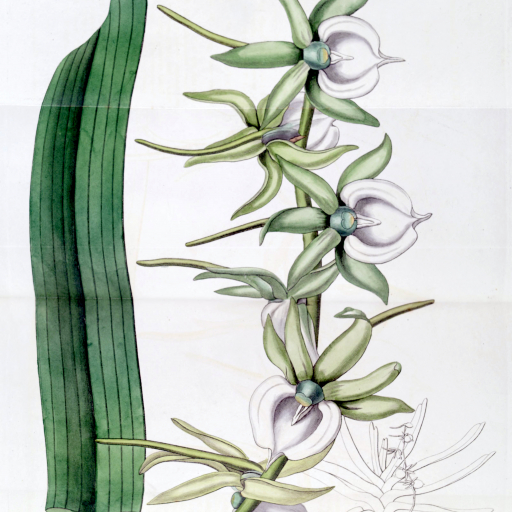
Known as the "Superb Angraecum" or the "Comet Orchid," this Madagascar native is a true giant of the orchid world. Unlike the dainty varieties found in grocery stores, Angraecum eburneum is a robust, architectural marvel that looks as much like a tropical shrub as it does a flowering plant. It is most famous for its ghostly white flowers that seem to glow in the moonlight, releasing a heavy, sweet fragrance that haunts the night air.
🔍 How to Identify
- 🍃 The Foliage: Features long, leathery, strap-shaped leaves that grow in a distinct fan-like (monopodial) arrangement. The leaves are deep emerald green and very stiff to the touch.
- 🌸 "Upside-Down" Blooms: The flowers are non-resupinate, meaning the large, heart-shaped white lip (labellum) points upward, while the green sepals point downward.
- 🧪 The Nectar Spur: At the back of each flower, you will find a long, thin, greenish-white "tail" or spur, which holds the nectar for long-tongued pollinators.
🏡 In Your Garden
- 🏺 Root Sensitivity: This orchid produces thick, silvery aerial roots that love to wander. It is notoriously "grumpy" about being moved; repotting should be avoided unless absolutely necessary, as root damage can stop growth for an entire season.
- ☀️ Light & Air: Because it is an epiphyte (growing on trees in the wild), it requires excellent air circulation. It craves bright, filtered light—think of the dappled sun under a canopy—but its thick leaves will scorch if left in harsh, direct midday sun.
- 💧 Humidity is Key: To see those long-lasting blooms, it needs a "steamy" environment. If your home is dry, placing it near a humidifier or in a bright bathroom will prevent the flower spikes from drying out before they open.
⚠️ Safety & Toxicity
- ✅ Pet Friendly: Like most members of the Orchidaceae family, Angraecum eburneum is considered non-toxic to cats, dogs, and horses.
- 👶 Safe for Kids: It is generally safe for curious toddlers, though the stiff, pointed leaves can be a minor physical hazard if someone runs into them.
✨ Fun Fact
- 🌙 Midnight Perfume: This plant is "vespertine," meaning it only releases its scent at night. It evolved this way to attract its specific pollinator—the Hawkmoth—which uses its incredibly long proboscis to reach the nectar hidden deep inside the flower's spur.

Detailed Care Instructions
To grow Angraecum Eburneum plants, follow these steps:
- Climate: Angraecum Eburneum plants thrive in warm and humid tropical climates. They require temperatures between 60 to 80°F (15 to 27°C) during the day and slightly cooler temperatures at night.
- Light: Provide your Angraecum Eburneum plant with bright but indirect sunlight. A shaded area with filtered or diffused light is optimal. Avoid direct sunlight as it may scorch the leaves.
- Watering: Water your Angraecum Eburneum plant regularly to keep the growing medium slightly moist. However, allow the soil to dry slightly between waterings to prevent waterlogging and root rot. Overwatering can be fatal to the plant.
- Humidity: These orchids thrive in high humidity. Aim for a humidity level above 50%. You can increase humidity around the plant by placing a tray of water nearby or using a humidifier.
- Potting medium: Use a well-draining orchid potting mix or a mix of orchid bark, sphagnum moss, and perlite. This will provide proper drainage and aeration for the plant's root system.
- Fertilizer: Apply a balanced orchid fertilizer every 2-4 weeks during the growing season (spring and summer). Use a dilute solution according to the packaging instructions to prevent burning the roots.
- Repotting: Angraecum Eburneum plants generally do well in small pots and prefer to be slightly root bound. However, if the plant becomes too large for its current pot or the growing medium breaks down, repot it in fresh orchid mix during spring or summer.
- Air circulation: Good air circulation is essential for these orchids. Ensure that the plant has proper ventilation to prevent stagnant air and potential fungal infections.
- Pruning: Remove any dead or yellowing leaves and spent flower spikes to maintain the plant's appearance and promote healthy growth.
- Pollination: If you want to encourage pollination, consider hand pollinating the flowers by transferring the pollen from one flower to another using a small brush or cotton swab. This can result in the formation of seed pods.
Remember, growing orchids can be challenging, so it's essential to research and understand the specific needs of your particular orchid species. Additionally, ensure you are using appropriate orchid care techniques to maximize their growth and health.

Place in a window with dappled sun or a spot in the middle of a room. Or directly in a window facing west or east.

Angraecum eburneum is an orchid species that requires frequent watering to thrive. It is best to water the plant early in the morning or late in the afternoon to avoid scorching the leaves with direct sunlight.
To water an Angraecum eburneum plant, you should first check the soil to see if it is dry. If the soil feels dry to the touch, it is time to water the plant. Use room temperature water and avoid using hard water or water that has been treated with chemicals.
Pour the water slowly over the soil until it begins to drain out of the bottom of the pot. Allow the pot to drain thoroughly to prevent water from accumulating in the bottom.
It is important to avoid overwatering the Angraecum eburneum plant, as this can lead to root rot and other fungal diseases. Check the soil frequently and adjust your watering schedule as needed to keep the plant healthy and thriving.
To fertilize this plant, use a balanced fertilizer with equal amounts of nitrogen, phosphorus, and potassium. Dilute the fertilizer to half-strength, and apply it to the plant's roots every two weeks during the growing season. During the winter months, reduce the frequency of fertilizing to once every four to six weeks. Avoid over-fertilizing as it can harm the plant's roots.
Angraecum Eburneum plant belongs to the orchid's family and requires a specific type of soil to thrive. The soil used should be well-draining and should not retain too much moisture. It should also be rich in organic matter and nutrients to provide the necessary minerals for plant growth.
The ideal soil mix for Angraecum Eburneum plant is a combination of peat moss, perlite, and bark. The peat moss provides organic matter, while the perlite improves drainage, and the bark provides structure and aeration. This mix helps to prevent waterlogging and root rot in the plant.
It is also important to use a potting mix specifically designed for orchids. These mixes are typically made from a combination of materials like sphagnum moss, perlite, bark, and coconut coir, which provide the necessary nutrients and drainage required for the plant.
It is essential to note that Angraecum Eburneum plant prefers to grow in a humid environment. Therefore, it is crucial to mist the plant regularly and provide adequate ventilation to prevent fungal growth.
Proper soil mix and care are crucial for the healthy growth of Angraecum Eburneum plant, and it is essential to follow care instructions for tropical orchids.
An orchid belonging to the genus Angraecum can be propagated through various methods including seedling propagation and vegetative propagation. For seedling propagation, the orchid seeds need to be sown onto a sterile medium that is specifically formulated for orchids. The medium should be moistened and placed in a warm location that receives indirect sunlight. The seedlings typically take several months to germinate and require careful monitoring during this period.
Vegetative propagation can be done by dividing the plant itself. First, the orchid should be removed from its pot and the roots should be carefully examined. Any damaged or unhealthy roots should be trimmed away. Next, the plant can be divided into several portions, being careful to ensure that each portion has a healthy growing point and enough roots to support it.
Once divided, each portion can be potted into its own container with fresh potting mix. The plant should be watered carefully to ensure that it does not become waterlogged. Over time, the divided portions will grow into individual plants that can be cared for in the same way as the original plant.








