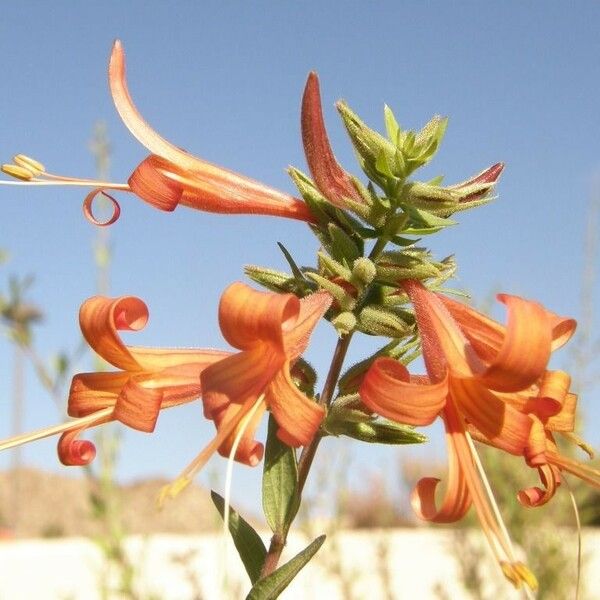
Plant Overview
Known to many as Thurber’s Desert Honeysuckle, this resilient shrub is a crown jewel of the Sonoran and Chihuahuan deserts. Its fiery, tube-shaped blooms earn it the Spanish nickname "Chuparosa," which translates literally to "rose-sucker"—a charming nod to the hummingbirds that treat this plant like a 24-hour desert diner. While it looks delicate, it is a rugged survivor built to withstand the intense heat of the American Southwest.
🔍 How to Identify
- 🌺 Fiery Blooms: Look for long, tubular flowers that range from bright tangerine to deep brick red. The lower petals typically curl back, creating a perfect landing pad for insects.
- 🌿 Narrow Foliage: The leaves are small, lance-shaped, and light green. They have a slightly sandpaper-like texture and may drop during extreme drought to help the plant save water.
- 🪵 Shaggy Stems: The plant grows in a multi-stemmed thicket. Mature branches feature distinct, straw-colored bark that peels away in thin, papery strips.
🏡 In Your Garden
- ☀️ Heat Specialist: This plant thrives in the harshest afternoon sun where other garden favorites might wilt. It is exceptionally drought-tolerant once established, though a little extra water in the summer will trigger a spectacular "second bloom."
- ✂️ Taming the Wild: Because it has a naturally "leggy" or sprawling growth habit, it can look a bit untidy in formal gardens. A hard prune in late winter helps maintain a denser, bushier shape and encourages more flower production for the coming season.
- 🐝 Pollinator Magnet: If you plant it, they will come. It is one of the most effective plants for attracting Costa’s and Anna’s hummingbirds, providing a vital nectar source when other desert flora is dormant.
⚠️ Safety & Toxicity
- ✅ Non-Toxic: Anisacanthus thurberi is generally considered safe and non-toxic for humans and common household pets like cats and dogs.
- 🖐️ Gentle Nature: Unlike many other desert shrubs, this species lacks thorns or irritating saps, making it a "friendly" choice for walkways or areas where children play.
✨ Fun Fact
The name "Chuparosa" is used for several different desert plants with red, tubular flowers. In some indigenous cultures, the nectar-filled blossoms were plucked and eaten as a sweet snack, much like honeysuckle flowers in other parts of the world!

Detailed Care Instructions
To successfully grow Anisacanthus Thurberi, also known as Thurber's desert honeysuckle, follow these steps:
- Climate: Choose a growing location suitable for this plant. Anisacanthus Thurberi is native to arid and semiarid regions. It thrives in USDA hardiness zones 8-10. Ensure your climate matches these conditions or provide a greenhouse or indoor setting if you reside outside of these zones.
- Sunlight: Provide full sun exposure to the plant. Anisacanthus Thurberi requires at least 6-8 hours of direct sunlight daily for optimal growth.
- Soil: Use well-draining soil for planting, as this plant does not tolerate waterlogged conditions. Sandy or loamy soil types are suitable for Anisacanthus Thurberi. If the soil is heavy clay, amend it with organic matter to improve drainage.
- Watering: Initially, water the plant consistently to establish strong root growth. Once established, Anisacanthus Thurberi is drought-tolerant and requires minimal watering. Water deeply but infrequently, allowing the soil to dry out between waterings to avoid overwatering.
- Fertilizing: Apply a balanced, slow-release fertilizer during the growing season to provide the necessary nutrients for healthy growth. Follow the fertilizer package instructions for application rates.
- Pruning: Trim back the plant to maintain a desired shape and size. Pruning is typically done in late winter or early spring before new growth starts. Remove any dead, diseased, or damaged stems to promote good plant health.
- Mulching: Apply a layer of organic mulch around the base of the plant to help conserve soil moisture, suppress weed growth, and moderate soil temperature. Leave space around the stem to prevent rotting.
- Pests and diseases: Anisacanthus Thurberi is generally resistant to pests and diseases. However, occasional problems with aphids or spider mites may occur. Treat any infestations promptly with insecticidal soap or natural predators.
- Propagation: You can propagate Anisacanthus Thurberi through stem cuttings. Take 4-6 inch cuttings from the plant during the spring or early summer. Remove lower leaves, dip the cut end in rooting hormone, and plant it in a well-draining potting mix. Keep the cutting moist and in a warm location until new growth starts.
Remember to regularly monitor the plant's progress and adjust care accordingly. With proper attention to sunlight, watering, and soil conditions, your Anisacanthus Thurberi plant should grow successfully.

Place in a bright room that is sun drenched almost all day. Or directly in a south-facing window.

To water this plant, you should first check the soil regularly to ensure that it is not completely dry or overly saturated. When watering, it is important to provide enough water to penetrate the soil to a depth of at least a few inches. However, you should avoid saturating the soil to the point where it becomes waterlogged. It is also important to water this plant evenly around the root zone rather than just at its base. Finally, you should avoid getting water on the leaves of the plant, as this can lead to the development of fungal diseases. It is best to water this plant in the morning or evening, rather than during the heat of the day, to reduce evaporation and ensure that the water is absorbed by the plant.
To fertilize this plant, use a balanced fertilizer with a 10-10-10 ratio, or a higher ratio of phosphorus. Apply the fertilizer in the spring and again in the fall, following the instructions on the packaging. Do not fertilize during the winter or summer months. Water the plant thoroughly after fertilizing.
Anisacanthus Thurberi plant requires a well-draining soil mix that is specifically formulated for desert or drought-resistant plants. The soil should be rich in nutrients but not too heavy or compact. It is important that the soil has good aeration and do not hold too much moisture. A good mix would include perlite, gravel, and sand in equal proportions to create the perfect environment for healthy root growth. Additionally, adding organic matter such as compost or peat moss will enrich the soil and provide additional nutrients to the plant. It is important to ensure that the pH level of the soil is slightly acidic and that the soil is thoroughly moistened before planting. This will help the roots to establish quickly and prevent transplant shock. Regular watering and fertilizing will help the plant thrive and produce vibrant flowers.
To propagate this plant, you will need to take stem cuttings from a mature plant. Ideally, you will want to take cuttings in the spring or early summer, when the plant's growth is most active.
Select a healthy stem that is at least 4-6 inches long, and use a sharp, sterile pair of pruning shears to make a clean cut just below a leaf node.
Remove any leaves from the lower half of the stem, and dip the cut end in a rooting hormone powder to encourage root growth.
Plant the cutting in a pot filled with a well-draining potting mix, and water it thoroughly. Place the pot in a warm, bright location, but out of direct sunlight.
Keep the soil moist, but not waterlogged, and within a few weeks, you should start to see new growth emerging from the stem.
Once the new plant has grown roots and is established in its pot, you can transplant it into a larger container or into the garden.








