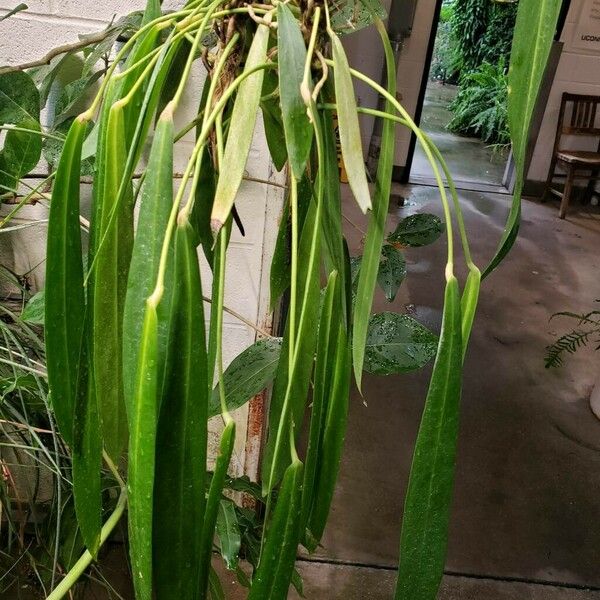
Plant Overview
Often called the "Strap-leaf Anthurium," Anthurium pendens is a dramatic jungle treasure that brings a sense of ancient mystery to any collection. Native to the humid rainforests of Panama and Colombia, this plant doesn't grow upward like most house plants; instead, it spills downward in a graceful, emerald cascade. In its natural habitat, it lives high in the canopy, draped over tree branches like living velvet ribbons.
🔍 How to Identify
- 🍃 The Foliage: Characterized by incredibly long, narrow, and lance-shaped leaves that can grow several feet long while remaining only a few inches wide.
- 🪵 Texture and Tone: The leaves have a leathery, matte-to-semi-glossy finish and a deep forest-green color that looks almost metallic under the right light.
- 🌿 Pendulous Growth: Unlike its cousin, the Anthurium vittarifolium, this species has a distinct way of hanging perfectly vertical, creating a "curtain" effect.
🏡 In Your Garden
- ☁️ Humidity is Essential: As a cloud-forest epiphyte, it breathes through its leaves. It thrives in high humidity (60%+) and may struggle with "stuck" leaves or crispy tips if the air in your home is too dry.
- 🪴 Breathable Substrate: Because it grows on trees in the wild, it hates heavy soil. It requires a very "chunky" mix—think orchid bark, charcoal, and perlite—to ensure the roots never sit in stagnant water, which leads to rapid root rot.
⚠️ Safety & Toxicity
- 🚫 Toxicity Status: Toxic to humans, cats, and dogs.
- 🐾 The Details: Like most members of the Araceae family, it contains calcium oxalate crystals. If ingested, it causes immediate mouth irritation, swelling of the throat, and digestive distress. Always hang it high out of reach of curious nibblers.
✨ Fun Fact
In the wild, Anthurium pendens acts as a "litter-collector." Its downward-hanging shape and the way its roots cluster allow it to catch falling leaves and organic debris from the trees above, which then decompose to provide the plant with its own custom-made fertilizer!

Detailed Care Instructions

Place in a window with dappled sun or a spot in the middle of a room. Or directly in a window facing west or east.

The presence of a dry surface layer of soil does not indicate that the plant requires water. Instead, stick your finger 1-2" (3-5 cm) deep in the soil to feel dampness or moisture content. If the soil seems dry, it's time to water your greens. If the soil is still moist, however, it is better not to water your plant and instead wait a day or two. Overwatering or waterlogging raises the risk of root rot. So if the soil takes longer than a week to dry, check the light conditions because it's likely that the plant isn't getting enough light. It's fine if the upper layer of soil is dry between waterings, but the deeper soil layer should always have some moisture.
Without the need of fertilizer, these plants can thrive and bloom. If a plant requires fertilization, it will display indicators of nutrient insufficiency, such as yellowing leaves. It is safe to apply slightly diluted fertilizers in these circumstances. Over fertilizing, on the other hand, should be avoided because excess nutrients might cause plant mortality. Slow-release fertilizers are therefore advised for these plants.
You may use All Purpose Plant Food or Green Plant Food for your Anthurium Pendens
Common pests of the anthurium pendens include Mealybugs, spider mites, thrips. Make a habit of checking your anthurium pendens frequently for pests so that any infestations can be caught and managed early.








