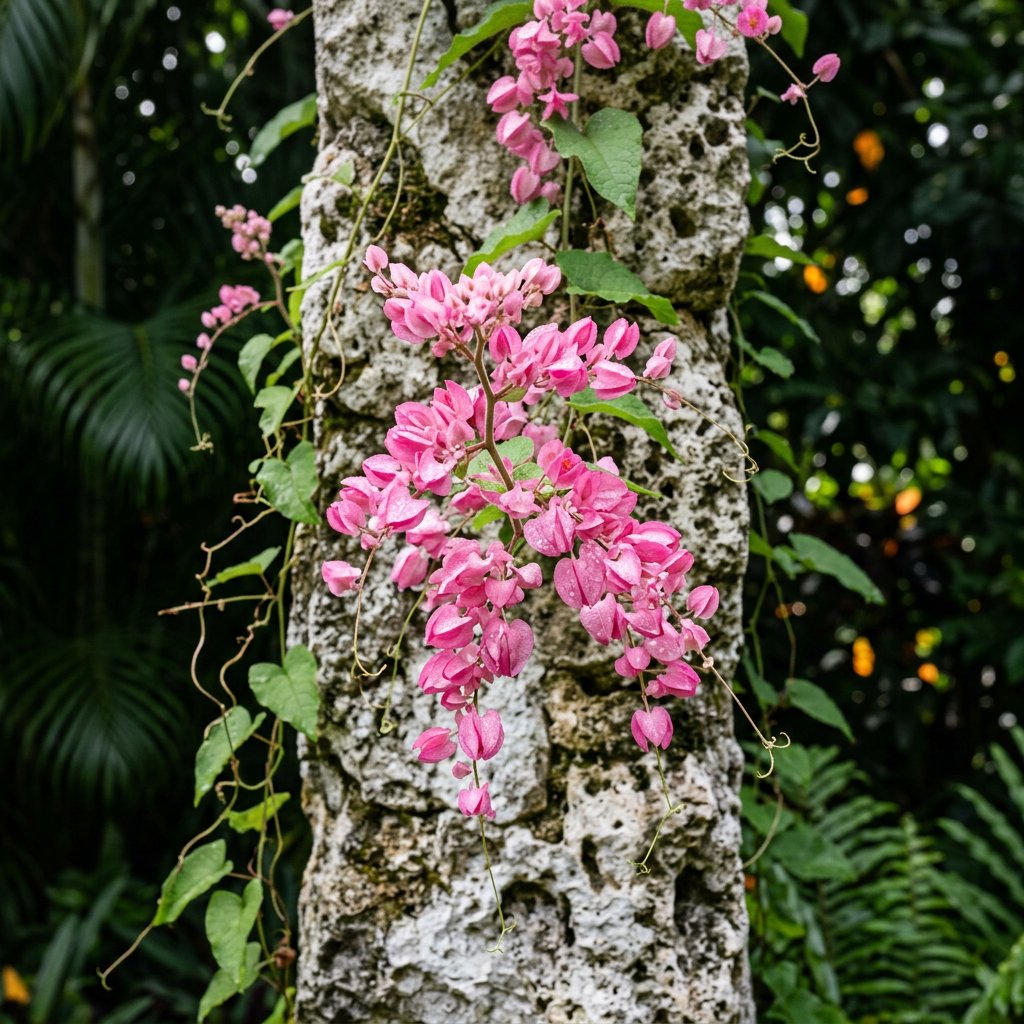
Plant Overview
Commonly known as the Coral Vine, Queen's Wreath, or the romantic Chain of Love, Antigonon leptopus is a high-climbing perennial that turns fences and trellises into waterfalls of hot pink. Native to Mexico, this vigorous vine is beloved in tropical climates for its ability to bloom almost year-round, providing a lush, Victorian-era aesthetic to any garden landscape.
🔍 How to Identify
- 💖 The Foliage: Look for soft, bright green leaves shaped like perfect hearts (or arrowheads) with distinct wavy margins and a slightly wrinkled texture.
- 🌸 The Blooms: Its most striking feature is the cascading clusters of small, "winged" flowers, usually in vibrant shades of coral pink, though white varieties exist.
- 🧶 The Tendrils: Unlike many vines that twist their stems, the Coral Vine uses thin, wiry tendrils located at the ends of its flower branches to pull itself upward.
🏡 In Your Garden
- 🧱 The Great Hider: Because it grows with incredible speed, it is the perfect "living curtain" for disguising unsightly chain-link fences, old sheds, or stone walls.
- ☀️ Sun-Seeker: This plant is a sun worshiper; the more light it receives, the more intense the pink of its flowers will be. In shadier spots, it tends to become leggy and produces more leaves than blooms.
- 🥔 Hidden Strength: It develops large, underground tubers that store water and energy. This makes the plant incredibly drought-tolerant, but be warned: those same tubers make it very difficult to "un-invite" from your garden once it has settled in.
⚠️ Safety & Toxicity
- ✅ Safe for Humans: The Coral Vine is generally considered non-toxic to humans and has even been used in traditional folk medicine in its native regions.
- 🐾 Pet Friendly: There are no recorded toxic effects for cats or dogs, making it a safe choice for pet-filled backyards.
- 🌿 Ecological Note: In tropical regions like Florida or Hawaii, it can be too successful. Its rapid growth can smother native plants, so it is often classified as invasive in those specific climates.
✨ Fun Fact
The underground tubers of the Coral Vine are actually edible! In some parts of Mexico, they are harvested, prepared like potatoes, and have a pleasant, nut-like flavor. Additionally, the plant is a "pollinator party"—it is one of the top sources of nectar for honeybees and butterflies in late summer.

Detailed Care Instructions
To grow Antigonon leptopus, commonly known as Coral Vine or Queen's Wreath, you can follow these steps:
- Planting: Select a location with full sun exposure and well-draining soil. Dig a hole about twice the size of the root ball. Place the plant in the hole and backfill with soil, firming it gently around the roots. Water the plant thoroughly after planting.
- Watering: Antigonon leptopus prefers regular watering, especially during dry periods. Keep the soil moist but not waterlogged. Irrigate deeply to encourage root growth.
- Fertilization: Use a balanced, slow-release fertilizer during the growing season to provide necessary nutrients. Follow the instructions on the fertilizer packaging for application rates.
- Pruning: Coral Vines may require occasional pruning to control their growth. Remove any dead or damaged branches, and trim back any unwanted growth. Pruning also helps maintain a neat appearance.
- Support: Due to their vigorous growth habit, Antigonon leptopus often requires a support structure. Provide a trellis, fence, or arbor for the plant to climb on. Regularly train and tie the vines to the support structure as they grow.
- Propagation: You can propagate Coral Vine through seed or stem cuttings. To propagate from cuttings, take 6-8 inch (15-20 cm) stem cuttings, remove the lower leaves, and place them in moist potting soil. Keep the cuttings in a warm and bright location and mist them regularly. Once roots develop, transplant them into individual pots or directly into the garden.
- Pest and Disease Control: Antigonon leptopus is generally resistant to pests and diseases. However, keep an eye out for common garden pests like aphids or spider mites. If necessary, treat the affected areas with insecticidal soap or an organic pesticide.
- Cold Protection: Coral Vine is a tender plant and can be damaged by frost or freezing temperatures. If you live in a colder climate, grow it as an annual, or provide it with frost protection, such as covering it with a blanket or moving it to a protected area during cold spells.
With proper care and suitable growing conditions, Antigonon leptopus can quickly establish and become a beautiful, flowering vine in your garden.

Place in a bright room that is sun drenched almost all day. Or directly in a south-facing window.

To water this plant, it is important to first check the soil moisture level. Stick your finger into the soil about two inches deep, and if it feels dry to the touch, then it is time to water. When watering, use a gentle stream of water to thoroughly soak the soil around the base of the plant. Avoid getting water on the foliage as it can lead to fungal diseases. It is best to water in the morning or evening when the sun is not too hot to avoid leaf burn. During the hotter and drier months, you may need to water more frequently, but be careful not to overwater as this can lead to root rot. A good rule of thumb is to water deeply once a week or every 10 days, depending on weather conditions.
- Use a balanced fertilizer: Choose a fertilizer that contains an equal amount of Nitrogen (N), Phosphorus (P), and Potassium (K). For example, a 10-10-10 or a 20-20-20 fertilizer.
- Apply in the spring: Apply the fertilizer in the spring when new growth begins.
- Follow package instructions: Read and follow the instructions on the fertilizer package for the appropriate amount to use.
- Water after application: After applying the fertilizer, water the plant thoroughly to help distribute the nutrients into the soil.
- Repeat once a year: Repeat the fertilization process once a year in the spring to keep the plant healthy and promote new growth.
The Antigonon Leptopus plant requires a well-draining soil that is rich in nutrients. The ideal soil pH level is between 6.0 to 7.5. A nutrient-rich soil will help in the proper growth and development of the plant. The soil should be a mix of compost, sand, and loam to provide the required texture and structure. Additionally, the soil should not be compacted as it can lead to poor drainage and hinder the growth of the plant. Therefore, it is recommended to provide a loose and airy environment for the roots to grow and take up nutrients. It is also important to water the plant regularly to prevent the soil from becoming too dry which can lead to damage to the root system. Overall, the soil should be well-draining, nutrient-rich, loose and airy, and have a neutral pH level.
To propagate this particular plant, one can take softwood cuttings from the stem tips and trim the leaves to about 2-3 inches to reduce moisture loss. The cuttings should be about 4-6 inches long and dipped in a rooting hormone. Then, they should be planted in well-draining soil and kept in a slightly shaded area. Regular misting and watering should be done to keep the soil moist. The cuttings should root within a few weeks and can be transplanted to a permanent location once they have developed a strong root system.
Common pests of the coral vine include Spider mites, aphids. Make a habit of checking your coral vine frequently for pests so that any infestations can be caught and managed early.








