Plant Overview
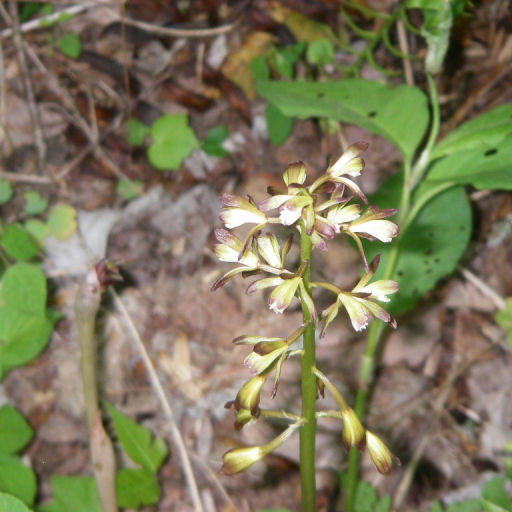
Known as the Puttyroot or the Adam and Eve Orchid, this North American native is a master of the "seasonal shift." Unlike most plants that hide from the cold, this orchid sends up its single, pinstriped leaf just as the autumn leaves begin to fall. It is a quiet, charismatic forest dweller that thrives in the shadows of ancient deciduous trees.
🔍 How to Identify
- 🍃 The Pinstriped Leaf: Look for a single, oval leaf that is bluish-green with striking, silver-white parallel veins. It appears in late autumn and remains vibrant throughout the snowy winter.
- 🕯️ The Ghostly Spike: In late spring—long after the leaf has withered away—a leafless, brownish-purple stalk emerges, carrying a cluster of small, nodding flowers that are yellowish-green with purple highlights.
- 🥔 Twin Corms: Underground, the plant grows from two bulb-like structures (corms) connected by a thin root. One is the current year’s growth, and the other is the previous year’s, leading to its "Adam and Eve" nickname.
🏡 In Your Garden
- 🌳 The Canopy Context: In the wild, it lives in rich, moist soils under hardwoods like Maples and Beeches. It relies on the winter sun reaching the forest floor while the trees are bare to photosynthesize.
- 🍄 Fungal Friendships: This orchid is notoriously difficult to grow in a traditional garden because it depends on specific soil fungi (mycorrhizae) to survive. It is best left to flourish in its natural habitat; "rescuing" it from the woods usually results in the plant failing.
- 🍂 Leaf Litter Lover: It hates "clean" soil. It prefers a thick layer of decomposing leaf mulch, which provides the cool, damp environment its sensitive root system requires.
⚠️ Safety & Toxicity
- 🟢 Non-Toxic: This plant is generally considered non-toxic to humans and common household pets.
- 🐾 Disturbance Risk: While not poisonous, it is very fragile. Trampling the soil around the plant can damage the delicate underground corms and the fungal network it needs to feed itself.
✨ Fun Fact
The name "Puttyroot" isn't just a nickname—it’s a job description! Early American settlers discovered that crushing the orchid's corms produced a thick, sticky paste. They used this botanical "superglue" to mend cracked ceramic bowls and plates.

Detailed Care Instructions
To grow Aplectrum hyemale, also known as the putty root or Adam and Eve orchid, follow these steps:
- Choose a suitable location: Aplectrum hyemale prefers partial to full shade and moist, humus-rich soil. It can be grown in woodland areas or in shaded gardens.
- Planting: Plant Aplectrum hyemale tubers in the fall, about 2-4 inches deep in the soil.
- Watering: Keep the soil consistently moist but not waterlogged. Water during dry periods, especially during the growing season.
- Fertilizing: Aplectrum hyemale does not require regular fertilizing. However, you can add a slow-release fertilizer in the spring to provide extra nutrients.
- Mulching: Mulch around the base of the plant to help retain moisture and suppress weeds.
- Pruning: Aplectrum hyemale does not require pruning, but you can remove any dead or damaged foliage as needed.
- Propagation: Aplectrum hyemale can be propagated by dividing the tubers in the fall.
- Pests and diseases: Aplectrum hyemale is relatively pest and disease-free, but watch out for slugs, snails, and deer.
With proper care and attention, Aplectrum hyemale should thrive and produce beautiful flowers year after year.

Place in a window with dappled sun or a spot in the middle of a room. Or directly in a window facing west or east.

To properly water this plant, you should ensure that it is receiving a consistent amount of moisture. It prefers moist, but not soggy, soil and can be watered using either a watering can or hose. It is important to avoid getting water on the foliage, as this can increase the risk of fungal diseases. Additionally, the plant should not be allowed to dry out completely between waterings. It is recommended to check the soil moisture level regularly by inserting a finger into the soil and watering as necessary. Additionally, Aplectrum Hyemale will benefit from a layer of mulch around the base of the plant to help retain moisture in the soil.
To fertilize the plant Aplectrum Hyemale, first make sure the plant is well-established and has been growing for at least a year. In early spring, before new growth appears, apply a balanced fertilizer with a ratio of 10-10-10 or similar. Spread the fertilizer around the base of the plant, being careful not to get any on the leaves. Water thoroughly after fertilizing to help the nutrients penetrate the soil and reach the roots. Repeat this process once or twice more during the growing season, following the same instructions. Avoid over-fertilizing, as this can harm the plant.
When growing the plant known by its botanical name, Aplectrum Hyemale, it is recommended to use a well-draining, acidic soil mix. This can be achieved by mixing equal parts of peat moss, perlite or sand, and leaf mold or compost. The soil should have a pH range of 4.5 to 6.0 and should be kept moist but not waterlogged. Adding organic matter to the soil can also help improve its quality and fertility. It is important to avoid using heavy or clay soils, as they can retain too much water and cause root rot. Additionally, Aplectrum Hyemale prefers growing in partially shaded areas, so it is ideal to place it in a spot that receives between 50-70% shade throughout the day.
Propagation of Aplectrum hyemale can be done through division of rhizomes or by collecting and sowing seeds. To propagate through division, carefully dig up a mature plant and separate the rhizomes into smaller sections, each with at least one growth bud. Replant these divisions in a suitable location with well-draining soil and adequate moisture.
To propagate through seeds, collect ripe seed pods from a mature plant and carefully open them to extract the small seeds inside. Sow these seeds in a seed starting mix in a shallow container, covering lightly with soil. Keep the soil consistently moist and place the container in a location with indirect sunlight. Germination can take several weeks to months, so be patient.
Once the divisions or seedlings have established themselves, continue to provide them with the appropriate growing conditions, including regular moisture and partial shade. With adequate care, the propagated Aplectrum hyemale plants should continue to grow and thrive in their new location.








