Plant Overview
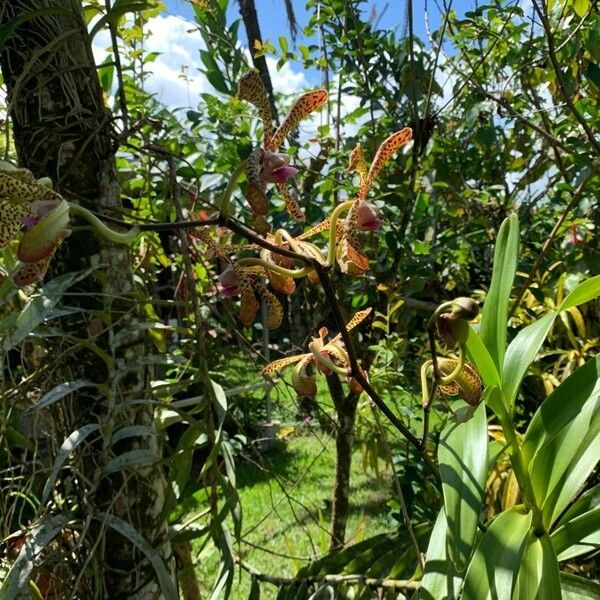
Often called the Spider Orchid or Scorpion Orchid, this Southeast Asian native is a true giant of the orchid world. Its Latin name, flos-aeris, translates literally to "flower of the air," nodding to its epiphytic nature and its habit of dangling its blooms high above the ground. It doesn't just sit quietly in a pot; it climbs and rambles with a wild, exotic energy that makes it a dramatic showstopper in tropical landscapes.
🔍 How to Identify
- 🕷️ Spider-Like Blooms: The long, slender, curving petals and sepals are typically a pale greenish-yellow, heavily barred with dark maroon or chocolate-brown, mimicking the spindly legs of a large spider.
- 🎋 Woody Climbing Stems: Unlike compact houseplant orchids, these have thick, scrambling stems that can reach several meters in length, often producing stiff aerial roots that cling to supports.
- 🍃 Leathery Foliage: The leaves are tough, strap-shaped, and arranged in two neat rows (distichous) along the stem, designed to withstand intense tropical humidity and light.
🏡 In Your Garden
- 🧗 The Scrambler: This orchid is a "vandal" of the garden; it needs a sturdy trellis, a fence, or even a large tree trunk to scale. It is best suited for outdoor tropical gardens or very large, high-ceilinged conservatories where it has room to roam.
- ☀️ Sun Worshipper: While many orchids hide in the shade, the Spider Orchid is a sun-lover. To trigger its magnificent blooms, it requires very bright light, often thriving in full morning sun which would scorch more delicate species.
⚠️ Safety & Toxicity
- ✅ Non-Toxic Status: Arachnis flos-aeris is generally considered non-toxic to humans, cats, and dogs.
- 🪴 Handling Care: While the plant isn't poisonous, its stems can become very woody and stiff. Use caution when pruning or moving the plant to avoid minor skin scrapes from the leaf edges or sharp, dried aerial roots.
✨ Fun Fact
The Spider Orchid is famous for its unique fragrance—unlike the sweet, floral scent of many orchids, its blooms emit a heavy, musky aroma that is most potent during the hottest part of the day to attract specific tropical pollinators.

Detailed Care Instructions
To grow Arachnis Flos-aeris, also known as the "Flying Spider Orchid," you need to create a suitable environment and provide proper care. Here are some steps to help you grow this unique orchid:
- Light: Arachnis Flos-aeris thrives in bright, indirect light. Place it near a south or east-facing window that receives several hours of indirect sunlight daily. Avoid direct sunlight, as it can scorch the leaves.
- Temperature and Humidity: Maintain a temperature range of 70-85°F (21-29°C) during the day and slightly cooler at night. These orchids prefer high humidity levels between 50-70%. Consider using a humidifier or place the plant on a tray filled with water and pebbles to increase humidity. Mist the plant occasionally.
- Watering: Water the orchid thoroughly when the top inch of the potting medium feels dry. It is crucial not to overwater or let the orchid sit in standing water, as it may lead to root rot. Proper drainage is essential. Use filtered or distilled water if your tap water has high mineral content.
- Potting Medium: Use a well-draining orchid potting mix that consists of bark chips, sphagnum moss, perlite, or a mixture of these components. Repot the orchid every 2-3 years or when the potting medium breaks down.
- Fertilization: Feed the orchid regularly with a balanced orchid fertilizer. Dilute the fertilizer to half its recommended strength and apply it every two to four weeks during the growing season (spring and summer). Reduce or stop fertilizing during the plant's dormant period (fall and winter).
- Air Circulation: Good air circulation is important for Arachnis Flos-aeris. Avoid placing it in a stagnant area, especially during the nighttime when stale air may lead to fungal or bacterial diseases.
- Support and Stake: As the plant grows, it may require support to keep the long flower spikes upright. Use bamboo stakes or other supports to prevent bending or breaking of the flower spikes.
- Blooming: Arachnis Flos-aeris blooms usually in late winter or early spring. The flower spikes can grow up to several feet long and may produce multiple vibrant, spider-like flowers. Be patient, as it can take several years for the plant to mature and bloom.
By following these guidelines, you can successfully grow and enjoy the beauty of Arachnis Flos-aeris, one of the captivating spider orchids.
Watering Arachnis flos-aeris plants requires careful consideration of the plant's specific needs. Here are some guidelines to follow:
- Assess soil moisture: Before watering, check the moisture level of the soil. Insert your finger about an inch deep into the soil to determine if it feels dry. If it does, it's a sign that the plant needs watering.
- Use lukewarm water: Arachnis flos-aeris plants prefer lukewarm water over cold. Fill a watering can or container with water at room temperature. Avoid using water straight from the tap, as it may contain chlorine or other chemicals that can harm the plant.
- Water thoroughly: When watering, aim to thoroughly moisten the entire root ball. Slowly pour the water onto the soil around the plant until it begins to drain from the bottom of the pot. This ensures that moisture reaches the plant's roots and encourages healthy growth.
- Avoid overwatering: Arachnis flos-aeris plants can be sensitive to overwatering. It's crucial not to let the plant sit in waterlogged soil, which can lead to root rot. After watering, remove any excess water that drains into the saucer or tray beneath the pot.
- Observe the plant's response: Pay attention to your plant's behavior after watering. If the foliage becomes dark or discolored, it may indicate that the roots are staying too wet. On the other hand, if the leaves appear wilting or droopy, it can signify under-watering.
- Adjust watering frequency: The frequency of watering Arachnis flos-aeris plants depends on various factors such as temperature, humidity, and the specific soil mix. As a general rule, allow the top inch or so of soil to dry out before watering again. This prevents excessive moisture buildup while ensuring the plant is adequately hydrated.
Remember, the watering needs of plants can vary, so it's important to observe and adapt your watering routine accordingly.
To successfully fertilize the Arachnis Flos-aeris plant, follow these instructions:
- Choose a balanced water-soluble fertilizer with equal ratios of nitrogen (N), phosphorus (P), and potassium (K). A 20-20-20 or 10-10-10 formulation is suitable.
- Dilute the fertilizer according to the package instructions. Generally, a ratio of 1 tablespoon per gallon of water is appropriate.
- Water the Arachnis Flos-aeris plant thoroughly before applying the fertilizer. This ensures that the roots are moist and ready to absorb nutrients.
- Pour the diluted fertilizer solution into a watering can or spray bottle.
- Apply the fertilizer evenly to the soil around the base of the plant. Avoid splashing the solution onto the leaves or flowers.
- If using a watering can, slowly pour the fertilizer solution until it begins to flow out of the drainage holes at the bottom of the pot. Allow the excess liquid to drain away.
- If using a spray bottle, lightly mist the soil surface with the fertilizer solution until it is evenly moistened.
- Repeat the fertilization process every two to four weeks during the active growing season, typically spring through early fall. Decrease the frequency to once every six to eight weeks during the plant's dormant period in winter.
- Monitor the plant's response to fertilization. If the foliage becomes yellow or shows signs of fertilizer burn, reduce the concentration or frequency of fertilizer application.
- Finally, always follow the specific fertilizer instructions for your particular brand and adjust the dosage and frequency accordingly.
Arachnis Flos-aeris, also known by its scientific name, requires a specific type of soil to thrive. This unique orchid variety prefers an orchid-specific potting mix that is well-draining, loose, and has high porosity. The ideal soil should retain moisture but should not become waterlogged, as excessive moisture can cause root rot and other issues.
The recommended potting mix for Arachnis Flos-aeris often consists of a combination of materials such as pine bark, sphagnum moss, coconut husk chips, perlite, and charcoal. This combination provides a balance between moisture retention and proper aeration for the roots.
Pine bark is commonly used in orchid potting mixes as it is highly porous, allowing air circulation around the roots, while holding some moisture. Sphagnum moss helps retain moisture and provides a cushion for the roots. Coconut husk chips improve aeration and moisture retention, ensuring the roots do not dry out completely.
Perlite, a lightweight volcanic rock, is added to the soil mixture to enhance drainage further and prevent the potting mix from compacting. Charcoal is often included in the mix to prevent the accumulation of harmful materials, keep the soil fresh, and reduce the risk of fungal or bacterial growth.
It is important to note that Arachnis Flos-aeris plants are epiphytic, meaning they typically grow attached to other plants, rather than in the ground. This influences the soil requirements, as they need a substrate that somewhat replicates their natural habitat.
Overall, providing the right soil composition is crucial to maintaining the health and vitality of Arachnis Flos-aeris. Using a well-draining, porous, and moisture-retentive orchid potting mix containing ingredients like pine bark, sphagnum moss, coconut husk chips, perlite, and charcoal is recommended for this particular orchid species.
Propagation of Arachnis Flos-aeris can be done using several methods:
- Division: This is the most common method used to propagate Arachnis Flos-aeris. To propagate through division, gently separate the plant's pseudobulbs, ensuring each division has at least three to four growths or pseudobulbs. Plant the divisions in well-draining orchid potting mix and provide them with appropriate care.
- Backbulbs: Another propagation method is using backbulbs. Backbulbs are older bulbs that have lost their leaves or are less vigorous. These bulbs can be removed from the mother plant and carefully divided into sections, making sure each section has at least one healthy growth or pseudobulb. Plant the backbulbs in a suitable potting mix, taking care not to bury them too deeply.
- Keiki propagation: Arachnis Flos-aeris can also produce keikis, which are small plantlets that develop along the flower stem or aerial roots. To propagate using keikis, wait until they have developed their own roots and are at least one-third the size of the parent plant before detaching them. Once removed, plant the keikis in pots using an appropriate orchid mix. Provide them with proper care, including regular watering and indirect light.
- Meristem culture: A more advanced propagation technique is meristem culture or tissue culture. This method involves taking a small piece of tissue or meristem from the plant and placing it in a sterile culture medium containing nutrients and growth hormones. This process allows for the mass production of new plants in a laboratory setting and is commonly used in commercial orchid production.
Regardless of the propagation method chosen, it is essential to provide the newly propagated Arachnis Flos-aeris plants with suitable growing conditions. This includes placing them in a bright, indirect light location, maintaining high humidity levels, ensuring proper ventilation, and watering appropriately. Additionally, it is beneficial to use a well-draining orchid potting mix and provide regular fertilization to support healthy growth.








