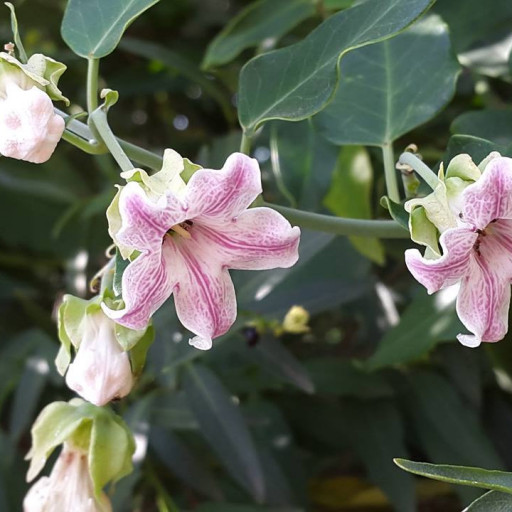
Plant Overview
Often called the "Cruel Vine" or "Moth Plant," this South American climber is as beautiful as it is devious. While its fragrant, bell-shaped flowers seem welcoming, they harbor a sticky secret that gives the plant its sinister nickname. In many parts of the world, it is viewed as a persistent "garden escapee" that can quickly overwhelm fences and native trees with its rapid, twining growth.
🔍 How to Identify
- 🌿 The Foliage: Triangular or heart-shaped leaves that grow in opposite pairs. They have a distinctively pale, grayish-green underside with a slightly fuzzy texture.
- 🌸 The Blooms: Waxy, star-shaped flowers that range from creamy white to pale pink. They emit a heavy, cloying scent that is strongest in the late afternoon and evening.
- 🍐 The Fruit: Large, grooved, pear-shaped pods (resembling a Chayote or Chuchu) that turn woody as they dry. When they split, they release hundreds of seeds attached to long, silky white hairs.
🏡 In Your Garden
- 🧗 A Vigorous Twiner: This plant doesn't use tendrils; it wraps its entire stem tightly around supports. Because it grows so aggressively, it can "strangle" host plants by competing for light and weighing down branches until they break.
- 🌱 Seed Management: If you choose to keep this plant (and it isn't listed as a noxious weed in your area), you must be vigilant. A single pod can release thousands of seeds that travel for miles on the wind, making it very difficult to contain once the pods burst.
⚠️ Safety & Toxicity
- 🩹 Skin Irritant: The stems and leaves contain a thick, milky white latex sap. This sap is a known skin irritant and can cause itchy rashes or "contact dermatitis" upon touch. Always wear gloves when pruning.
- 🐾 Pet & Livestock Warning: Araujia sericifera is toxic if ingested. It contains cardiac glycosides that can cause digestive upset, drooping, or more serious heart issues in cats, dogs, and horses.
✨ Fun Fact
The "Cruel Vine" gets its name from its unique pollination tactic. The flower is designed to trap the proboscis (tongue) of a moth inside its internal mechanism. The moth remains a "prisoner" throughout the night and is only released the following morning once the flower wilts, ensuring the insect is thoroughly dusted with pollen before it flies away!

Detailed Care Instructions
| Lighting | Full Sun |
| Hardiness Zones | 8B - 10B |
To grow Araujia Sericifera plants, follow these steps:
- Purchase seeds or young plants: Araujia Sericifera plants can be started from seeds or young plants. Purchase them from a reputable supplier.
- Planting in containers: If you live in an area with cold winters, it’s best to grow Araujia Sericifera plants in containers so you can bring them indoors during winter. Choose a container with good drainage holes.
- Soil: Use well-draining soil that is rich in organic matter. A mix of potting soil and perlite or sand works well.
- Planting seeds or young plants: If planting seeds, sow them directly in the container at a depth of 1/4 inch (0.6 cm). If using young plants, gently remove them from their nursery containers and plant them at the same level they were growing.
- Watering: Water the soil thoroughly after planting, and keep it consistently moist until the plant is established. After that, allow the top inch (2.5 cm) of soil to dry out between watering.
- Sunlight: Place the container in a spot where the plant can receive full sun or partial shade. Araujia Sericifera plants thrive in bright light conditions.
- Fertilizing: Feed the plant with a balanced, slow-release fertilizer once a month throughout the growing season (spring and summer). Follow the instructions on the fertilizer packaging for the correct dosage.
- Pruning: To maintain a compact shape, trim the plant back in early spring before new growth begins.
- Pests and diseases: Keep an eye out for common pests, such as aphids and spider mites. Treat any pest infestations promptly with an appropriate insecticide or horticultural soap.
- Overwintering: If you live in a region with frosty winters, bring the container indoors before the first frost. Place it in a well-lit area, and reduce watering during winter as the plant goes into dormancy.
- Propagation: You can propagate Araujia Sericifera plants by taking stem cuttings in late spring or early summer. Use a rooting hormone to encourage root development, and keep the cuttings in a moist environment until they establish roots.
With proper care and attention, Araujia Sericifera plants can grow vigorously and produce beautiful, fragrant flowers.

Place in a bright room that is sun drenched almost all day. Or directly in a south-facing window.

To properly care for this plant, it is important to water it regularly. The plant prefers moist, but not waterlogged soil, so be sure to allow the top layer of soil to dry out slightly before watering. The frequency of watering will depend on the temperature and humidity in your growing environment, as well as the time of year. In general, you should plan to water this plant every 7-10 days during the growing season. When watering, be sure to thoroughly saturate the soil and allow any excess water to drain away. In addition to regular watering, this plant may benefit from periodic misting to increase humidity around the leaves.
- Use a balanced fertilizer with equal amounts of nitrogen, phosphorus, and potassium.
- Add fertilizer to the soil once a month during the growing season (spring and summer).
- Dilute the fertilizer according to the instructions on the packaging before application.
- Water the plant thoroughly after fertilizing.
- Avoid over-fertilizing, as this can damage the plant.
The Araujia Sericifera plant prefers well-draining, nutrient-rich soil that is slightly acidic to slightly alkaline with a pH range of 6.0 to 7.5. It requires a soil blend that is light and airy with good water retention capacity. A mixture of organic materials such as peat moss, compost, and well-rotted manure with perlite, vermiculite, and sand is suitable for planting this plant. The soil should be loose enough to allow water to penetrate easily but firm enough to hold the roots securely. The plant requires regular watering, but the soil should not be waterlogged. Proper soil preparation will help the Araujia Sericifera plant to establish healthy roots and thrive.
Araujia sericifera can be propagated through seed germination or stem cuttings. To propagate through seed germination, collect mature seeds that are developed in the late summer or early fall and plant them in a potting mix that is rich in organic matter and has good drainage. Keep the seeds moist, but not waterlogged in a warm, light-filled location. The seeds typically take two to three weeks to germinate and should be transplanted into their individual pots once they have at least two sets of true leaves.
To propagate through stem cuttings, take a stem cutting that is about six inches long from a mature plant in late summer or early fall. Ensure that the cutting has at least one node and remove the bottom leaves, leaving only the top few. Dip the cut end of the stem into a rooting hormone and then place it into a potting mix that is moist, well-draining, and has good aeration. Place the pot in a warm, bright area, but out of direct sunlight. After a few weeks, roots should start to form. Once the roots have established, the cutting can be transplanted into its own pot or in a suitable planting site.








