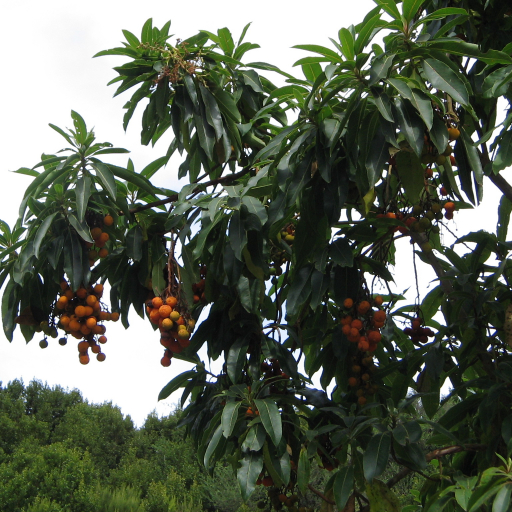
Plant Overview
Often called the "Canary Madroño," the Arbutus canariensis is a rare and elegant evergreen tree native to the lush volcanic slopes of the Canary Islands. It is beloved by rare-plant enthusiasts for its striking, multicolored peeling bark and its clusters of delicate, wax-like flowers. In its homeland, it is a protected species, serving as a vital part of the unique "Laurisilva" (laurel forest) ecosystem.
🔍 How to Identify
- 🪵 Papery Bark: The most dramatic feature is the smooth, reddish-orange bark that peels away in thin, papery curls to reveal a fresh, pistachio-green layer underneath.
- 🔔 Urn-Shaped Blooms: It produces hanging clusters of creamy white or pale pink flowers that look like tiny, upside-down porcelain bells or urns.
- 🍓 Globose Fruit: The fruit is a spherical, warty berry that transitions from yellow to a vibrant orange-red as it matures, superficially resembling a wild strawberry.
🏡 In Your Garden
- ⛰️ Volcanic Heritage: This tree craves excellent drainage. It thrives in slightly acidic, gritty soil that mimics its native volcanic habitat; if its "feet" stay too wet, it is prone to root rot.
- 🛑 Sensitive Roots: Like most members of the Heath family, it possesses a sensitive taproot and resents being moved. It is best to plant it in its "forever home" while it is young, as older trees rarely survive a transplant.
- 🌬️ Coastal & Cool: While it enjoys the sun, it prefers the "cloud-line" atmosphere—warm days with high humidity and cool nights. It is surprisingly wind-tolerant, making it a great choice for coastal gardens in Mediterranean climates.
⚠️ Safety & Toxicity
- ✅ Non-Toxic: The Canary Island Strawberry Tree is generally considered non-toxic to humans, dogs, and cats.
- 🍭 Edible (But Bland): The berries are technically edible and are used locally to make traditional sweets or liqueurs. However, they are often described as having a mealy texture and a rather flat flavor compared to the more common Arbutus unedo.
- 🍷 Fermentation Note: Very ripe fruits can ferment on the branch. If a pet or bird eats a large quantity of these overripe berries, they may experience mild digestive upset or slight lethargy from the natural sugars turning to alcohol.
✨ Fun Fact
In the Canary Islands, this tree is deeply rooted in local folklore and history. Its wood is incredibly dense and hard; historically, it was the preferred material for crafting sturdy agricultural tools and the traditional "lucha canaria" (Canary wrestling) sticks!

Detailed Care Instructions
To grow Arbutus Canariensis plant, also known as Canary Island Strawberry Tree, you can follow these steps:
- Climate and location: Arbutus Canariensis thrives in Mediterranean climates. It prefers full sun and well-drained soil. Choose a location that receives sunlight for at least a few hours each day.
- Soil preparation: This plant prefers slightly acidic to neutral soil. Ensure the soil is well-drained and rich in organic matter. If the soil is heavy and poorly drained, consider adding sand, perlite, or organic matter to improve drainage.
- Planting: The best time to plant Arbutus Canariensis is in early spring or early fall. Dig a hole twice as wide and deep as the root ball of the plant. Gently place the plant in the hole, making sure it is at the same level as the surrounding soil. Fill the hole with soil, firm it gently, and water thoroughly.
- Watering: Arbutus Canariensis is drought-tolerant once established, but it is important to keep the plant well-watered during the first year or two. Water deeply and thoroughly, allowing the soil to dry out slightly between waterings. Avoid overwatering, as excessive moisture can lead to root rot.
- Mulching: Apply a layer of organic mulch around the base of the plant, such as wood chips or compost, to help retain moisture in the soil and suppress weed growth. Leave a gap around the stem to prevent the mulch from touching the base, as this could cause rot.
- Pruning: Arbutus Canariensis generally does not require much pruning. However, you can remove any dead, damaged, or crossing branches to maintain a healthy shape. Pruning should be done in late winter or early spring before new growth begins.
- Fertilizing: In general, Arbutus Canariensis does not require heavy fertilization. However, you can apply a balanced slow-release fertilizer in late winter or early spring to provide essential nutrients for the plant's growth.
- Pests and diseases: Arbutus Canariensis is relatively resistant to most pests and diseases. However, occasional issues may include aphids, scale insects, or leaf spot diseases. Monitor the plant regularly and take appropriate action if any issues arise.
Remember to check your local gardening guidelines and consult with experts regarding the specific needs and recommendations for Arbutus Canariensis in your region.
The watering needs of this plant can vary depending on factors such as soil type, temperature, and humidity. It is important to monitor the soil moisture regularly and water only when the top inch of soil is dry to the touch. Overwatering can lead to root rot and other plant health issues. When watering, it is best to give a deep, thorough soaking rather than frequent shallow watering. Water should be applied to the base of the plant and not directly onto the leaves or trunk. In hot or dry conditions, it may be necessary to increase the frequency of watering. In cooler or humid conditions, watering can be reduced.
To properly fertilize this plant, it is important to use a balanced fertilizer with equal parts nitrogen, phosphorus, and potassium. Mix the fertilizer with water and apply it to the soil around the plant, taking care to avoid getting the fertilizer on the leaves or stem. Fertilize the plant once a month during the growing season, which is typically from spring to fall. Always follow the instructions on the fertilizer packaging for best results.
To grow the Arbutus Canariensis plant, it is recommended to use well-draining soil that is slightly acidic with a pH range of 5.5 to 6.5. The soil composition should include a good mix of organic matter such as peat moss or compost to improve soil texture and water retention. It is also important to ensure that the soil has good aeration to allow for proper root development. Adding perlite or vermiculite to the soil mixture can help improve drainage and air circulation. It is generally best to avoid using heavy clay soils or soils that are too compact as they can restrict root growth and cause drainage issues. Overall, the ideal soil for the Arbutus Canariensis plant should be well-draining, slightly acidic, nutrient-rich, and have good aeration.
Arbutus canariensis can be propagated through several methods, including seed propagation, cutting propagation, and layering propagation.
Seed propagation involves collecting ripe seeds from the plant and sowing in a seed tray. The seeds should be covered with a fine layer of soil and placed in a warm, well-lit area. They should be watered regularly and within a few weeks, the seeds should germinate. The seedlings can then be transplanted to their permanent location.
Cutting propagation involves taking cuttings from the plant in the summer months when the plant is actively growing. The cuttings should be taken from the tips of the plant and be around 4-6 inches long. Once the cutting has been taken, it should be dipped in hormone rooting powder and planted in a pot of soil. The pot should be placed in a bright, warm area and kept moist. Within a few weeks, roots should form and the cutting can be transplanted to a permanent location.
Layering propagation involves bending a branch of the plant down to the soil and burying a section of it under the soil. The buried section should be scraped with a knife to encourage rooting. The branch should be kept moist and within a few months, roots should form. Once the roots have formed, the branch can be cut and transplanted to a permanent location.
All of these methods of propagation require care and attention to ensure successful growth. With patience and care, Arbutus canariensis can be propagated easily and effectively.








