Plant Overview
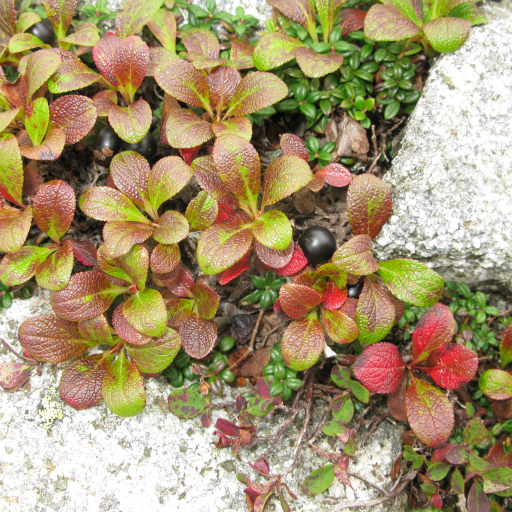
Often called the Alpine Bearberry or Black Bearberry, this resilient little shrub is a master of survival in the harshest environments on Earth. While its cousins might prefer lush forests, this plant hugs the rocky ground of the Arctic tundra and high mountain peaks. Its most dramatic feature is its autumn transformation, where the leaves turn a "fire-engine red" that can be seen from miles away across the mountain slopes.
🔍 How to Identify
- 🍃 Wrinkled Foliage: The leaves are small, oval, and have a distinctively "toothed" edge toward the tip with a noticeably wrinkled (rugose) texture.
- 🔔 Urn-Shaped Flowers: In early spring, it produces tiny, drooping clusters of greenish-white or pinkish flowers that look like miniature delicate bells.
- 🌑 Jet-Black Berries: Unlike the common red bearberry, this species produces berries that start green, turn red, and eventually ripen into a glossy, ink-black color.
🏡 In Your Garden
- 🏔️ The Alpine Specialist: This plant is an "extremophile" and requires very specific conditions to thrive in a home setting. It demands acidic, well-draining, and gritty soil—mimicking the rocky scree of its mountain home.
- ❄️ Heat Sensitive: It hates "warm feet." In a garden, it needs a cool root zone and will likely struggle in regions with hot, humid summers. It is best suited for rock gardens in northern latitudes or high altitudes.
⚠️ Safety & Toxicity
- 🟢 Safe & Edible: The berries are non-toxic and have been a traditional food source for indigenous peoples in the Arctic.
- 🐾 Pet Friendly: There are no known toxic effects for dogs, cats, or horses, making it a safe choice for a wildlife-friendly landscape.
- 👅 Acquired Taste: While safe, the berries are often described as "mealy" or bland when raw, though they become much sweeter and more palatable when cooked into jams or syrups.
✨ Fun Fact
The name Arctostaphylos comes from the Greek words arktos (bear) and staphyle (a bunch of grapes), referring to the fact that grizzly bears and black bears frequently feast on these berries to fatten up before their winter slumber!

Detailed Care Instructions
To grow Arctostaphylos alpinus (also known as alpine bearberry), follow these steps:
- Obtaining seeds or seedlings: You can purchase seeds or young plants from native plant nurseries or online. Alternatively, collect seeds from mature plants if they are locally available and allowed.
- Choosing the right location: Bearberry plants prefer full sun to partial shade, so select a spot with at least six hours of direct sunlight per day. The soil should be well-draining, slightly acidic, and sandy to rocky.
- Preparing the soil: Clear the area of weeds or grass. If the soil is heavy clay or poorly draining, add sand or organic matter like compost to improve drainage and aeration.
- Planting from seeds: Sow the seeds in the spring, as the cold stratification period (a period of chilling to break seed dormancy) occurs naturally during the winter. Gently press the seeds into the soil, ensuring they are covered with a light layer (about 1/8 inch) of soil. Water lightly.
- Planting seedlings: Dig a hole slightly larger than the root ball of the seedling. Place the plant in the hole, ensuring the soil level around the stem matches the previous soil level. Backfill the hole with soil, gently firming it around the roots. Water the plant thoroughly.
- Watering: Bearberry plants are drought-tolerant once established, so water sparingly. However, it is important to water regularly during the first few weeks after planting to help the roots establish.
- Mulching: Apply a layer of organic mulch, such as wood chips or pine straw, around the plant to help retain moisture, suppress weeds, and protect the roots from extreme temperatures.
- Pruning: Minimal pruning is required for bearberry plants. However, you can trim back any dead or damaged branches in early spring to maintain a tidy appearance.
- Fertilizing: Bearberries generally do well without additional fertilization. However, if you decide to fertilize, use a slow-release, balanced fertilizer in early spring.
- Winter protection: Mature bearberry plants are generally hardy, but young plants may need protection from extreme cold temperatures during their first winter. Mulch around the base of the plant to insulate the roots.
Remember to check your local regulations regarding seed collection and plant propagation from the wild.

Place in a bright room that is sun drenched almost all day. Or directly in a south-facing window.

To water this plant, it is important to consider its specific water requirements. Arctostaphylos Alpinus plants are typically sensitive to overwatering and need moderate watering. It is recommended to allow the top layer of soil to dry out before watering again.
When watering, pour water slowly and directly onto the soil around the plant's base rather than sprinkling the water on the foliage. Ensure that excess water drains out of the pot or soil, as sitting water can cause root rot.
During periods of drought or high temperatures, the plant may need more frequent watering. However, it is important to avoid watering too much or too frequently.
Overall, it is crucial to monitor the soil moisture level regularly and adjust the watering schedule as necessary to ensure the plant thrives.
To fertilize this plant, apply a balanced, slow-release fertilizer in early spring before new growth appears and again in late summer after flowering has finished. Use a fertilizer with equal amounts of nitrogen, phosphorus, and potassium and apply at a rate of 1/2 pound per 100 square feet. Water thoroughly after applying fertilizer to ensure nutrients reach the roots. Avoid applying fertilizer too close to the base of the plant as it may burn the roots.
The Arctostaphylos Alpinus plant prefers a well-draining soil with a slightly acidic pH level. A mixture of sand, peat moss, and loam is recommended for optimal growth. The soil should be moist but not waterlogged, as the plant is susceptible to root rot. The addition of organic matter, such as compost or leaf litter, can also benefit the plant's growth and overall health. It is important to note that this plant is native to alpine and subalpine regions, so it may require extra care to establish in lower elevation locations with different soil and climate conditions.
Arctostaphylos Alpinus can be propagated using two primary methods, vegetative propagation or seed propagation.
Vegetative propagation is the process of creating new plants from existing plant parts. Arctostaphylos Alpinus can be propagated using cuttings, layering, or division. Cuttings are the most common method, and they involve cutting a stem or branch from the parent plant and placing it in a growing medium to develop roots. Layering is another method that involves bending a stem or branch to the ground and covering it with soil to encourage rooting. Division involves separating the parent plant into smaller sections and replanting them.
Seed propagation involves planting seeds from a mature Arctostaphylos Alpinus plant. However, the seeds have a hard and thick coat, so before planting, they should first be scarified. Scarification is the process of breaking or scratching the seed coat to allow for water penetration and germination. Once scarified, the seeds can be planted in a seed-starting mix and kept moist until germination occurs.
Regardless of the method chosen, the new plants should be kept in a cool, moist environment until they have become established. This process can take several months, but with patience and proper care, Arctostaphylos Alpinus can be propagated successfully.








