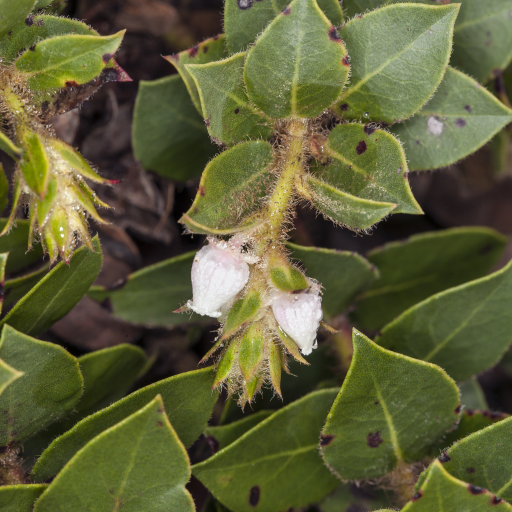
Plant Overview
The Mount Bruno Manzanita (Arctostaphylos imbricata) is a rare, living treasure found exclusively on the windswept ridges of San Bruno Mountain in California. Known for its low-profile, mounding silhouette, this resilient shrub is a master of survival in harsh, coastal conditions. Its name, "imbricata," refers to the beautiful way its leaves overlap like shingles on a roof, a clever adaptation to capture moisture from the Pacific fog.
🔍 How to Identify
- 🍃 Overlapping Foliage: The small, heart-shaped leaves are "imbricate," meaning they tightly overlap one another along the stems, creating a dense, shingled appearance.
- 🪵 Mahogany Bark: Like its cousins, it features smooth, reddish-brown bark that provides a stunning contrast against its dull green leaves.
- 🔔 Urn-Shaped Blooms: In late winter to early spring, it produces clusters of tiny, waxy, white-to-pink flowers that look like miniature upside-down vases.
- ☁️ Fuzzy Stems: If you look closely at the new growth, the stems are covered in fine, bristly hairs that help the plant trap humidity.
🏡 In Your Garden
- 🪨 Drainage is Non-Negotiable: In a garden setting, this plant is notoriously "fussy" because it evolved in rocky, nutrient-poor soils. It will likely fail in heavy clay; it requires exceptionally sharp drainage to prevent root rot.
- 💧 The Fog Factor: While it is highly drought-tolerant once established, it thrives on "atmospheric moisture." In inland gardens, it appreciates an occasional evening misting to mimic the coastal fog of its home.
- 🌱 Slow and Steady: This is not a plant for those seeking an overnight hedge. It grows very slowly and resents being moved or pruned heavily, as it lacks a "burl" to regrow from the base if cut to the ground.
⚠️ Safety & Toxicity
- ✅ Pet & Human Safe: Like most Manzanita species, Arctostaphylos imbricata is generally considered non-toxic to dogs, cats, and humans.
- 🐜 Habitat Value: While safe for us, it is a vital "safety net" for local pollinators. It provides early-season nectar for bees and hummingbirds when few other plants are in bloom.
✨ Fun Fact
The Mount Bruno Manzanita is one of the rarest plants in the world; its entire natural range is limited to just a few square miles on a single mountain near San Francisco. If you see one in the wild, you are looking at a species that exists nowhere else on Earth!

Detailed Care Instructions
To grow Arctostaphylos imbricata, also known as the sandmat manzanita, you can follow these steps:
- Choose a suitable location: Arctostaphylos imbricata thrives in well-draining soil and prefers full sun exposure. Select a spot in your garden that receives at least 6 hours of direct sunlight each day.
- Prepare the soil: Sandy or loamy soil is best for this plant. Make sure the soil is well-draining by adding organic matter like compost or peat moss to improve its texture and drainage.
- Planting: Dig a hole in the prepared soil that is slightly larger and deeper than the container or root ball of your Arctostaphylos imbricata plant. Gently remove the plant from its container and place it in the hole, ensuring that the top of the root ball is level with the surrounding soil. Backfill the hole gently but firmly, ensuring that there are no air pockets around the roots.
- Watering: After planting, water the plant thoroughly to settle the soil and help establish the roots. Arctostaphylos imbricata prefers a moderate amount of water, so water deeply but infrequently, allowing the soil to dry out slightly between watering sessions. Avoid overwatering, as it can lead to root rot.
- Mulching: Applying a layer of organic mulch around the base of the plant can help maintain soil moisture, suppress weed growth, and moderate soil temperature. Use materials like wood chips, straw, or bark to provide a 2-3 inch layer of mulch.
- Pruning and maintenance: Arctostaphylos imbricata usually requires minimal pruning. However, you can trim and shape the plant to maintain its desired size and form. Avoid pruning during the active growth period and remove any dead or diseased branches.
- Fertilization: Arctostaphylos imbricata generally doesn't require frequent fertilization. However, if the plant shows signs of nutrient deficiencies, you can apply a balanced slow-release fertilizer according to the package instructions. Apply the fertilizer in late winter or early spring when the plant is still dormant.
- Protection: Protect young Arctostaphylos imbricata plants from extreme weather conditions like frost or strong winds. You can use protective coverings like burlap or erect windbreaks until the plant becomes established.
By following these steps and providing proper care, your Arctostaphylos imbricata plant should grow well and thrive.

Place in a bright room that is sun drenched almost all day. Or directly in a south-facing window.

Arctostaphylos Imbricata is a plant species that requires proper watering to thrive. To water this plant, it is important to consider its specific needs to avoid over or under watering. Here are some steps on how to water Arctostaphylos Imbricata:
1. Check the soil moisture: Before watering your Arctostaphylos Imbricata plant, it is important to check the soil moisture level. Insert your finger into the soil, and if it feels dry to the touch, then it is time to water.
2. Water deeply and infrequently: This plant requires deep watering to promote deep root growth. It is recommended to water Arctostaphylos Imbricata at least once a week during the growing season and every two weeks during the winter months.
3. Avoid overwatering: Overwatering can lead to root rot, so it is important to avoid watering the plant too frequently. Make sure the soil has adequate time to dry out between watering.
4. Water in the morning: Watering in the morning allows the plant to absorb the water it needs and dry out during the day. Avoid watering in the evening as this can cause the plant to remain damp throughout the night.
5. Use a watering can or drip irrigation: Watering cans or drip irrigation allow for a slow and steady stream of water that avoids damaging the plant's leaves and branches.
By following these steps, you can effectively water Arctostaphylos Imbricata and promote its growth and health.
To fertilize this plant, choose a slow-release fertilizer with a balanced N-P-K ratio. Apply the fertilizer once a year in early spring, just before new growth begins. Scatter the fertilizer around the base of the plant, keeping it at least 6 inches away from the trunk. Water thoroughly after applying the fertilizer.
Arctostaphylos imbricata plant prefers well-drained soil with a slightly acidic pH level. The soil should be moist but not waterlogged, as waterlogged soil can lead to root rot. It is important to avoid using heavy clay soils or compacted soils, as they can hinder root growth and nutrient absorption. A loamy soil with good drainage is ideal for this plant. It is also recommended to add organic matter to the soil, such as compost or peat moss, to improve its fertility and moisture retention properties. Additionally, a layer of mulch around the base of the plant can help to retain moisture in the soil and suppress weeds.
To propagate this plant, one can collect seeds from the berries in the fall and plant them in a sandy, well-draining soil mixture. The seeds can be stratified in the refrigerator for 60-90 days to improve germination rates. Alternatively, stem cuttings can be taken in the summer and rooted in a mixture of perlite and peat moss. Cuttings should be taken from healthy, disease-free plants and treated with a rooting hormone before planting. Keep the cuttings in a humid environment with bright, indirect light until roots develop.








