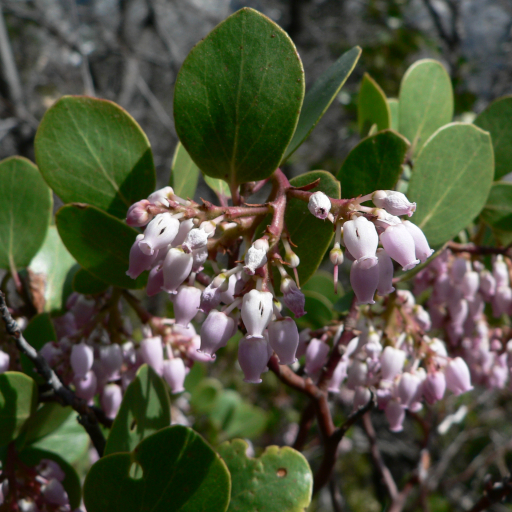
Plant Overview
Known as the Greenleaf Manzanita, this rugged beauty is a staple of the high-elevation forests and volcanic slopes of Western North America. Its common name, "Manzanita," is Spanish for "little apple," a nod to the plant's tiny, fruit-like drupes. It is a plant of high drama and resilience, often seen standing as a vibrant, evergreen contrast against the charred remains of a forest fire.
🔍 How to Identify
- 🌿 The Foliage: Bright green, leathery leaves that are oval or round. Interestingly, the leaves often stand vertically to minimize the surface area exposed to the harsh midday sun.
- 🪵 The Bark: Its most iconic feature is the smooth, polished bark that ranges from deep cinnamon to mahogany-red. In summer, the old bark peels away in thin, papery curls.
- 🌸 The Blooms: Small, waxy, urn-shaped flowers that dangle in clusters. They are typically a soft white to blush pink and are a favorite for early-season bumblebees.
- 🍎 The Fruit: It produces small, flattened berries that turn from green to a dark, reddish-brown as they mature, resembling miniature apples.
🏡 In Your Garden
- ⛰️ Living Sculpture: Because of its slow-growing, twisted branch structure, it is often used as a focal point in xeriscapes (water-wise gardens). It provides year-round structural interest that looks better with age.
- 🔥 The Fire Starter: This plant is a "resprouter." It possesses a large, woody underground burl called a lignotuber. If the top of the plant is destroyed by fire, it can regenerate entirely from this hidden energy source.
- 💧 Drainage is Vital: The Greenleaf Manzanita is adapted to rocky, nutrient-poor soils. In a garden setting, it will struggle and likely die in heavy clay or over-watered soil, as it is highly susceptible to root rot.
⚠️ Safety & Toxicity
- 🐾 Safe Status: This plant is generally considered non-toxic to humans, dogs, and cats. It is a common forage plant for deer and bears in the wild.
- 👅 Edibility Note: While the berries are not poisonous, they are notoriously "mealy" and dry. Historically, they were used by Indigenous peoples to make a refreshing cider-like drink rather than being eaten raw.
✨ Fun Fact
The seeds of the Greenleaf Manzanita are true survivors; they can lay dormant in the soil for decades, only germinating once they "smell" the chemicals in smoke or feel the intense heat of a wildfire passing over them.

Detailed Care Instructions
To grow Arctostaphylos Patula, also known as greenleaf manzanita, you can follow these steps:
- Climate and Soil Conditions: This plant is primarily native to western North America and thrives in dry, sandy, or rocky soils. It prefers well-draining soil with a pH ranging from slightly acidic to slightly alkaline. Ensure that you choose a planting location that receives full sun to partial shade.
- Planting Method: The best time to plant Arctostaphylos Patula is in the early spring or fall. Dig a hole around twice the size of the root ball and loosen the soil at the bottom of the hole. Gently place the plant into the hole, ensuring that the top of the root ball is level with or slightly above the soil surface. Backfill the hole with soil and firmly press it around the roots.
- Watering: Arctostaphylos Patula is drought-tolerant, but it requires regular watering during the first year after planting. Water deeply and thoroughly, allowing the soil to dry partially between watering sessions. Once established, reduce the frequency of watering, as the plant prefers drier conditions.
- Mulching: Apply a layer of organic mulch around the base of the plant, such as wood chips or pine needles. Mulch helps retain moisture, suppresses weed growth, and regulates soil temperature. However, ensure that the mulch does not come into direct contact with the plant's stem, as it may cause rot.
- Pruning: Prune your Arctostaphylos Patula during the late winter or early spring when it is dormant. Remove any dead or damaged branches, as well as any crossing or crowded branches. This will promote healthy growth and proper air circulation within the plant.
- Fertilization: Arctostaphylos Patula generally does not require fertilization. However, if the plant appears pale or lacks vigor, you can apply a slow-release, balanced fertilizer in early spring. Follow the manufacturer's instructions for application rates.
- Pests and Diseases: Arctostaphylos Patula is relatively resistant to pests and diseases. However, keeping the plant healthy through proper watering, good air circulation, and regular pruning can minimize the risk of any issues.
By following these guidelines, you can successfully grow Arctostaphylos Patula and enjoy its beautiful evergreen foliage and flowers.

Place in a bright room that is sun drenched almost all day. Or directly in a south-facing window.

To water this plant, you should first check the soil moisture level by sticking your finger about an inch into the soil. If the soil feels dry to the touch, it's time to water. Use a watering can or hose with a gentle spray nozzle to water the soil around the base of the plant, being sure not to get water on the leaves. Water slowly to allow the soil to absorb the moisture and avoid runoff. Wait until the soil has dried out slightly before watering again, as overwatering can lead to root rot. During hot or dry weather, you may need to water the plant more frequently.
To fertilize the Arctostaphylos Patula plant, apply a slow-release, balanced fertilizer during the growing season. Use a fertilizer with an NPK ratio of 10-10-10 or similar. Apply according to the manufacturer's instructions and make sure not to over-fertilize, as this can damage the plant. Water the plant well after fertilizing to ensure the nutrients are absorbed properly. Avoid fertilizing in the winter months when the plant is dormant.
Arctostaphylos Patula, a plant native to California, requires well-draining and acidic soil for optimal growth. It is recommended to use a mixture of sand, peat moss, and perlite to achieve the desired soil composition. The soil pH should range between 5.5-6.5, and the plant prefers to grow in full sun to partial shade. Adequate watering is necessary to prevent the soil from drying out completely, but overwatering should be avoided to prevent root rot. It is also important to avoid fertilizers high in phosphorus, as this can negatively affect the growth of Arctostaphylos Patula.
Arctostaphylos Patula is a plant that can be propagated through various methods. The first method is by taking stem cuttings. To do this, take a healthy stem from the plant and cut it off approximately 5 to 6 inches from the tip. Remove all the leaves except for the top two or three and dip the cut end into rooting hormone. Plant the cutting in a pot filled with well-draining soil and keep it moist while it develops roots.
The second method of propagation is through layering. To do this, choose a healthy branch of the plant and bend it down to the ground. Make a small cut in the branch where it touches the ground and cover it with soil. Keep the soil moist until the branch develops roots. You can then cut the branch from the parent plant and transplant it to a new location.
Another method of propagation is by dividing the plant. This can be done by digging up the plant and separating the root clumps into smaller sections. Each section should have its own root system and a few stalks or leaves. Transplant these sections into new soil and keep them well-watered until they become established.
Finally, Arctostaphylos Patula can also be propagated through seed. Collect ripe berries from the plant and remove the seeds. Plant the seeds in pots or directly into the ground in the fall. Keep the soil moist, and the seeds should germinate in the spring.








