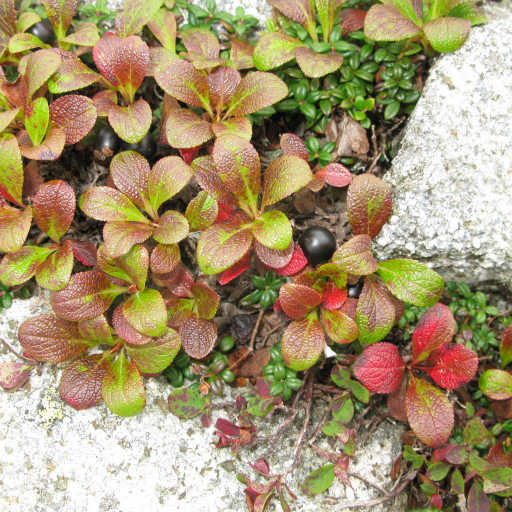
Plant Overview
Often called the Alpine Bearberry, Arctous alpina is a master of survival in the harshest landscapes on Earth. While it looks like a delicate groundcover, it thrives where most plants fail—atop windswept mountain ridges and across the frozen Arctic tundra. This resilient shrub is famous for its dramatic seasonal "wardrobe change," transforming from a humble green carpet into a sea of blazing crimson every autumn.
🔍 How to Identify
- 🍃 The Leaves: Look for small, paddle-shaped leaves with a distinct "wrinkled" or veiny (rugose) texture and finely serrated edges. Unlike many other mountain shrubs, these leaves are deciduous, meaning they drop every winter after a spectacular color show.
- 🔔 The Blooms: In late spring, it produces tiny, nodding, cream-colored or greenish-white flowers shaped like little upside-down urns.
- 🫐 The Berries: Watch the color cycle! The fruits start green, transition to a juicy red, and eventually ripen into a deep, glossy black—this "ink-black" finish is the easiest way to tell it apart from the common (red-berried) Bearberry.
🏔️ Habitat & Ecology
- ❄️ The Cold Specialist: This plant is a true "extremophile." It requires a long, cold winter dormancy to thrive and will quickly wither in humid or hot climates. It is most at home in the subarctic or at high elevations where the air is thin and crisp.
- 🪨 Rocky Foundations: It demands highly acidic, well-draining, and nutrient-poor soil. In the wild, it acts as a pioneer, anchoring itself into rocky scree or peaty tundra where few other plants can find a foothold.
⚠️ Safety & Toxicity
- ✅ Status: Generally considered safe and non-toxic.
- 🐾 Wildlife & Pets: The berries are a vital food source for bears, birds, and small mammals. They are non-toxic to dogs and cats, though the plant is rarely found in traditional residential landscapes where pets would encounter it.
- 🥣 Edibility: While humans can eat the berries, they are often described as "watery" or "bland" when raw. In some northern cultures, they are cooked into jams or mixed with other more flavorful wild berries.
✨ Fun Fact
The Alpine Bearberry provides one of nature's most reliable "fire" displays. In the Arctic and high mountains, when the first frost hits, entire mountainsides appear to be "on fire" because of the synchronized, brilliant red color change of these resilient little shrubs.

Detailed Care Instructions
To grow Arctous Alpina, also known as Alpine Bearberry, follow these steps:
- Choose the right location: Select a spot in your garden that receives full sun to partial shade. Ensure the area has well-draining soil since excessive moisture can harm the plant.
- Prepare the soil: Bearberries thrive in slightly acidic soil. Before planting, amend the soil with compost or peat moss to enhance its drainage and acidity. Additionally, remove any weeds or grass from the area.
- Planting: Dig a hole that is slightly wider and deeper than the plant's container. Gently remove the plant from the container and loosen the roots. Place the plant in the hole, ensuring that the top of the root ball is level with the soil surface. Fill the hole with soil, gently patting it down and watering lightly.
- Watering: Initially, water the plant thoroughly to help establish its roots. Afterward, water regularly, providing around 1 inch of water per week during the growing season. However, do not overwater as this can rot the roots.
- Mulching: Apply a layer of organic mulch, such as wood chips or pine needles, around the base of the plant. Mulch helps retain moisture, control weeds, and regulate soil temperature.
- Fertilizing: Bearberries generally do not require much fertilizer. However, if the soil is poor, you can use a slow-release or organic fertilizer in early spring. Follow the instructions on the packaging for the correct application rate.
- Pruning: Prune the plant annually to promote healthy growth and shape. Remove any dead, damaged, or diseased branches. You can also trim the plant to maintain the desired size and shape.
- Pests and diseases: Bearberries are generally resistant to pests and diseases. However, in some cases, aphids, spider mites, or fungal diseases can affect the plant. If needed, treat with appropriate insecticides or fungicides.
- Propagation: Arctous Alpina can be propagated through seeds or stem cuttings. Seeds generally need to be stratified for 1-3 months before sowing. Stem cuttings taken in early spring or late summer can also be rooted.
- Winter care: Arctous Alpina is cold hardy and can withstand freezing temperatures. However, extreme cold (below -30°F) may damage the plant. Consider providing some protection, such as mulch or burlap, in severe winter conditions.
Remember to regularly monitor the plant's growth, watering needs, and overall health. With proper care, Alpine Bearberry can thrive and add beauty to your garden.
Arctous Alpina is a perennial plant that prefers moist soil and moderate watering. It is important to water this plant deeply but infrequently, allowing the soil to dry out slightly between waterings. Overwatering can lead to root rot and other issues. It is also recommended to water the plant at the base rather than from overhead, as this can prevent moisture from accumulating on the leaves which can lead to disease. During the growing season, it may require more frequent watering, but during the winter months, it can withstand periods of drought. Adding a layer of mulch around the base of the plant can help to retain moisture and regulate soil temperature.
To fertilize this plant, use a balanced fertilizer with equal parts nitrogen, phosphorus, and potassium. Apply the fertilizer in early spring before new growth appears and again in late summer. Follow the manufacturer's instructions for the appropriate amount of fertilizer to use based on the size of the plant. Make sure to water the plant after fertilizing to ensure the nutrients are absorbed properly.
The best soil for growing Arctous Alpina plants is a well-draining, acidic soil with a pH between 4.5 and 5.5. The soil should be rich in organic matter, such as peat moss or leaf mold, and should be kept moist but not waterlogged. It is recommended to add perlite or sand to improve drainage if the soil is too heavy. The plant prefers a cool, damp environment, so mulching around the base with pine needles or bark is also beneficial. It is important to avoid using soil that is alkaline or has a high pH, as this can damage the plant's roots and prevent it from thriving.
Propagation of this plant can be done by taking cuttings in the early summer or by dividing mature plants in the fall. To take cuttings, select a healthy plant and cut a 4-6 inch stem just below a leaf node. Remove the lower leaves, leaving only a few at the top, and dip the cut end in rooting hormone. Plant the cutting in a well-draining soil mix and keep the soil moist. Cuttings should root in 4-6 weeks. To divide a mature plant, dig it up and gently separate the root clumps, being careful not to damage the roots. Replant the divided clumps in well-draining soil in a new location.








