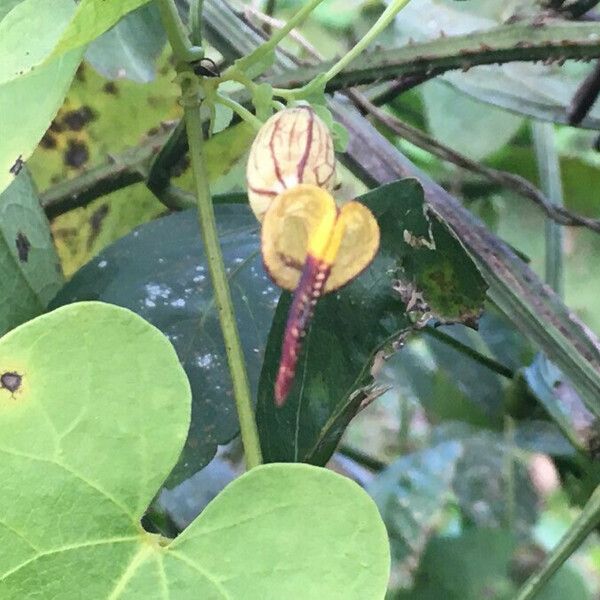
Plant Overview
Known as the Snake-killing Birthwort or Bejuco de Santiago, this exotic climber is steeped in jungle legend. Native to the tropical regions of Central and South America, it earned its name from an old folk belief that its roots could paralyze or even kill venomous snakes. While its serpent-slaying powers are likely myth, its striking, "alien-looking" flowers and fast-growing nature make it a fascinating—if slightly dangerous—addition to a collector's garden.
🔍 How to Identify
- 🌸 The "Smoker’s Pipe" Bloom: The flowers are bizarre, mottled tubes that curve upward like a Dutch pipe, often featuring shades of maroon, cream, and deep purple with intricate veining.
- 🍃 Delicate Heart Leaves: Its foliage is distinctly heart-shaped (cordate), with soft, bright green leaves that grow alternately along a thin, twining stem.
- 🐍 Serpentine Vine: The vine itself is slender and flexible, wrapping tightly around trellises or neighboring trees, mimicking the movement of a snake as it climbs.
🏡 In Your Garden
- ☁️ Humidity is Key: As a tropical native, this plant thrives in "steamy" conditions. If your garden air is too dry, it may drop its leaves or fail to produce its signature otherworldly blooms.
- 🦋 A Complex Relationship: While it attracts certain swallowtail butterflies who lay eggs on it, the plant is also a master of deception. It emits a faint odor of decaying organic matter to lure small flies into its tubular flowers for pollination, temporarily "trapping" them with downward-pointing hairs until the job is done.
⚠️ Safety & Toxicity
- ☠️ Severe Internal Toxicity: Every part of the Aristolochia anguicida contains aristolochic acid, a potent toxin that is both carcinogenic and highly damaging to the kidneys.
- 🚫 Keep Away from Pets & Kids: Ingestion is dangerous for humans, dogs, and cats. It should be grown as an ornamental plant only, and handled with gloves if you have sensitive skin, as the sap can cause minor irritation.
✨ Fun Fact
The name anguicida literally translates to "snake-killer." Ancient travelers in Colombia and Mexico believed that if a person chewed the root and spat into a snake’s mouth, the snake would lose its ability to bite or die instantly! While modern science has debunked this, the plant remains a staple of historical botanical folklore.

Detailed Care Instructions








