Plant Overview
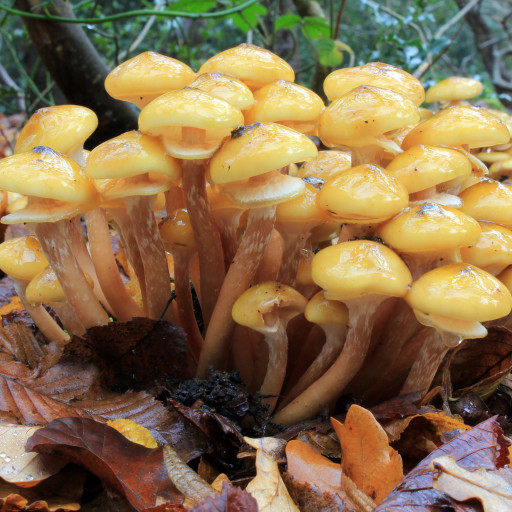
Often called the Honey Mushroom, Armillaria mellea is both a forager's delight and a gardener’s greatest foe. While its golden clusters look like something out of a woodland fairytale, this fungus hides a predatory secret beneath the soil. It is a powerful "white rot" pathogen, known for stretching out black, root-like threads to claim the lives of even the sturdiest old-growth trees.
🔍 How to Identify
- 🍯 The Cap: Honey-yellow to tawny-brown, usually 3–15 cm wide. When young, the center is often covered in tiny, dark, hair-like scales that look like "stubble."
- ⚪ The Gills: Pale cream to whitish, becoming spotted with reddish-brown as the mushroom ages. They are "adnate" or "decurrent," meaning they attach to and run slightly down the stem.
- 💍 The Ring: A distinct, persistent white or yellowish ring (the annulus) sits high on the stem, looking like a tiny, flared skirt.
- 🪵 Growth Pattern: These mushrooms almost always grow in dense, crowded clusters (caespitose) at the base of living trees or on old, buried stumps.
🌲 Habitat & Ecology
- 🌳 The Garden Pathogen: Unlike many beneficial mushrooms, the Honey Mushroom is a parasite. It attacks the roots of healthy hardwoods and fruit trees, eventually causing "butt rot" that can lead to the tree suddenly falling over.
- 🕸️ Bootlaces: It spreads through the soil using thick, black, cord-like structures called "rhizomorphs." These look exactly like black shoestrings and allow the fungus to travel from one tree to another through the dirt.
⚠️ Safety & Toxicity
- 🍄 WARNING: This mushroom is TOXIC when raw. Even when cooked, it is known to cause severe stomach upset in a significant percentage of people. It must be boiled or sautéed thoroughly before consumption.
- ⚠️ Deadly Look-alikes: It can be easily confused with the Deadly Galerina (Galerina marginata), which contains the same lethal toxins as the Death Cap. If you do not see a cluster growing from wood or a distinct, thick ring, stay away.
- 🐾 Pets & Kids: Keep curious pets and children away from clusters in the yard, as ingestion can lead to vomiting and abdominal pain.
✨ Fun Fact
Certain species of Armillaria are responsible for the phenomenon known as "Foxfire." Their mycelium (the underground network) can glow with a faint, ghostly green bioluminescence in the dark, a sight that has inspired woodland folklore and ghost stories for centuries!

Detailed Care Instructions
Armillaria mellea, commonly known as honey fungus, is actually a parasitic fungus that infects and kills trees. It is not considered a plant that you can grow deliberately, as it is known to cause diseases in woody plants.
However, if you are interested in studying the growth and characteristics of Armillaria mellea, you can follow these steps:
- Identification: Learn how to correctly identify Armillaria mellea. There are multiple species of Armillaria, so make sure you specifically identify honey fungus.
- Suitable environment: Armillaria mellea prefers moist and cool climates. Look for areas with decaying wood and an ample supply of organic matter for the fungus to grow.
- Collecting spores: Armillaria mellea reproduces through spores. Find a mature fruiting body (mushroom) of honey fungus and collect a spore print by placing the cap gills facing down on a piece of paper or glass. The spores will drop overnight and form a distinct pattern.
- Growing on agar: Honey fungus can be cultured in a laboratory setting using agar plates. Prepare a nutrient agar medium and sterilize it. Transfer spores or a small piece of mushroom tissue onto the agar plate. Incubate the plate in a cool, dark place and monitor for growth.
- Transferring to wood: Once the mycelium has grown on agar, you can transfer it to a piece of decaying wood, such as a log or tree stump. Secure the mycelium to the wood and keep it in a suitable environment with appropriate humidity and temperature.
Please note that Armillaria mellea is a parasitic fungus and can cause significant damage to trees and other woody plants. It is important to handle it with caution and ensure that it does not spread to unintended areas where it can harm plants.

Place in a dark room with little light, like a dark bedroom or a spot far away from a window or directly in a north-facing window.
Armillaria Mellea is a type of plant that requires a moderate amount of water to grow and develop properly. When watering Armillaria Mellea, you should aim to keep the soil consistently moist but not waterlogged.
To water Armillaria Mellea, you should first check the soil moisture level by sticking your finger about an inch into the soil. If the soil feels dry, it's time to water.
You can water Armillaria Mellea either by using a watering can or a hose. If using a watering can, pour the water slowly and evenly around the base of the plant. If using a hose, use a gentle flow and water the plant evenly, being careful not to disturb the soil too much.
It's important not to overwater Armillaria Mellea as this can lead to root rot and other issues. Instead, water the plant deeply and less frequently, allowing the soil to dry out slightly before watering again.
Finally, it's important to note that Armillaria Mellea prefers well-draining soil and will not tolerate standing water. If your soil is heavy or compacted, consider adding organic matter such as compost or vermiculite to improve drainage and aeration.
Fertilizing instructions for Armillaria Mellea plants may vary depending on the specific needs of your plant and its current growth stage. However, here are some general guidelines to consider:
- Use a balanced fertilizer: Choose a fertilizer that provides equal amounts of nitrogen (N), phosphorus (P), and potassium (K). This balanced ratio helps promote overall plant health.
- Follow application instructions: Read the instructions on your chosen fertilizer carefully and follow the recommended application rates. Avoid over-fertilization, as this can cause damage to the plant.
- Apply during the growing season: Fertilize your Armillaria Mellea plant during its active growing season. This usually occurs in spring and summer, but it may vary depending on the specific climate and region.
- Pre-soak the soil: Prior to fertilizing, ensure that the soil is moist but not waterlogged. Pre-soaking allows the fertilizer to be evenly distributed and easily absorbed by the roots.
- Apply at the base of the plant: Distribute the fertilizer evenly around the base of the plant, keeping it at least a few inches away from the stem or trunk. This helps avoid direct contact with the plant's foliage, which can lead to burns or other damage.
- Water after fertilizing: After applying the fertilizer, water the plant thoroughly. This helps dissolve and distribute the nutrients into the soil, making them available to the roots.
- Monitor plant response: Keep an eye on your Armillaria Mellea plant after fertilizing. Look for signs of improved growth, such as increased leaf production or vibrant color. If you notice any adverse effects, such as wilting or discoloration, discontinue fertilization and adjust your approach accordingly.
Remember that the specific fertilization needs of your Armillaria Mellea plant may vary based on factors like soil conditions, sunlight exposure, and plant health. It's always beneficial to consult with a local horticulturist or plant expert for more accurate and personalized fertilizing recommendations.
Armillaria mellea is a fungus commonly known as honey fungus. It is important to note that honey fungus does not typically grow from soil but instead attacks and decays the roots and lower trunk of various woody plants and trees.
However, if you are looking to grow a plant that is resistant or unaffected by Armillaria mellea, it is recommended to use well-draining soil that is rich in organic matter. This type of soil is beneficial for most plants as it provides good aeration and nutrient availability.
When selecting soil for your plant, consider using a mixture that contains a combination of garden soil, compost, and perlite or vermiculite. Garden soil provides the necessary minerals and nutrients, compost enhances soil fertility and structure, while perlite or vermiculite aids in drainage and prevents waterlogging.
A pH level between 5.5 and 7.0 is generally suitable for most plants, including those resistant to honey fungus. However, for some specific plants, it might be beneficial to adjust the pH level accordingly.
In addition to choosing the right soil, it is crucial to ensure proper planting techniques and maintenance practices to promote plant health and reduce the risk of honey fungus infection. These include avoiding overwatering, practicing good sanitation, and regularly inspecting plants for any signs of disease or decay.
Please note that while Armillaria mellea is a common issue in many gardens and can cause significant damage to susceptible plants, selecting the appropriate soil alone may not guarantee complete prevention or control of the disease. Other strategies such as crop rotation, avoiding susceptible plants, and maintaining overall garden hygiene are also important in managing Armillaria mellea.
Armillaria mellea is a plant that can be propagated through several methods. Here is a detailed description of how to propagate Armillaria mellea:
- Spore Propagation: Armillaria mellea can be propagated from spores. To do this, collect mature mushrooms that have released their spores. Place the mushroom cap on a piece of paper or foil and cover it with a glass jar or bowl. This setup will help to trap the spores. Leave it undisturbed for a few hours or overnight to allow the spores to release. When you remove the mushroom cap, you will find a fine layer of spores on the paper/foil. These spores can be used to start new colonies.
- Mycelium Propagation: Armillaria mellea can also be propagated by transferring mycelium, the fungal thread-like structure, from an existing colony. Locate a mature and healthy Armillaria mellea colony in the wild or in your garden. Carefully dig around the outer edges of the colony, ensuring that you are collecting the underground mycelium. Transfer the mycelium to a new location such as a prepared bed or container filled with suitable growing medium. This method is useful for expanding an existing colony or establishing new ones.
- Root Division: Armillaria mellea can also be propagated through root division. Dig up a mature plant and carefully separate the root system into smaller sections, ensuring that each segment contains healthy roots and shoots. Replant each divided section in a suitable growing medium. Keep the soil moist, and over time, the divided sections will develop into new individual plants.
- Stem Cutting: While less common, Armillaria mellea can be propagated through stem cuttings. Take a healthy stem cutting from a mature plant, ensuring that it has several nodes. Remove the lower leaves and dip the cut end in a rooting hormone. Plant the cutting in a well-draining potting mix, burying a few nodes beneath the soil. Maintain a moist environment and provide indirect light. Over time, the cutting will develop roots and can be gradually acclimated to outdoor conditions.
Remember that propagation success may vary depending on the availability of specific materials, environmental conditions, and the overall health of the plant. It is important to take necessary precautions, such as using sterile tools to minimize the risk of spreading diseases. Additionally, research and follow any local regulations or guidelines regarding the cultivation and propagation of Armillaria mellea or any other plant species.







