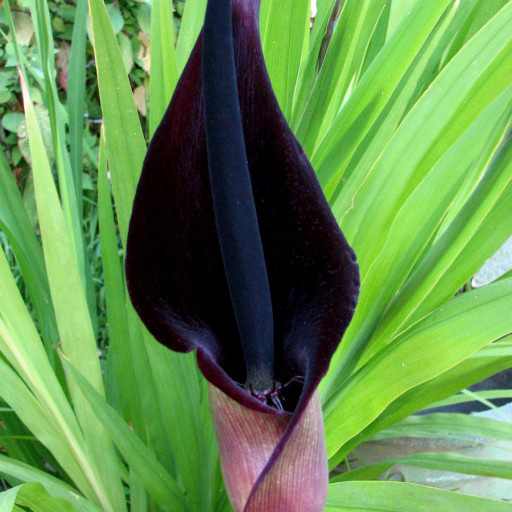
Plant Overview
Known by evocative names like "Lords-and-Ladies," "Cuckoo Pint," or "Wake Robin," the Arum is a masterpiece of woodland mystery. Native to Europe and parts of Asia, this plant has a dramatic lifecycle that shifts from elegant green hoods in the spring to striking spikes of scarlet berries in the autumn. In folklore, its arrival was often seen as a sign that the earth was finally waking up from its winter slumber.
🔍 How to Identify
- 🍃 Arrow-Head Leaves: Large, glossy, dark green foliage shaped like distinct arrowheads. Depending on the variety, they may be plain or marbled with silver or purple-black spots.
- 🕯️ The Spathe and Spadix: A pale green or creamy "hood" (the spathe) that partially wraps around a central, poker-like rod (the spadix) which can be purple or yellow.
- 🍒 Autumn Berries: After the leaves and "flower" die back in late summer, a single, leafless stalk remains, topped with a dense cluster of brilliant orange-red berries.
🏡 In Your Garden
- 🌳 The Shade Lover: Arums are the perfect solution for those tricky, dark corners of the garden. They thrive in the dappled light found under deciduous trees, mimicking their natural forest floor habitat.
- 🪵 Dormancy Cycle: One of the Arum's most unique traits is its disappearing act. The leaves often wither away in the heat of summer, leaving the stage clear for the berries to take the spotlight—don't mistake this for the plant dying!
⚠️ Safety & Toxicity
- 🚫 Highly Toxic: Every part of the Arum plant is poisonous. It contains needle-shaped calcium oxalate crystals that cause intense irritation.
- 🐶 Risk to Pets & Kids: The bright red berries are particularly tempting to children and pets but are extremely dangerous. Ingestion causes immediate swelling of the throat, severe pain, and digestive distress. Always wear gloves when handling or thinning these plants to avoid skin irritation.
✨ Fun Fact
The Arum is a "thermogenic" plant, meaning it can actually generate its own heat! The spadix can heat up to several degrees above the surrounding air temperature to help disperse a foul, dung-like scent. This trickery attracts tiny flies, which get trapped inside the hood overnight to ensure the plant is thoroughly pollinated.

Detailed Care Instructions
To grow an Arum plant, follow these steps:
- Choose a suitable location: Arum plants prefer partial shade to full shade. They can tolerate some direct morning sunlight but should be protected from harsh afternoon sun. Select a spot with well-draining soil.
- Prepare the soil: Arum plants prefer rich, organic soil. Amend the soil by adding compost or well-rotted manure to improve fertility and drainage.
- Plant the tubers: Arum plants grow from tubers, which are typically planted in spring or fall. Dig a hole deep enough to accommodate the tuber, usually about 4-6 inches deep. Place the tuber in the hole with the pointed end facing up. Cover the tuber with soil, leaving the top slightly exposed.
- Watering: Arum plants require regular watering, especially during dry periods. Keep the soil consistently moist but avoid overwatering, as excessive moisture can lead to root rot.
- Mulching: Apply a layer of organic mulch around the base of the plant to conserve moisture, suppress weeds, and maintain a more even soil temperature.
- Fertilizing: Feed Arum plants with a balanced, slow-release fertilizer in early spring. Repeat the fertilizer application every few months during the growing season as directed on the package.
- Provide support: Depending on the variety, some Arum plants may require support as they grow. Use bamboo stakes or other similar materials to support the tall stems if needed.
- Pruning: Remove any dead or yellowing leaves as they appear. After the blooming period, you can cut back the foliage to ground level to encourage new growth.
- Protection from cold: Arum plants are usually hardy but may benefit from protection in colder regions. Mulch around the base of the plant in late fall to insulate the tuber and protect it from freezing temperatures.
- Disease and pest control: Arum plants are generally pest-resistant, but they can occasionally be affected by slugs or snails. Use organic slug control methods or apply a pet-friendly slug pellet if necessary. Keep an eye out for any signs of disease, such as leaf spots or rot, and take appropriate action if needed.
By following these steps, you should be able to successfully grow and enjoy your Arum plant.

Place in a window with dappled sun or a spot in the middle of a room. Or directly in a window facing west or east.

To water the Arum plant, first check the soil moisture level by inserting your finger into the soil up to about an inch. If the soil feels dry, then it is time to water the plant. Use a watering can or a hose with a gentle stream of water to slowly water the base of the plant, making sure not to water the foliage. Water the plant until the soil is moist but not waterlogged, and allow any excess water to drain away. Repeat this process once a week, or as needed, depending on the temperature, humidity, and the size of the plant. Always monitor the soil moisture level and adjust the watering schedule accordingly.
To fertilize this plant, use a slow-release fertilizer with a balanced NPK ratio (such as 10-10-10 or 20-20-20) in the early spring, just as new growth is beginning to emerge. Apply fertilizer according to the manufacturer's instructions, being careful not to over-fertilize. During the growing season, you can also use a liquid fertilizer (again with a balanced NPK ratio) every two weeks, but be sure to dilute it according to the package instructions. Avoid fertilizing in the fall and winter, as the plant will be dormant during this time.
Arum plants thrive in well-draining soil that is acidic to neutral in pH. It is best to use a soil mixture that is designed for indoor plants, as this will provide the proper balance of nutrients and drainage. A good mixture includes peat moss, perlite, and vermiculite. It is also important to make sure the soil is moist but not waterlogged, as Arum plants are susceptible to root rot. Finally, adding a slow-release fertilizer to the soil can help promote healthy growth and flowering.
To propagate a certain plant, you can start by selecting a healthy parent plant and taking a cutting. Cut a stem or leaf with a sharp, sterile tool and remove any leaves from the bottom two-thirds of the cutting. Dip the cut end in rooting hormone and plant it in a well-draining soil mix. Keep the soil moist and place the cutting in a warm, humid area with bright, indirect sunlight. After a few weeks, roots should start to form, and you can gently pull on the cutting to see if it has anchored into the soil. Once the cutting has established roots, you can gradually acclimate it to brighter light and lower humidity.







