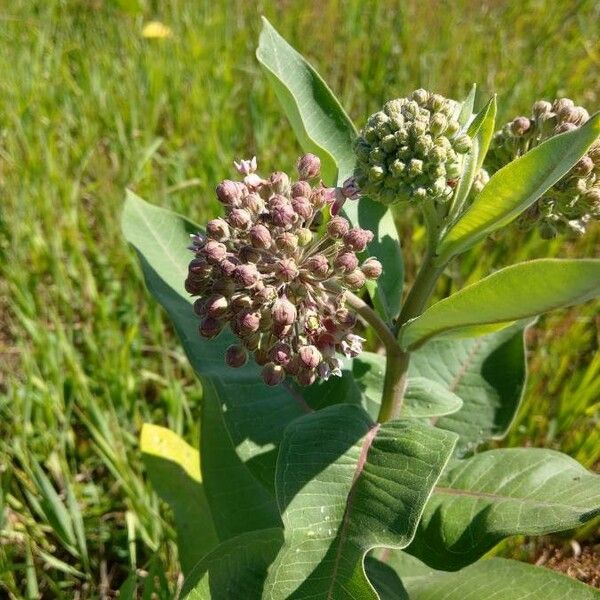
Plant Overview
Known as the Broadleaf Milkweed, this sturdy perennial is a champion of the Great Plains and the American Southwest. Unlike its spindly cousins, Asclepias latifolia boasts massive, leathery leaves that look more like they belong in a tropical jungle than a dry prairie. It is a vital architectural plant for pollinator gardens, acting as a high-nutrition "pit stop" for migrating Monarch butterflies.
🔍 How to Identify
- 🍃 The Leaves: The most distinguishing feature; they are broad, oval-to-round, and quite thick. They grow in opposite pairs and often have a dusty, pale-green hue with prominent veins.
- 🌸 The Flowers: Clusters (umbels) of pale yellow-green to cream-colored flowers bloom from the leaf axils. They are subtle in color but possess the intricate "crown" structure typical of all milkweeds.
- 📏 Growth Habit: A stout, upright plant that usually reaches about 1 to 3 feet in height. The stems are thick and unbranched, giving it a very bold, structural silhouette.
🏡 In Your Garden
- ☀️ Drought Warrior: This plant is a master of water conservation. It thrives in poor, rocky, or sandy soils where other plants might wither. It is perfect for xeriscaping or "low-maintenance" corners of the yard.
- 🌱 The Taproot Rule: Like many milkweeds, it develops a deep, stubborn taproot. This makes it incredibly resilient against drought, but it also means it hates being moved. Choose its forever-home carefully, as transplanting an established plant usually results in failure.
- 🦋 Monarch Magnet: It is a primary host plant for Monarch butterfly larvae. If you see the leaves being eaten, don't reach for the pesticide—that’s the goal! The plant is tough enough to survive the "hungry caterpillar" phase.
⚠️ Safety & Toxicity
- 🐾 Toxic to Pets: Like all members of the Asclepias genus, the milky white sap contains cardiac glycosides. If ingested in large quantities, it can cause heart rhythm issues, drooling, or vomiting in dogs, cats, and horses.
- 🧤 Skin Irritant: The "milk" (latex) in the stems can cause skin irritation or rashes for some people. It is particularly dangerous if it gets into your eyes. It is best to wear gloves when pruning.
✨ Fun Fact
Monarch caterpillars aren't just eating for energy; they are "chemical thieves." By consuming the toxins in the Broadleaf Milkweed, the caterpillars become toxic themselves, a defense they carry into their adult lives to tell birds, "Eat me and you'll regret it!"

Detailed Care Instructions
To grow Asclepias latifolia, also known as broadleaf milkweed, you can follow these steps:
- Procure seeds or plants: Obtain the seeds or young plants from a reputable source or a local nursery that specializes in native plants. Ideally, choose native plant sources or ecotype seeds that are adapted to your specific region.
- Site selection: Find a suitable location for your Asclepias latifolia, keeping in mind that it prefers well-drained soil and full sunlight. Ideally, choose an area that receives at least six hours of direct sunlight per day.
- Soil preparation: Prepare the soil by removing any existing grass, weeds, or debris. Loosen the soil to improve drainage and remove any rocks or large clumps. You can also amend the soil with organic matter, such as compost, to improve fertility.
- Sowing seeds: If you have seeds, you can sow them directly in the soil during the early spring. Lightly press the seeds into the soil surface, ensuring good seed-to-soil contact, but do not bury them too deep. Water gently to keep the soil moist until germination.
- Planting transplants: If you have young plants, dig a hole in the prepared soil, making it deep enough to accommodate the entire root system. Place the plant in the hole, backfill with soil, and gently press around the roots to eliminate any air pockets. Water thoroughly after planting.
- Watering: Initially, keep the soil moist but not waterlogged until the plants become established. Once established, Asclepias latifolia is fairly drought-tolerant and can survive with minimal watering. However, in extremely dry conditions, provide supplemental water as needed.
- Mulching: Apply a layer of organic mulch around the plants, such as shredded leaves or straw, to help retain soil moisture, suppress weed growth, and insulate the roots.
- Maintenance: Remove any competing weeds around the plants to reduce competition for nutrients and water. Additionally, consider providing support or staking if the plants grow tall and may need support during windy conditions.
- Avoid pesticide use: Asclepias latifolia is a vital host plant for monarch butterflies and other pollinators, so avoid using any pesticides or insecticides on or near the plant. Instead, embrace its role as a habitat for beneficial insects and butterfly larvae.
- Winter care: In colder climates, Asclepias latifolia experiences dieback during winter. Consider leaving the dried stems in place as they can provide winter interest and habitat for insects. By the following spring, new shoots will emerge from the base.
By following these steps, you can successfully grow Asclepias latifolia and provide important habitat and food sources for monarch butterflies and other pollinators.

Place in a bright room that is sun drenched almost all day. Or directly in a south-facing window.

Asclepias Latifolia is a plant that is native to North America and is commonly grown for its ornamental and ecological value. It prefers dry to medium soil that is well-drained and enriched with organic matter. The plant requires minimal watering once it's established, so it is recommended to water it only when the top one inch of soil is completely dry.
To ensure that water is distributed evenly, use a watering can or a hose with a gentle spray nozzle to water the soil around the base of the plant. Avoid watering directly onto the leaves to prevent water from sitting on the surface, as this can lead to fungal diseases. Watering should be done early in the morning or late in the evening to prevent excess moisture from evaporating.
During periods of hot, dry weather, it is important to increase watering frequency to prevent the plant from becoming too stressed. However, it is still important to avoid overwatering, as this can lead to root rot and other issues. Additionally, Asclepias Latifolia performs best when it is planted in areas with good air circulation, which can help prevent moisture-related problems.
To fertilize this plant, you can use a slow-release fertilizer with a 5-10-10 or 10-10-10 ratio. Apply the fertilizer at a rate of 1 tablespoon per square foot of planting area. Be sure to water the plant thoroughly after applying the fertilizer. Avoid getting fertilizer on the foliage or flowers of the plant. Fertilize once in early spring and again in late summer.
Asclepias Latifolia is a plant that belongs to the family Asclepiadaceae. It requires well-drained soil with a pH ranging from neutral to slightly acidic (pH 6.5-7.5). The soil should be rich in organic matter, with good drainage and aeration. Sandy loam or loamy soils are best for Asclepias Latifolia. It is recommended to avoid heavy clay soils that can become waterlogged and compact easily. The plant prefers a sunny location, and in areas with high temperatures, partial shade is recommended. A regular watering schedule is necessary for optimum plant growth and development. Overwatering should be avoided as the plant is susceptible to root rot. Fertilizers may be applied occasionally, but they should be high in phosphorus and low in nitrogen. Additionally, avoid using pesticides, herbicides, or fungicides near these plants as they can be toxic to Asclepias Latifolia and other pollinators.
To propagate this plant, you will need to collect the seeds from the pods that form once the flowers have bloomed and begin to wither. These seeds can be sown in moist soil and kept in a warm, sunny location until they begin to germinate. Once the seedlings have emerged, they can be transferred to individual pots or planted directly in the ground.
Another method of propagation is to take stem cuttings from mature plants. Select a healthy stem and cut it just below a leaf node. Remove any leaves from the lower part of the stem and dip the cut end in rooting hormone. Then, place the cutting in moist soil and keep it in a warm, humid location until it begins to root. Once rooted, the cutting can be planted in soil and cared for like a regular plant.
It is important to note that Asclepias Latifolia is best propagated in the spring or early summer, as this is when the plant is actively growing and producing new shoots.








