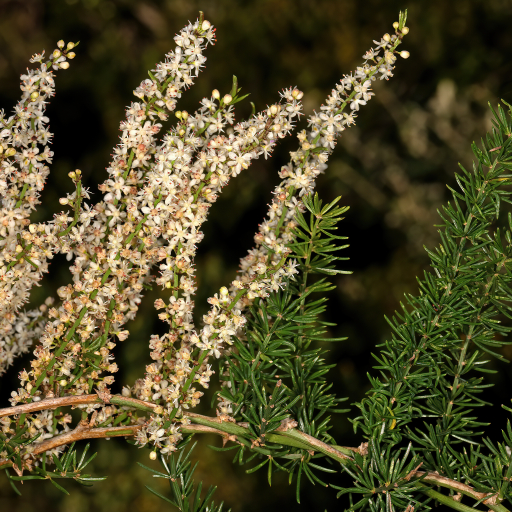
Plant Overview
Often called the Emerald Fern or Sprenger's Asparagus, this South African native is a master of deception. Despite its feathery, fern-like appearance, it is actually a member of the Lily family and is more closely related to the asparagus you eat than to any true fern. It is a favorite for hanging baskets, where its cascading "fountains" of green add a lush, prehistoric vibe to any room or patio.
🔍 How to Identify
- 🌿 The "Leaves": What look like tiny needles are actually flattened stems called cladodes. They grow in dense clusters, giving the plant its signature soft, airy texture.
- 🌸 Summer Blooms: In the right conditions, it produces tiny, white-to-pinkish star-shaped flowers that are surprisingly fragrant.
- 🍒 Bright Berries: After flowering, the plant develops small, round berries that start green and ripen into a vivid, waxy red.
- ⚓ Hidden Hooks: Be careful when pruning! Mature stems develop small, sharp, recurved thorns that can easily snag your skin or clothing.
🏡 In Your Garden
- 💧 The Tuber Secret: If you notice the plant is "bulging" out of its pot, it’s because of its thick, watery tubers. These underground nodules store massive amounts of water, making the plant incredibly resilient to occasional neglect.
- 🏃 A Fast Traveler: Because it spreads via both seeds (dropped by birds) and underground rhizomes, it is considered invasive in many warm climates like Florida and Hawaii. In a garden bed, it can quickly take over if not contained.
- ⛅ Light Preferences: While it loves bright, indirect light, too much direct sun will cause its needles to turn yellow and drop, leaving a messy "green snow" on your floor.
⚠️ Safety & Toxicity
- 🚫 Toxic Status: Mildly toxic to humans and highly irritating to pets.
- 🐾 Pet Warning: If cats or dogs ingest the red berries, they may experience vomiting, diarrhea, or abdominal pain.
- 🧴 Skin Irritation: Repeated exposure to the sap, or accidental scratches from its hidden thorns, can cause "sap dermatitis" (a red, itchy rash) in sensitive individuals.
✨ Fun Fact
The Asparagus Fern is a botanical "shape-shifter." Its "leaves" (cladodes) perform photosynthesis just like real leaves, but they are technically modified branches. This evolution allows the plant to survive in the rocky, coastal scrublands of South Africa where true, thin-leaved ferns would quickly wither and dry out.

Detailed Care Instructions
To grow Asparagus Sprengeri, you can follow these steps:
- Choose a suitable location: Asparagus Sprengeri prefers partial shade to full shade. It is commonly used in hanging baskets or as a groundcover in shaded areas. Select a location with well-draining soil.
- Prepare the soil: Asparagus Sprengeri prefers slightly acidic soil with a pH between 5.5 and 6.5. Amend the soil with organic matter like compost to improve its fertility and drainage.
- Plant the Asparagus Sprengeri: Dig a hole slightly larger than the container or root ball of the plant. Place the plant in the hole and backfill with soil, firming it gently to remove any air pockets. Make sure the crown of the plant is level with the soil surface.
- Watering: Asparagus Sprengeri prefers consistent moisture but not excessive watering. Water the plant deeply and regularly, allowing the soil to dry out between waterings. Avoid overwatering as it can lead to root rot.
- Mulch: Mulching around the base of the plant helps to retain moisture and inhibit weed growth. Apply a layer of organic mulch like wood chips or straw around the plant, ensuring not to cover the crown.
- Fertilization: Asparagus Sprengeri does not require heavy fertilization. Use a balanced, slow-release fertilizer once or twice a year during the growing season, following the package instructions.
- Pruning: To maintain the desired shape and prevent overgrowth, prune the plant occasionally by removing any dead or damaged fronds. This will also encourage new growth.
- Propagation: Asparagus Sprengeri can be propagated through division or by planting seeds. To propagate through division, carefully separate the root ball into smaller sections and replant them in well-prepared soil.
- Pest and disease control: Asparagus Sprengeri is relatively resistant to pests and diseases. However, keep an eye out for common garden pests like aphids or mites. Treat any infestations promptly with insecticidal soap or neem oil.
By following these steps and providing proper care, your Asparagus Sprengeri plant should thrive and grow well.

Place in a window with dappled sun or a spot in the middle of a room. Or directly in a window facing west or east.

To water this particular plant, it is important to consider the soil moisture level before proceeding with watering. The soil should be allowed to dry slightly before watering again, as over-watering may lead to root rot. When watering, avoid getting water on the leaves or foliage as this may lead to fungal growth. Instead, water directly at the base of the plant and allow the water to soak into the soil. This plant prefers well-draining soil, so be sure to monitor the water levels and adjust accordingly. During the winter months, the plant may require less water than during the active growing season, so it is important to adjust watering schedules accordingly.
To properly fertilize this plant, you should use a balanced fertilizer that is low in nitrogen and higher in phosphorus and potassium. Apply the fertilizer every 4-6 weeks during the growing season, being careful not to over-fertilize. Water the plant thoroughly before and after applying the fertilizer to avoid burning the roots. Avoid fertilizing the plant during the winter months while it is dormant.
Asparagus Sprengeri prefers a well-draining soil that is rich in organic matter. It is important to avoid heavy soils that retain moisture, as excess moisture can lead to root rot. A soil pH of 6.0-7.0 is ideal for optimal growth. The use of a high-quality commercial potting mix that contains perlite, peat moss, and vermiculite is recommended. Additionally, adding organic compost or aged manure to the soil can provide necessary nutrients for the plant's growth. It is important to water the Asparagus Sprengeri plant regularly, without letting the soil become waterlogged.
To propagate this plant, you will need to prepare a potting mixture that has a good balance of soil, sand, and perlite. Next, carefully remove a section of the plant's rhizomes from the soil and cut them into small sections that have at least one node each. Dip these sections into rooting hormone powder and then plant them in the potting mixture, ensuring that the nodes are covered with soil. Water the soil well and keep the pot in a warm and humid environment, away from direct sunlight. Over time, the cuttings will develop roots and new growth, at which point they can be transplanted into individual pots or into a larger container to continue to grow.








