Plant Overview
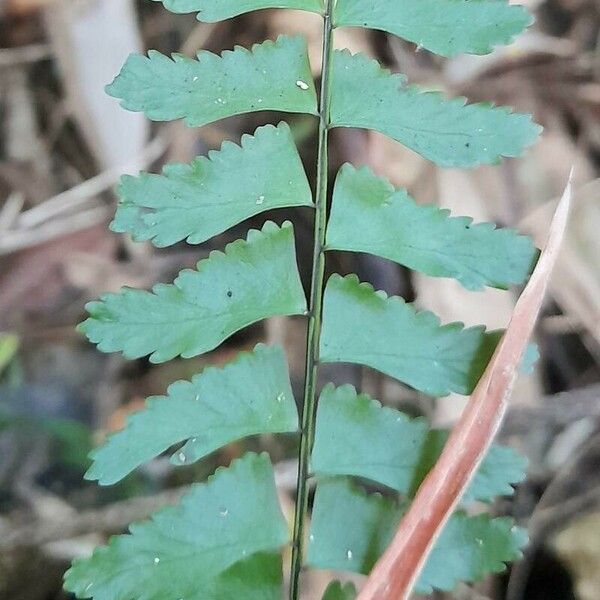
Often called Claussen's Spleenwort, this delicate fern is a master of the damp, shaded crevices of South American rainforests. Its finely divided fronds give it a lace-like appearance that adds a touch of prehistoric elegance to any shady corner or mossy rock face. While it may look fragile, it is a resilient survivor that has carved out a niche in the humid understories of Brazil and Argentina.
🔍 How to Identify
- 🌿 Frond Structure: The leaves are "once-pinnate," meaning the small leaflets (pinnae) are arranged neatly on either side of a central stem, creating a narrow, ladder-like shape.
- 📏 Compact Stature: It typically grows in a neat rosette, with fronds reaching about 10 to 15 inches in length, making it much smaller and more refined than many common garden ferns.
- 🟤 Linear Sori: If you flip a mature leaf over, you will see distinct, brownish-orange lines. These are the "sori" (spore cases), which are arranged in diagonal stripes along the veins.
🏡 In Your Garden
- 🪨 The "Stone-Lover" Context: In its natural habitat, this plant is often lithophytic, meaning it grows on rocks. In a home setting, it hates "wet feet." Use a very airy, porous potting mix—like one designed for orchids or African violets—to mimic its rocky home.
- ☁️ Humidity is Key: Because it hails from misty forests, it struggles in dry, air-conditioned rooms. It is a perfect candidate for a large glass terrarium or a humid bathroom where it can soak up the steam from your shower.
⚠️ Safety & Toxicity
- ✅ Non-Toxic: Claussen's Spleenwort is generally considered safe and non-toxic for both humans and household pets like cats and dogs.
- 🍃 Gentle Handling: While it isn't poisonous, the fronds are physically delicate. Rough handling or high-traffic areas can cause the leaflets to snap or brown, so place it somewhere it won't be frequently bumped.
✨ Fun Fact
The genus name Asplenium comes from the Greek word "asplenon," which translates to "spleen medicine." In the Middle Ages, many believed that because the spore patterns on the back of the leaves resembled the human spleen, the plant could be used to treat various organ-related ailments!

Detailed Care Instructions








