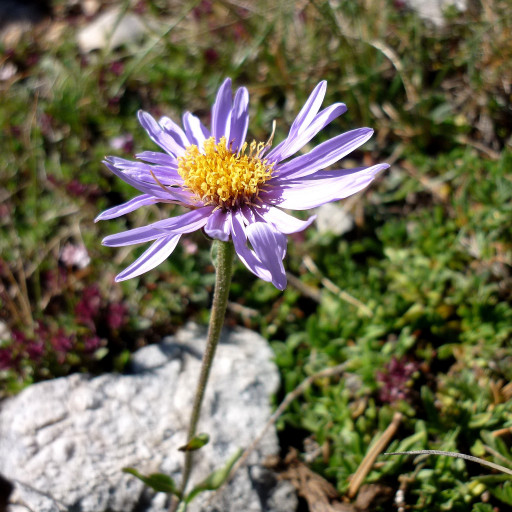
Plant Overview
Often called the "Blue Alpine Daisy," the Aster alpinus is a rugged little survivor that brings the majesty of the high mountains down into your backyard. These "Star-flowers"—named after the Greek word for star—form low-growing carpets of color that act as a vital bridge between spring and summer blooms. In the wild, they cling to rocky crevices and limestone cliffs, proving that even the most delicate-looking daisy can be tough as nails.
🔍 How to Identify
- 🌸 The Bloom: Classic daisy-shaped flowers roughly 1.5 to 2 inches wide, featuring a bright "sunny-side-up" yellow center surrounded by ray-like petals in shades of deep lavender, violet, or cool white.
- 🍃 The Foliage: Small, spatula-shaped leaves that are slightly fuzzy (pubescent) to the touch, forming a dense, dark-green rosette close to the ground.
- 📏 The Stature: Unlike its tall, leggy garden cousins, this alpine variety stays compact, rarely exceeding 6 to 12 inches in height, making it look like a natural floral cushion.
🏡 In Your Garden
- 🪨 The "Mountain" Soil: Because it originates from rocky slopes, this plant hates "wet feet." It requires exceptionally well-drained soil. If your garden is heavy clay, consider planting it in a rock garden or a raised container with plenty of grit or perlite.
- ☀️ Sun & Air: It thrives in full sun but prefers its roots to stay cool. A thin layer of gravel mulch around the base of the plant mimics its natural environment and helps prevent crown rot during rainy seasons.
- 🦋 The Pollinator Magnet: While it’s small, it is a powerhouse for local wildlife, providing an early-season nectar source for butterflies and hoverflies when other flowers are still waking up.
⚠️ Safety & Toxicity
- ✅ Status: Generally considered non-toxic and safe.
- 🐾 Details: This plant is not known to be poisonous to dogs, cats, or horses. It is a fantastic choice for "pet-friendly" landscaping where you want color without the worry.
✨ Fun Fact
In ancient times, it was believed that burning Aster leaves would drive away evil spirits and serpents. Today, we mostly use them to drive away the "winter blues" with their vibrant early-summer display!

Detailed Care Instructions
| Color | Pink, Violet-Lavender, Or White-Near White |
| Soil Ph | Neutral To Acidic |
| Lighting | Full Sun |
| Toxicity | Non-Toxic |
| Soil Type | Loamy, Well-Drained |
| Bloom Time | Summer, Fall |
| Plant Type | Herbaceous Perennial |
| Mature Size | 8-12" Tall |
| Native Area | North America |
| Sun Exposure | Full Sun |
| Hardiness Zones | 4-7 |
Here are some steps to help you grow Aster Alpinus plants:
- Choose the right location: Aster Alpinus plants prefer full sun to partial shade. Select a spot in your garden that receives at least six hours of sunlight each day. The soil should be well-draining and fertile.
- Prepare the soil: Before planting, prepare the soil by removing any weeds, rocks, or debris. Add organic matter, such as compost, to improve the soil's fertility and drainage.
- Planting: Aster Alpinus plants can be grown from seeds or propagated by division. If using seeds, sow them directly into the prepared soil in early spring or fall. Gently press them into the soil and cover with a thin layer of soil. Water lightly after planting. If propagating by division, dig up an established plant and separate the root clumps into smaller sections. Replant the divisions in the prepared soil.
- Watering: Keep the soil evenly moist but not waterlogged. Avoid overwatering as it can lead to root rot. Provide water during dry spells or when the top inch of soil feels dry to the touch.
- Mulching: Apply a layer of organic mulch, such as shredded bark or straw, around the base of the plants. This helps to retain moisture, suppress weed growth, and regulate soil temperature.
- Fertilizing: Aster Alpinus plants generally do not require heavy fertilization. However, you can apply a balanced organic fertilizer in the spring to promote healthy growth. Be cautious not to over-fertilize, as it can cause excessive foliage growth with fewer blooms.
- Pruning: After the plant has finished flowering, you can cut back the spent flower stalks to encourage a tidy appearance. In early spring, you can also trim back the entire plant to promote fresh growth.
- Pests and diseases: Aster Alpinus plants are generally resistant to most pests and diseases. However, keep an eye out for aphids, slugs, and snails. Treat any infestations promptly with appropriate organic pest control methods.
With proper care and attention, your Aster Alpinus plants should grow and bloom beautifully in your garden.

Place in a bright room that is sun drenched almost all day. Or directly in a south-facing window.

Aster Alpinus is a type of perennial herbaceous plant that requires regular watering to thrive. The plant should be watered deeply, but not excessively, to ensure the moisture reaches the roots. Over watering can lead to root rot and other plant diseases.
The frequency of watering will depend on various factors, including the climate, soil type, and plant size. It is necessary to monitor the plant's moisture level regularly and provide water as needed.
When watering, it is best to avoid getting the foliage and flowers wet, as this can cause fungal diseases. Instead, aim the water directly at the soil around the plant's base.
One effective way to water Aster Alpinus is to use a soaker hose or drip irrigation system. These methods provide a slow, steady stream of water that penetrates deeply into the soil, promoting healthy root growth and reducing water waste.
Before watering the plant, it is essential to check the soil's moisture level first. Stick your finger into the soil to a depth of around 1 inch. If the soil feels dry, it is time to water the plant.
In summary, to water Aster Alpinus effectively:
- Water deeply, but not excessively
- Monitor the moisture level regularly
- Avoid getting foliage and flowers wet
- Use a soaker hose or drip irrigation system
- Check soil moisture level before watering.
To optimize the growth of this plant, fertilize it once every two weeks with a balanced fertilizer that has equal parts nitrogen, phosphorus, and potassium. Dilute the fertilizer in water according to the instructions on the packaging, and apply it around the base of the plant. Be sure to water the plant thoroughly before and after applying fertilizer to prevent any potential harm to its roots.
The ideal soil for this plant should be well-draining, loamy, and rich in organic matter. It should have a pH range of 6.0 to 7.5 and be slightly acidic to neutral. The soil should also be able to retain some moisture, but not be excessively wet or waterlogged. Compost or peat moss can be added to improve soil structure and fertility. It is also important to ensure that the soil is not compacted, as this can hinder the growth of the plant's roots.
To propagate this plant, you will need to gather a few materials. First, you will need a healthy mature plant from which to take cuttings. You will also need a sharp pair of scissors or pruning shears, a clean container filled with moist soil or water, and a rooting hormone (optional).
Begin by selecting a stem from the parent plant that is at least 3-4 inches long and has several healthy leaves. Using the scissors or pruning shears, make a clean cut just below a leaf node (the place where a leaf attaches to the stem). Remove any leaves from the lower portion of the stem that will be submerged in the rooting medium.
If you are using soil as your rooting medium, make a small hole in the soil with your finger or a pencil, and insert the cutting into the hole. If you are using water, simply place the cutting into the container so that the lower portion of the stem is submerged in the water.
If you are using rooting hormone, dip the cut end of the stem into the hormone powder before planting it in the soil or water.
Regardless of the rooting medium used, place the container in a bright, warm location, but out of direct sunlight. Keep the soil or water moist but not waterlogged, and mist the leaves periodically to help prevent wilting.
With proper care, the cutting should begin to develop roots within a few weeks. Once the roots have established, the new plant can be transplanted into a larger container or directly into the ground.








