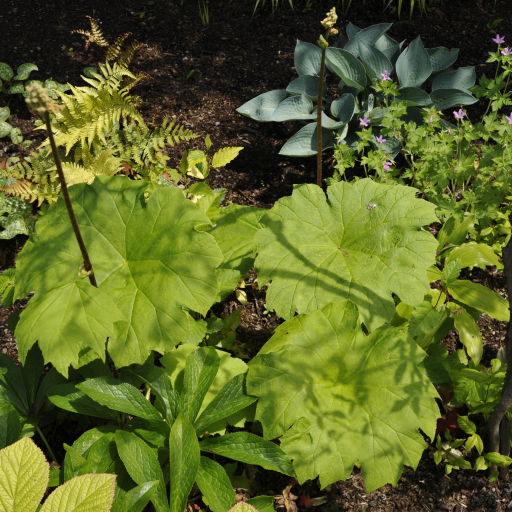
Plant Overview
Looking like something plucked straight from a prehistoric forest or a dinosaur’s lunch menu, the Shield Leaf (or Tableleaf) is a dramatic showstopper. Native to the cool, moist ravines of Northern China and Korea, this perennial is prized for its massive, circular leaves that can grow up to three feet across. It creates a bold, architectural statement that makes smaller garden plants look like tiny miniatures by comparison.
🔍 How to Identify
- 🍃 The "Umbrella" Leaf: The leaves are perfectly circular (peltate), meaning the thick, fuzzy stem attaches directly to the center of the leaf underside rather than the edge.
- 🦴 Textured Surface: Each leaf has a rough, sandpapery texture with slightly lobed edges and prominent veins radiating from the center.
- ☁️ Feathery Blooms: In mid-summer, it sends up tall, arching wands of creamy-white flowers that look remarkably like its cousin, the Astilbe.
- 🌳 Growth Habit: It forms a massive, slowly spreading mound of foliage that commands attention in any shaded corner.
🏡 In Your Garden
- 💧 A Thirsty Giant: Because those massive leaves evaporate water quickly, this plant is a "moisture-hog." It is the perfect choice for the edge of a pond or a boggy area where other plants might get "wet feet."
- 🛡️ The Wind Factor: Due to the sheer surface area of the leaves, they act like sails. You must plant it in a sheltered spot, or a strong summer breeze might snap the stems or tatter the edges of the foliage.
- 🌑 Shade Seeker: This is not a sun-loving plant. In hot afternoon sun, the giant leaves will crisp and turn brown at the edges; it thrives best in dappled light or deep woodland shade.
⚠️ Safety & Toxicity
- ✅ Safe Status: Astilboides tabularis is generally considered non-toxic to humans and common household pets like cats and dogs.
- 🧤 General Caution: While not poisonous, the rough hairs on the stems and leaves can occasionally cause mild skin irritation for those with very sensitive skin. It is always a good idea to wear gloves when dividing the massive root clumps.
✨ Fun Fact
The leaf of the Astilboides is so perfectly shaped and strong that in its native regions, the leaves were historically used as temporary "plates" or "tablecloths" for forest picnics—hence its common name, the Tableleaf.

Detailed Care Instructions
To successfully grow Astilboides tabularis plants, also known as shield leaf rodgersia or giant rhubarb, follow these steps:
- Climate: These plants prefer cool, moist climates, similar to that of their native habitats in China, Japan, and Korea. They can grow in USDA hardiness zones 5-9.
- Sun exposure: Plant them in a location that receives partial shade to full shade. Direct sunlight can scorch the leaves.
- Soil: The soil should be rich in organic matter, moist, and well-drained. Ensure good drainage to prevent waterlogged conditions that can harm the roots.
- Watering: Keep the soil consistently moist, but not waterlogged. Provide regular watering, especially during dry periods. Mulching around the base of the plant can help retain moisture.
- Fertilizer: Shield leaf rodgersia plants don't require heavy feeding. Apply a balanced, slow-release fertilizer in spring, following the package instructions.
- Planting: Dig a hole slightly larger than the root ball of the plant. Place the plant in the hole and backfill with soil. Gently firm the soil around the base of the plant and water thoroughly.
- Spacing: These plants can spread quite a bit, so space them 3-4 feet apart to allow for their growth.
- Maintenance: Remove any dead or damaged leaves regularly. Cut back spent flower stalks to ground level after blooming. Mulching around the base of the plant can help control weeds.
- Dividing: Every few years, in early spring or late fall, consider dividing the plant to prevent over-crowding. Dig up the plant and divide the root clump, and then replant the divisions.
- Winter care: In colder climates, shield leaf rodgersia may die back to the ground in winter. Mulch around the base of the plant in late fall to provide some protection from freezing temperatures.
By following these guidelines, you should be able to grow healthy and vibrant Astilboides tabularis plants in your garden.

Place in a window with dappled sun or a spot in the middle of a room. Or directly in a window facing west or east.

To properly water this plant, be sure to regularly check the soil moisture content. This can be done by touching the soil and feeling for moisture or by using a soil moisture meter.
When watering, ensure that the water is applied evenly and thoroughly to the soil around the plant. Avoid getting water on the leaves or foliage, as this can lead to fungal diseases.
It is important not to overwater the plant, as this can cause root rot. Allow the top inch of soil to dry out between waterings, but do not let the soil completely dry out.
If the plant is growing in a pot, ensure that there are drainage holes to prevent water from accumulating in the bottom of the pot.
During periods of hot and dry weather, it may be necessary to water the plant more frequently. However, during periods of cooler weather or dormancy, the plant may require less water.
Overall, it is important to strike a balance between providing enough water for the plant to thrive and avoiding overwatering.
To fertilize this plant, first ensure that the soil is moist but well-drained. Use a balanced fertilizer with equal amounts of nitrogen, phosphorus, and potassium, such as a 10-10-10 or 20-20-20 blend. Apply the fertilizer according to the manufacturer's instructions, taking care not to over-fertilize as this can harm the plant. Fertilize in the spring as new growth appears, and again in mid-summer if desired. Water the plant well after fertilizing to help distribute the nutrients throughout the soil.
Astilboides Tabularis prefers a nutrient-rich, well-draining soil that is consistently moist but not waterlogged. It will benefit from adding organic matter such as compost or well-rotted manure to the soil before planting. The soil should have a pH range of 6.0 to 7.5. Sandy or clay soils can be amended with peat moss or perlite to improve drainage and texture. It is recommended to avoid planting this species in heavy or compacted soils.
Astilboides Tabularis can be propagated through division. Here is how to propagate Astilboides Tabularis without using its common names:
- Choose a mature plant with a healthy root system.
- Carefully dig up the entire plant and remove excess soil from the roots.
- Gently separate the plant into smaller sections using a sharp, sterile knife or garden tool. Each section should have at least one healthy root system and several stems with leaves.
- Replant each section in a well-draining soil mix enriched with organic matter.
- Water the newly planted sections thoroughly, keeping the soil consistently moist until new growth appears.
- Provide partial shade and regular watering until the new plants are established.
Propagation through division is best done in early spring or fall, when the plant is not actively growing. It is important to remember to handle the delicate root system carefully and to keep the newly planted sections in partial shade to prevent transplant shock.








