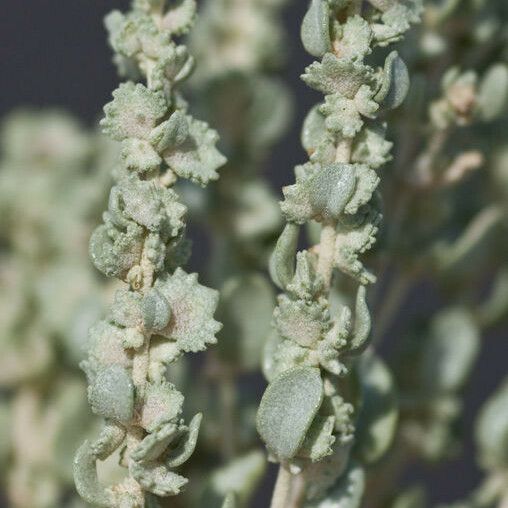
Plant Overview
Known as the Mound Saltbush or New Mexico Saltbush, this resilient desert dweller is a master of survival in the harsh, alkaline flats of the American Southwest. It creates a shimmering, silvery-blue presence in arid landscapes where most other plants would wither. It is often celebrated by xeriscaping enthusiasts for its ability to thrive on "neglect" and its fascinating evolutionary adaptations to salt.
🔍 How to Identify
- 🍃 Leaf Shape: True to its name, the leaves are obovate—shaped like an upside-down egg or a teardrop, being wider at the tip than at the base.
- 🥈 Silvery Sheen: The foliage has a distinct scurfy, gray-green coating that looks like a fine dusting of salt or flour, which helps the plant reflect intense desert sunlight.
- 🌾 Growth Habit: It typically grows as a low, mounding subshrub, often staying under two feet tall but spreading wide to anchor the surrounding soil.
🏡 In Your Garden
- 🌵 The Soil Specialist: This plant is a "halophyte," meaning it loves salt. It is the perfect choice for "problem areas" in a yard, such as heavy, alkaline clay or salty coastal patches where most ornamental plants would fail.
- ☀️ Sun Worshiper: It requires full, direct sun to maintain its compact shape. In the shade, it can become "leggy" and lose the brilliant silver color that makes it so visually striking against dark mulch or rocks.
- 💧 Root Resilience: Because it has evolved a deep taproot to survive droughts, it hates being moved once established. Pick its "forever home" carefully to avoid transplant shock.
⚠️ Safety & Toxicity
- ✅ General Safety: Atriplex obovata is considered non-toxic to humans and common household pets like dogs and cats.
- 🧪 Nitrate Warning: While safe for a backyard, saltbushes can accumulate nitrates if grown in over-fertilized soil. This is primarily a concern for livestock (like sheep or cattle) if they graze on the plant in large quantities, as it can cause digestive upset.
✨ Fun Fact
The "white powder" on the leaves isn't dust—it’s actually tiny, specialized salt bladders! The plant pumps excess salt out of its system into these microscopic balloons. When they burst, they leave a salty residue that acts as a natural sunscreen and prevents the leaf from losing moisture to the dry desert air.

Detailed Care Instructions
Atriplex obavata, also known as Oval-leaf Orache, is a hardy plant that grows well in dry and sandy conditions. Here are some tips on how to grow Atriplex obavata:
- Location: Atriplex obavata thrives in full sun and well-drained soil. Choose a spot in your garden that receives at least 6 hours of sunlight per day.
- Soil: This plant prefers sandy or loamy soil with good drainage. You can improve soil drainage by adding organic matter such as compost.
- Planting: Atriplex obavata can be grown from seeds or cuttings. If planting seeds, sow them directly into the soil in early spring. If planting cuttings, ensure they have at least one node and are planted in well-draining soil.
- Watering: Atriplex obavata is drought-tolerant and does not require much water once established. Water sparingly, especially during dry spells, to prevent root rot.
- Fertilizing: Atriplex obavata does not require regular fertilization. However, you can feed it with a balanced fertilizer in spring to promote healthy growth.
- Pruning: Atriplex obavata does not require regular pruning. However, you can trim back any dead or damaged foliage to maintain a tidy appearance.
- Pests and diseases: Atriplex obavata is relatively pest and disease-free. However, keep an eye out for aphids, spider mites, and powdery mildew. Treat any infestations promptly with an organic insecticidal soap or neem oil.
By following these tips, you can successfully grow Atriplex obavata in your garden. Enjoy the beautiful foliage and drought-tolerant nature of this unique plant!
Atriplex obovata plants should be watered consistently and thoroughly, ensuring that the soil is moist but not waterlogged. It is important to allow the top layer of soil to dry out slightly between waterings to prevent root rot. Water the plant at the base, avoiding wetting the foliage to prevent the risk of disease. Additionally, consider the environmental conditions such as temperature, humidity, and sunlight exposure, as these factors can affect the plant's water requirements. Adjust watering frequency accordingly during periods of extreme heat or cold to ensure the plant remains healthy and thriving.
To fertilize Atriplex obovata plants, apply a balanced, slow-release fertilizer in the early spring before new growth begins. Follow the instructions on the fertilizer packaging for the correct application rate. Avoid over-fertilizing as this can harm the plant. Water the plant well after applying the fertilizer to help it absorb the nutrients efficiently. Repeat the fertilization process once or twice throughout the growing season, following the same guidelines.aim to provide the plant with essential nutrients to support healthy growth and development.
Atriplex obovata plants prefer well-draining soil that is sandy or loamy in texture. It is important to choose a soil mix that is slightly alkaline in pH, with a pH range between 7.0 and 8.5. The soil should also be rich in organic matter to provide the necessary nutrients for the plant to thrive. Additionally, incorporating perlite or coarse sand into the soil mix can help improve drainage and prevent waterlogging, which can be detrimental to the plant's health. It is best to avoid heavy clay soils, as they can cause root rot in Atriplex obovata plants. Overall, a well-draining, slightly alkaline soil mix with good levels of organic matter is ideal for growing Atriplex obovata plants successfully.
Atriplex obovata can be propagated through seeds, cuttings, or division.
- Seeds: Collect mature seeds from the plant and sow them in well-draining soil. Keep the soil moist and place the container in a location with plenty of sunlight. Germination typically takes a few weeks.
- Cuttings: Take a stem cutting from a healthy plant, making sure it has at least two leaf nodes. Remove the lower leaves and dip the cutting in a rooting hormone. Plant the cutting in a pot with well-draining soil and keep it moist. Place the pot in a location with indirect sunlight.
- Division: Atriplex obovata can also be propagated through division. Carefully dig up a mature plant and separate the roots into smaller sections, each with a few stems and roots. Plant these sections in individual pots with well-draining soil and water them regularly.
Regardless of the propagation method used, it is important to provide the new plants with adequate sunlight, water, and nutrients to ensure successful growth.








