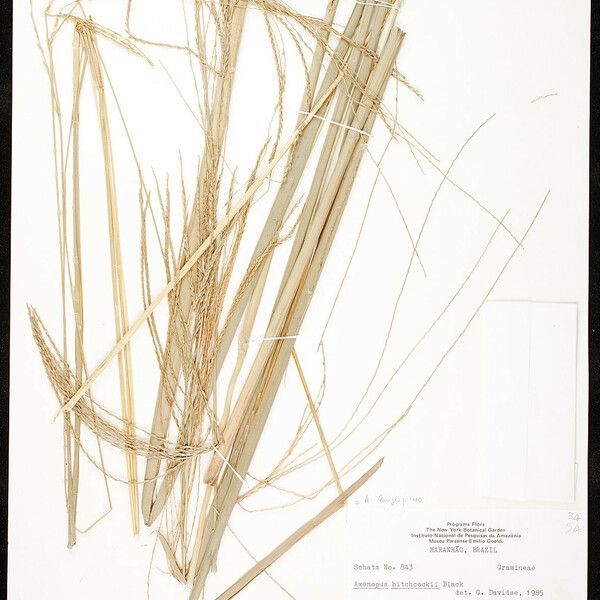
Plant Overview
Known as a rugged traveler of the tropical grasslands, Axonopus longispicus is a resilient perennial grass primarily native to the moist regions of South America. While it might look like standard lawn grass to the untrained eye, its elegant, elongated flower spikes earn it the "longispicus" title. In its native habitat, it serves as a crucial ground cover, weaving a living green carpet that protects the earth from heavy tropical downpours.
🔍 How to Identify
- 🌿 Leaf Texture: The blades are relatively broad and soft to the touch, often featuring a distinct midrib and tapering to a slightly rounded tip.
- 🌾 Elongated Spikes: The defining feature is its "longispicus" (long-spiked) inflorescence. These slender, finger-like branches stand tall above the foliage, carrying tiny flowers in a neat row.
- 🛤️ Creeping Runners: It spreads via stolons—above-ground runners that "crawl" across the soil and take root at every joint, creating a dense, mat-like growth.
🏡 In Your Garden
- 💧 Moisture Lover: Unlike many drought-tolerant turf grasses, this species thrives in damp, humid environments. It is perfectly at home near pond edges or in low-lying garden spots where water tends to settle.
- 🌱 Erosion Control: Because of its aggressive creeping habit, it is a functional hero for sloped landscapes. Its root network acts like a natural net, holding topsoil in place during heavy watering or storms.
- 🌞 Light Adaptability: While it prefers the bright sun of the tropics, it is surprisingly tolerant of partial shade, making it a versatile filler for the gaps under taller garden shrubs.
⚠️ Safety & Toxicity
- ✅ Safe Status: Axonopus longispicus is considered non-toxic to humans, dogs, cats, and livestock.
- 🌾 Seasonal Allergies: Like most members of the grass family, it produces airborne pollen during its flowering phase. Those sensitive to hay fever may want to trim the flower spikes before they fully mature to reduce irritation.
✨ Fun Fact
The genus name Axonopus is derived from the Greek words for "axis" and "foot," describing the unique way the seed spikes are attached to the central stem, resembling a bird's foot!

Detailed Care Instructions







