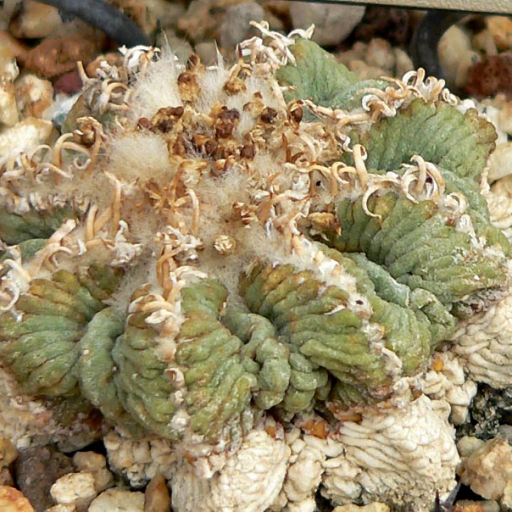
Plant Overview
The Aztekium ritteri, often called the "Aztec Cactus," is a true masterpiece of evolution. Found only in a tiny region of Nuevo León, Mexico, this cactus is legendary among collectors for its incredibly slow growth—it is widely considered the slowest-growing cactus in the world. Its name honors its resemblance to ancient Aztec stone carvings, appearing more like a weathered relic than a living plant.
🔍 How to Identify
- 🌵 The Ribs: Features numerous, deep, horizontal folds and secondary ribs that create a complex, wrinkled texture reminiscent of a concertina.
- 🗿 The Color: A distinctive grayish-green to olive-drab skin that looks almost like oxidized metal or aged limestone.
- 🌸 The Blooms: Small, delicate white or pale pink flowers emerge from the woolly apex (the top) during the summer months.
- 🧶 The Wool: The center of the plant is often filled with a tuft of white, fuzzy "wool," where the new growth and flower buds originate.
🏡 In Your Garden
- ⏳ Patience is Key: In the wild, a specimen the size of a golf ball might be over 30 years old. Because of this, many enthusiasts prefer "grafted" versions (attached to a faster-growing cactus base) to speed up its development.
- 🪨 The Mineral Diet: This cactus is a "gypsophile," meaning it thrives in mineral-heavy soil. It despises rich, organic potting soil, which often leads to immediate root rot. Use a mix heavy in pumice, limestone, or coarse sand.
- 💧 Sip, Don't Soak: Because it grows so slowly, it needs very little water. It should be kept bone-dry throughout the winter to mimic its natural dormant cycle on Mexican cliff faces.
⚠️ Safety & Toxicity
- ✅ Non-Toxic: Aztekium ritteri is generally considered non-toxic to humans and common household pets like cats and dogs.
- 🌵 Soft Spines: Unlike its fierce desert cousins, its spines are very small and brittle, often falling off as the plant matures, making it relatively safe to handle.
- 🛡️ Conservation Status: It is highly protected. Only buy from reputable nurseries that sell "seed-grown" or "nursery-propagated" plants to avoid supporting the illegal poaching of these rare icons.
✨ Fun Fact
The Aztekium ritteri was discovered in 1929 and was so unique that it remained the only species in its entire genus for over 60 years, until its cousin, Aztekium hintonii, was discovered in 1991.

Detailed Care Instructions

Place in a bright room that is sun drenched almost all day. Or directly in a south-facing window.

When the top few inches of soil dry out, water your plants. If the top few inches of soil are still moist, do not water your plant. Wait a few days, then poke your finger into the soil to see if anything has changed. Overwatering poses a disease risk, such as the development of fungal diseases in the roots. These plants have adaptations in there leaves that allow them to survive in low water supply.








