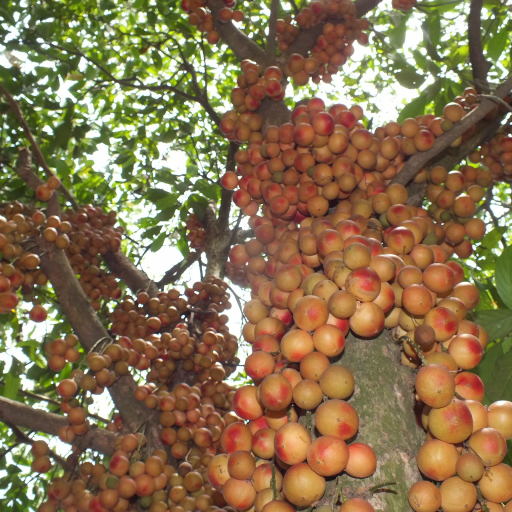
Plant Overview
Known affectionately as the Rambai, this tropical beauty is a superstar of Southeast Asian rainforests and village orchards. Unlike most trees that hide their treasures among the leaves, the Rambai displays its fruit in dramatic, cascading "necklaces" that hang directly from its trunk and main branches. It is celebrated across Malaysia and Sumatra for its refreshing, sweet-and-sour flavor that balances a tart punch with a sugary finish.
🔍 How to Identify
- 🍃 The Foliage: Features large, leathery, elliptical leaves that are dark green on top and slightly velvety or hairy on the underside.
- 🍇 The Fruit Clusters: Look for long, pendulous strands (racemes) of buff-colored or pale yellow berries that can grow up to 10 inches long.
- 🤍 The Inner Pulp: Inside the thin, velvety skin, you’ll find translucent white or rosy-pink segments—resembling a peeled clove of garlic—that cling tightly to the seeds.
🏡 In Your Garden
- 🌱 The Waiting Game: The Rambai is known for being a slow starter. It requires deep, acidic, and well-draining soil to thrive; it essentially wants to recreate the rich, leaf-littered floor of a tropical jungle.
- 👫 The Mating Mystery: This species is typically "dioecious," meaning individual trees are either male or female. If you want to harvest those iconic fruit clusters, you will generally need both a male and female tree nearby for pollination.
- 💧 Humidity is Key: It hates dry air. If grown outside its native humid tropics, it requires frequent misting and protection from drying winds to prevent leaf drop.
⚠️ Safety & Toxicity
- ✅ Status: Generally safe and highly valued for its edible fruit.
- 🐾 Details: The acidic pulp is safe for human consumption and rich in Vitamin C. However, the seeds are bitter and contain tannins; while not high-risk, they should be kept away from curious pets and toddlers to avoid choking or minor stomach upset.
✨ Fun Fact
The Rambai is a master of cauliflory—a botanical term for plants that flower and fruit directly from their woody trunks and thick branches. This makes it much easier for heavy-climbing mammals and ground-dwelling animals to reach the fruit and help spread the seeds!

Detailed Care Instructions
To grow Baccaurea Motleyana, also known as the Rambai plant, follow these steps:
- Climate and Soil: This plant prefers a tropical climate with high humidity and temperatures ranging from 68°F (20°C) to 86°F (30°C). Choose a well-draining soil rich in organic matter.
- Propagation: Propagate the plant through seeds or stem cuttings. Seeds should be soaked in water for a day before planting. Sow them in a seed tray or directly in soil, covering them lightly. Stem cuttings should be around 6-8 inches long, with at least three nodes. Dip the cut ends into powdered rooting hormone and plant them in a pot filled with moist soil.
- Planting: Transplant seedlings or rooted cuttings into larger pots once they reach about 4-6 inches tall. Ensure the pot has drainage holes. Place the plant in a location that receives partial shade or filtered sunlight.
- Watering: Keep the soil consistently moist, but not waterlogged. Water the plant regularly, especially during dry spells. Avoid overwatering, as it can lead to root rot.
- Fertilizing: Feed Baccaurea Motleyana with a balanced fertilizer every two to three months during the growing season. Use a slow-release fertilizer or apply liquid fertilizer diluted to half strength according to the package instructions.
- Pruning: Prune the plant to maintain its shape and remove any dead or damaged branches. This can be done during the dormant period, typically in early spring.
- Pests and Diseases: Monitor the plant for pests like aphids, spider mites, and scale insects. Treat infestations with appropriate insecticides or insecticidal soap. Ensure good airflow around the plant to prevent fungal diseases.
- Harvesting: Baccaurea Motleyana fruits are edible and ready for harvest when they become soft and change color, usually from green to yellow or pinkish. You can pluck the fruits directly from the tree.
By following these steps, you can successfully grow and cultivate Baccaurea Motleyana plants.
To water this plant, ensure that the soil is dry to the touch before watering. Use room temperature water to avoid shocking the roots, and water the plant thoroughly until water runs out the drainage hole. Do not let the plant sit in standing water as it can cause root rot. Water the plant once a week or as needed, based on temperature, humidity, and the condition of the soil. Adjust watering frequency accordingly.
To fertilize this plant, use a general-purpose fertilizer that is balanced with nitrogen, phosphorus, and potassium. Apply the fertilizer in the early spring and summer, during active growth periods. Use a slow-release fertilizer, liquid fertilizer, or composted organic matter. Avoid over-fertilizing the plant as it may cause damage to the roots. Always follow the instructions on the fertilizer package.
Baccaurea Motleyana plant prefers well-draining soil that is rich in organic matter. It requires a slightly acidic soil with a pH range of 5.5 to 6.5. The soil should have good water retention capacity, but excessive water shouldn't be allowed to accumulate around the plant's root zone. Loamy soil with a mix of sand, silt, and clay is ideal for the plant's growth. A soil that is too sandy will not retain enough moisture, whereas a clay-heavy soil will drain too slowly and can lead to waterlogging. The soil should be well-aerated to allow the roots to breathe and grow without any restriction. Adding compost or other organic matter to the soil before planting will help improve the soil's fertility and structure. The soil mixture should be loose and friable to allow easy root penetration and optimal soil nutrient uptake. Regular soil testing is recommended to ensure that the plant is receiving adequate nutrients and minerals.
Propagation of this plant can be achieved through several methods, including seed propagation, stem cutting propagation, and air layering propagation.
For seed propagation, ripe fruits from the plant should be harvested and the seeds should be extracted and cleaned. They should then be sown in a well-draining potting mix and kept in a warm and moist environment until germination occurs.
For stem cutting propagation, healthy stems should be selected and cut into sections with at least two leaf nodes. These cuttings should be treated with a rooting hormone and then inserted into a well-draining potting mix. They should be kept in a warm and moist environment until roots develop and the plant begins to grow.
For air layering propagation, a section of the stem should be selected and a small cut should be made. A mixture of peat moss and perlite should be wrapped around the cut section and covered with plastic wrap to create a moist environment. After roots develop, the section can be cut off from the parent plant and potted in a well-draining potting mix.
Overall, propagation of this plant can be achieved through different methods, each with their own advantages and disadvantages.








