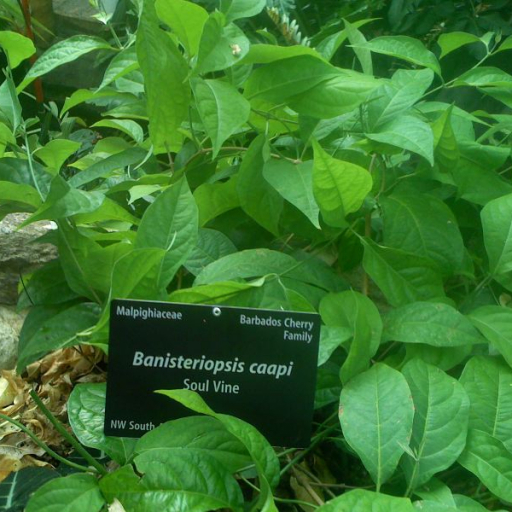
Plant Overview
Often called the "Vine of the Soul" or "Yagé," Banisteriopsis caapi is a legendary giant liana native to the Amazon rainforest. For centuries, it has been the spiritual cornerstone of indigenous Amazonian cultures, revered as a "teacher plant" with deep mystical significance. This woody climber doesn’t just grow; it drapes itself across the jungle canopy like thick, twisted ropes, creating a living bridge between the forest floor and the sky.
🔍 How to Identify
- 🌿 The Stem: Look for thick, woody, and "braided" vines. As the plant matures, the stem develops a distinct knotted or twisted appearance, resembling a heavy, weathered rope.
- 🍃 The Leaves: The leaves are large, oval-shaped (ovate-lanceolate), and grow in opposite pairs. They have a smooth texture and a vibrant green color, often with tiny glands visible near the base of the leaf stalk.
- 🌸 The Flowers: Though rare in indoor cultivation, it produces delicate, pale pink or white flowers with five fringed petals. These blooms are surprisingly dainty compared to the rugged, heavy nature of the vine itself.
🏡 In Your Garden
- 🌳 Climbing Ambition: This is a high-climbing liana that requires significant support. If you are growing it in a greenhouse or tropical garden, provide a heavy-duty trellis or allow it to scale a sturdy, mature tree, as it can easily overwhelm flimsy structures.
- 💧 Tropical Cravings: To thrive, this plant demands "jungle conditions"—high humidity, consistent warmth, and rich, well-draining soil. It is particularly sensitive to cold and will quickly drop its leaves if temperatures dip below 50°F (10°C).
- 🌱 Root Stability: Unlike many vines, it prefers to stay put once established. Avoid frequent repotting, as its root system is sensitive to disturbance, which can lead to a prolonged period of stunted growth.
⚠️ Safety & Toxicity
- 🚫 Status: Potentially Dangerous / Psychoactive.
- ⚠️ Details: The vine contains powerful harmala alkaloids (MAOIs). While it is a sacred medicine in specific cultural contexts, ingestion is highly dangerous outside of expert supervision. It can cause severe nausea, vomiting, and life-threatening interactions with common medications (like antidepressants) or certain foods. Keep this plant far out of reach of children and pets, as all parts of the plant are chemically potent.
✨ Fun Fact
In many indigenous traditions, Banisteriopsis caapi is considered the "Mother" of the forest. It is believed that the vine allows humans to communicate with the spirits of all other plants, acting as a "translator" for the botanical world.

Detailed Care Instructions
| Humidity | High |
| Lighting | Full Sun |
| Toxicity | Poisonous |
| Difficulty | Easy |
| Temperature | 32°C - 35°C |
| Hardiness Zones | 10 - 12 |
Growing Banisteriopsis caapi plants can be a rewarding and exciting process. Here are some steps to help you successfully grow this plant:
- Acquire a healthy plant: Obtain a Banisteriopsis caapi cutting or seedling from a reputable source. Purchasing from a trusted nursery or botanical garden can ensure the plant's quality.
- Choose the right container: Use a large pot with drainage holes or plant directly in the ground if you live in a suitable climate.
- Ideal growing conditions: Banisteriopsis caapi thrives in warm, humid environments. Keep temperatures between 65-85°F (18-29°C) and provide ample humidity.
- Soil mixture: Create a well-draining soil mixture by combining equal parts of peat moss, perlite, and coarse sand. This will help prevent root rot and allow proper water drainage.
- Lighting: Banisteriopsis caapi prefers partial shade or filtered sunlight. Indirect sunlight or dappled shade is ideal for healthy growth.
- Watering: Keep the soil lightly moist, allowing it to dry out slightly between waterings. Avoid overwatering, as this may lead to root rot.
- Fertilizer: Apply a balanced liquid fertilizer every two weeks during the growing season to provide essential nutrients. Follow the instructions on the fertilizer packaging for proper dosage.
- Support and trellising: Banisteriopsis caapi is a vine and benefits from a sturdy support system. Install a trellis or pole to provide stability as the plant grows.
- Pruning: Regularly prune the plant to control its size and shape. Additionally, removing dead or diseased parts will promote healthy growth.
- Patience: Banisteriopsis caapi is a slow-growing plant. Be patient, as it can take several years for it to reach a size suitable for use in preparations.
- Know local regulations: Ensure that growing Banisteriopsis caapi is legal in your area. Some regions have restrictions due to its entheogenic properties.
Remember to research and educate yourself thoroughly on the plant's growth requirements and any legalities before proceeding. Happy growing!

Place in a window with dappled sun or a spot in the middle of a room. Or directly in a window facing west or east.

The watering needs of this plant depend on various factors, such as the soil type, climate, and location. However, in general, it requires regular watering during its growing season, which typically runs from spring to fall.
Before watering, it is important to check the soil moisture level by inserting a finger into the soil. If it feels dry up to the first knuckle, it's time to water. However, avoid over-watering as it can lead to root rot and other fungal infections.
When watering, use room temperature, filtered water or rainwater and ensure that the water reaches the roots of the plant. Allow the soil to drain completely before replacing it in its pot as stagnant water can attract pests and damage the plant.
During the winter months, reduce the watering frequency and ensure that the plant is kept in a cool and dry place. This will help it to go dormant and prepare for new growth in the next season.
Here are the fertilizing instructions for the Banisteriopsis caapi plant:
- Choose a balanced fertilizer: Look for a fertilizer with an NPK ratio of around 10-10-10 or 20-20-20. This means it contains equal or balanced amounts of nitrogen (N), phosphorus (P), and potassium (K), as well as micronutrients.
- Dilute the fertilizer: Follow the instructions on the fertilizer packaging to dilute it in water. Generally, a 1/4 strength solution is suitable for regular feeding.
- Time the fertilization: Start fertilizing in early spring or at the beginning of the growing season. Continue fertilizing once every three to four weeks throughout the growing season, generally until late summer or early fall.
- Water the plant: Thoroughly water the plant before applying the fertilizer. This ensures better distribution and absorption of nutrients.
- Apply the fertilizer: Pour the diluted fertilizer solution around the base of the plant, avoiding direct contact with the stems or leaves. You can also use a watering can with a spout to water the plant gently.
- Monitor the plant: Pay attention to any signs of nutrient deficiencies or excesses, such as yellowing leaves, stunted growth, or burnt leaf edges. Adjust the fertilization accordingly, reducing or increasing the frequency or strength of the fertilizer as necessary.
Remember, it's always advisable to read the specific instructions on your fertilizer's packaging and adjust the fertilization process based on the plant's individual needs. Regularly observing your plant's health and growth can help you determine the best fertilizing routine to keep it thriving.
The ideal soil for Banisteriopsis Caapi should be well-draining with good aeration, and a slightly acidic pH level. It should be rich in organic matter and nutrients, such as nitrogen, phosphorus, and potassium. You can use a mix of soil, sand, and peat moss or coconut coir, along with perlite or vermiculite to improve drainage. Additionally, adding compost or worm castings can provide beneficial microorganisms and micronutrients. It's also important to avoid using soil that contains chemicals or pesticides, as this can harm the plant.
Banisteriopsis Caapi plants can be propagated through various methods, including stem cuttings and air layering. Here is a detailed guide on how to propagate Banisteriopsis Caapi without using its common names:
- Choose a healthy mature plant: Select a mature Banisteriopsis Caapi plant that is free from diseases or pests. It should have a well-developed root system and strong stems.
- Gather the necessary tools: Prepare a sharp and sterilized pair of pruning shears, a clean cutting surface, rooting hormone (optional), sphagnum moss or well-draining soil, and a small plant pot.
- Stem cutting propagation method:
a. Select a suitable stem: Look for a healthy stem that is about 6-8 inches long. It should have at least two to three leaf nodes or aerial roots.
b. Make a clean cut: With the sterilized pruning shears, make a clean cut just below a leaf node or aerial root.
c. Optional: Apply rooting hormone: If desired, dip the cut end of the stem into rooting hormone powder or gel. This can help encourage root development.
d. Plant the cutting: Fill a small plant pot with well-draining soil or moist sphagnum moss. Make a planting hole in the center and gently place the stem into it, ensuring the leaf nodes or aerial roots are covered with the soil/moss.
e. Water and provide humidity: Water the newly planted cutting thoroughly, ensuring the soil/moss is evenly moist but not waterlogged. Place a plastic bag or a clear plastic dome over the pot to create a humid environment.
f. Provide indirect light: Place the potted cutting in a warm and brightly lit location, preferably where it can receive indirect sunlight. Avoid direct sunlight as it can cause scorching.
g. Monitor and care for the cutting: Maintain consistent moisture levels, ensuring the soil/moss doesn't dry out completely. Monitor the cutting for root development, which can typically take several weeks. Once strong roots have formed, the cutting can be gradually acclimated to lower humidity levels and eventually potted into a larger container.
- Air layering propagation method:
a. Select a suitable stem: Identify a healthy and flexible stem that is about 6-8 inches long. Look for a section of stem that is exposed or can be easily accessed for rooting.
b. Make a cut and wound the stem: Make a 1-inch diagonal cut through the outer bark and cambium layer of the stem. Create a vertical or horizontal slit just below the first cut using a clean knife or blade, widening the wound.
c. Enclose the wound: Take moist sphagnum moss and wrap it around the wounded area of the stem. Secure it in place by wrapping plastic wrap or aluminum foil around the moss, making sure it remains moist.
d. Wait for root development: Over the next few weeks, monitor the air layer for root development. Keep the moss moist by misting it regularly or adding water if necessary. Roots will start growing into the moss.
e. Cut and pot the air layer: Once sufficient roots have formed, remove the air layer by cutting the stem just below the rooted section. Plant it in a small plant pot filled with well-draining soil or a suitable potting mix.
f. Provide proper care: Water the newly potted plant thoroughly and place it in a warm and brightly lit location with indirect sunlight. Ensure the soil remains moist but not waterlogged. Gradually acclimate the plant to its final growing environment, providing regular care and monitoring its growth.
Remember, propagation success may vary depending on factors such as temperature, humidity, and the overall health of the parent plant. Patience and proper care are necessary to ensure successful propagation of Banisteriopsis Caapi.








