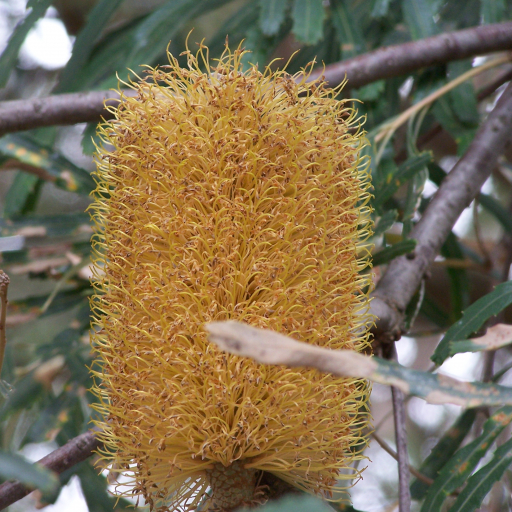
Plant Overview
Known affectionately as the Swamp Banksia, this Western Australian icon is a master of the wetlands. Unlike many of its cousins that prefer dry, sandy scrub, Banksia littoralis thrives where its "feet" can stay cool and damp. It often grows into a stately, gnarled tree with a hauntingly beautiful silhouette, especially when its golden floral "candles" illuminate the canopy during the cooler months.
🔍 How to Identify
- 🕯️ The Blooms: Features upright, cylindrical flower spikes that range from pale yellow to rich gold. As they age, they fade to a rustic bronze and eventually turn into woody, "toothy" cones.
- 🌿 The Foliage: The leaves are long, narrow, and linear. If you look closely, you’ll see distinctive serrated edges and a striking contrast between the dark green top and the silvery-white underside.
- 🪵 The Bark: As the tree matures, its trunk develops a thick, corky, and deeply fissured grey bark, which acts as a protective shield against the elements.
🏡 In Your Garden
- 💧 Water Management: While it loves moisture, it is sensitive to the type of water. In a garden setting, it needs excellent drainage even if the soil is kept moist. It is prone to "dieback" (Phytophthora), so avoid over-watering in heavy clay soils.
- 🦅 Wildlife Magnet: This plant is a five-star hotel for local wildlife. The high nectar production makes it a primary food source for honeyeaters, nectar-feeding birds, and pygmy possums during the winter when other food is scarce.
- 🧪 Soil Sensitivity: Like most members of the Proteaceae family, it has "proteoid" roots. Never use standard fertilizers; it requires a specialized low-phosphorus "Native" fertilizer to avoid nutrient toxicity.
⚠️ Safety & Toxicity
- ✅ Status: Non-toxic and generally safe.
- 🐾 Details: This plant is safe for curious pets and children. However, the dried, woody cones (often called "Banksia nuts") are incredibly hard and can be sharp; they should be kept off walkways to prevent trips or stubbed toes.
✨ Fun Fact
The "toothy" appearance of the dried Banksia cones was the primary inspiration for the "Big Bad Banksia Men" in May Gibbs’ classic Australian children’s stories, Snugglepot and Cuddlepie. These cones can remain on the tree for years, waiting for the heat of a bushfire to open their "mouths" and release their seeds!

Detailed Care Instructions

Place in a bright room that is sun drenched almost all day. Or directly in a south-facing window.

Some plants require more regular watering than others, which should be done every few days. It's critical to maintain the soil moist all of the time. The water requirements of the same plant placed in pots with varying sizes will differ. Because the water in the smaller pot evaporates faster than the water in the larger pot, it will require more watering. Regardless of pot size, the surface should constantly be maintained moist.








