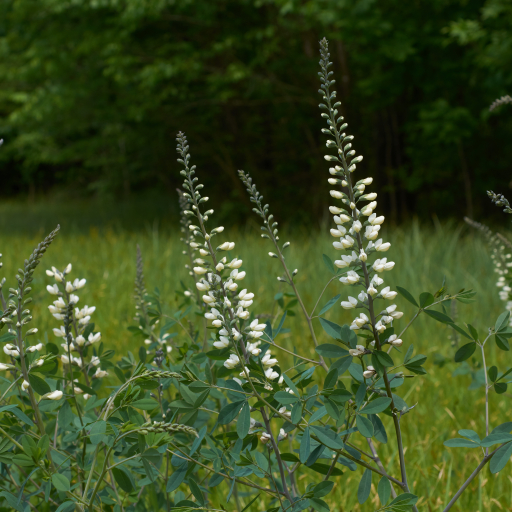
Plant Overview
Known as the White Wild Indigo, this elegant perennial is a true ghost of the North American prairies. With its structural, vase-like shape and spires of ivory flowers, it brings an air of sophisticated wildness to any landscape. While it looks like a shrub, it is actually a long-lived herbaceous plant that returns every spring to grace the garden with its charcoal-colored stems and frosty foliage.
🔍 How to Identify
- ☁️ Floral Spikes: It produces tall, upright racemes (spikes) of pea-like, creamy white flowers that bloom from the bottom up.
- 🌿 Trifoliate Foliage: The leaves are clover-like, divided into three rounded leaflets with a distinct blue-green or "glaucous" hue.
- 🖤 Winter Interest: After the flowers fade, they are replaced by large, inflated seed pods that turn a dramatic charcoal-black as they dry.
🏡 In Your Garden
- ⚓ The "Stay Put" Rule: This plant develops a massive, deep taproot that makes it incredibly drought-tolerant once established. However, this means it absolutely hates being moved; choose its forever home carefully, as transplanting often fails.
- 🧪 Soil Improvement: As a member of the legume family, it works with soil bacteria to "fix" nitrogen. It actually leaves the soil richer than it found it, making it a great companion for heavy-feeding neighbors.
- ⏳ Patience Required: Like many long-lived perennials, it follows the "Sleep, Creep, Leap" rule. It may look small for the first two years, but by year three or four, it will explode into a majestic, shrub-sized focal point.
⚠️ Safety & Toxicity
- 🚫 Status: Toxic to humans, pets, and livestock.
- 🤢 Details: The plant contains quinolizidine alkaloids. If ingested, it can cause nausea, vomiting, and abdominal pain. Fortunately, its bitter taste usually prevents children or pets from eating enough to cause serious harm, but it should still be planted away from curious nibblers.
✨ Fun Fact
The genus name Baptisia comes from the Greek word "bapto," meaning "to dye." While the White Wild Indigo wasn't as potent as its cousin, the Blue Wild Indigo, early American settlers still used it as a more affordable (though inferior) substitute for true indigo dye!

Detailed Care Instructions
To grow Baptisia Alba, also known as white wild indigo, follow these steps:
- Choose the right location: Baptisia Alba prefers full sun but can also tolerate partial shade. Make sure the location has well-draining soil.
- Prepare the soil: Before planting, amend the soil with compost or aged manure to improve drainage and fertility.
- Planting: Dig a hole that is wide and deep enough to accommodate the root system of the Baptisia Alba plant. Place the plant in the hole, ensuring the crown is level with the soil surface. Backfill the hole with soil, firming it gently around the roots.
- Watering: Baptisia Alba prefers a moderate amount of water during its initial growth. After establishment, it is quite drought-tolerant and only needs watering during extended dry periods.
- Mulching: Apply a layer of organic mulch around the base of the plant to help retain moisture and suppress weed growth. Leave some space around the stem to prevent rotting.
- Pruning: Baptisia Alba does not require extensive pruning. However, you can remove any dead or damaged stems in early spring before new growth appears to maintain its appearance.
- Fertilizing: Baptisia Alba generally does not need much fertilization. However, if the plant appears weak or lacks vigor, you can apply a balanced, slow-release fertilizer in early spring.
- Pest and disease control: Baptisia Alba usually has no major issues with pests or diseases. However, keep an eye out for Japanese beetles, which can sometimes feed on the foliage. Hand-pick and dispose of them to prevent significant damage.
- Division: Depending on its growth habit, Baptisia Alba may benefit from division every few years in early spring. Dig up the plant and separate the clumps, then replant them to give them more space to grow.
With proper care and suitable growing conditions, your Baptisia Alba plant should thrive and produce beautiful white flowers in late spring to early summer.

Place in a bright room that is sun drenched almost all day. Or directly in a south-facing window.

Baptisia Alba is a perennial herbaceous plant that requires regular watering to thrive. It is important to avoid over-watering, as this can lead to root rot and other adverse effects. To water Baptisia Alba, start by checking the moisture level of the soil around the plant. Stick your finger into the soil to a depth of about one inch. If the soil feels dry, it is time to water.
When watering Baptisia Alba, use a gentle stream of water to avoid disturbing the soil or damaging the plant. Allow the water to soak into the soil around the base of the plant, rather than watering the leaves or flowers. Water slowly and deeply to ensure that the roots are receiving enough moisture. Be sure to avoid watering the plant during the hottest part of the day, as this can cause the water to evaporate too quickly.
In general, Baptisia Alba should be watered about once a week, or more frequently during periods of hot or dry weather. It is important to maintain consistent moisture levels to avoid stress on the plant. If you are unsure about how often to water your Baptisia Alba, consult a gardening expert or reference guide for more detailed information.
To fertilize this plant, apply a balanced fertilizer in early spring before new growth appears. Use a fertilizer with an N-P-K ratio of 10-10-10 or 16-16-16. Apply the fertilizer at a rate of 1/2 to 1 pound per 100 square feet or follow the manufacturer's instructions. Water thoroughly after fertilization. Avoid fertilizing after mid-summer to prevent late-season growth that can be damaged by frost.
Baptisia Alba plant prefers soil that is well-draining and does not retain too much moisture. The ideal soil pH range is slightly acidic to neutral, between 6.0 and 7.0. It does not require particularly fertile soil, and often thrives in nutrient-poor soils. Sandy or loamy soils with good structure and aeration are preferred. It is important to avoid heavy clay soils that hold in too much moisture. The plant can also tolerate some drought conditions once established.
Propagation of this plant can be done through both seeds and cuttings. For seeds, collect them from the plant once they have dried and ripened on the plant. Sow them in well-draining soil and keep them moist until they germinate. For cuttings, take a stem cutting from a mature plant in the summer and dip the end in rooting hormone before planting it in a well-draining soil mix. Keep the soil moist and protect the cutting from direct sunlight until it has rooted. Both methods require patience and care to successfully propagate the plant.








