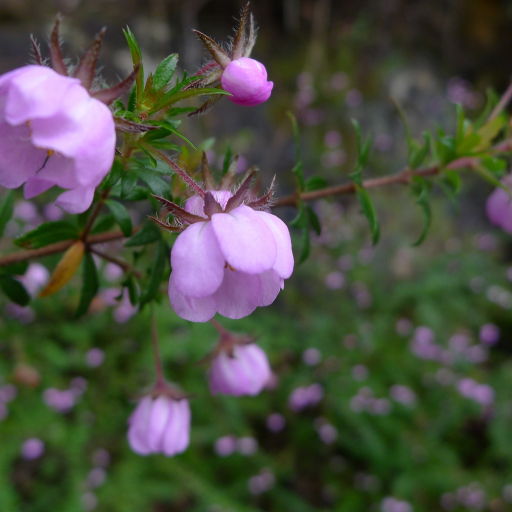
Plant Overview
Known affectionately as the "River Rose," this delicate Australian native brings a touch of wild elegance to damp, shady corners. Despite its name, it isn't a true rose, but its drooping, cup-shaped flowers offer a similar romantic charm. It is a resilient scrambler that often forms dense, wiry thickets along creek banks and sandstone cliffs in the cool temperate regions of Southeast Australia.
🔍 How to Identify
- 🍃 False Whorls: The small, serrated leaves appear to grow in circles of six around the stem. In reality, they are two opposite leaves, each divided into three leaflets, creating a beautiful geometric pattern.
- 🌸 Bell-Shaped Blooms: The flowers are dainty, nodding cups that range from snowy white to deep magenta, each housing a crown of prominent yellow stamens at the center.
- 🕸️ Wiry Habit: Its stems are thin, flexible, and slightly hairy, often tangling together to create a "scrambling" mound that can climb over nearby rocks or logs.
🏡 In Your Garden
- 💧 Moisture Lover: This plant thrives in "wet feet" conditions. It is the perfect candidate for bog gardens, rain gardens, or edges of garden ponds where the soil remains consistently damp and acidic.
- ✂️ Pruning Strategy: Because it has a naturally rambling and wiry growth habit, it can become quite sparse or "leggy" over time. A light trim after the flowering season encourages a much denser, more rounded shape.
- ⛅ Cool Roots: It prefers its head in the sun or dappled shade, but its roots must stay cool. Using a thick organic mulch or placing it near a large rock helps regulate the soil temperature.
⚠️ Safety & Toxicity
- ✅ Safe Status: Bauera rubioides is generally considered non-toxic and is not known to pose a poisoning risk to humans, dogs, or cats.
- 🧤 Mild Irritant: While not chemically toxic, the fine hairs on the stems and the serrated leaf edges can occasionally cause very mild mechanical skin irritation for sensitive individuals during heavy pruning sessions.
✨ Fun Fact
🎨 An Artist’s Legacy: The genus was named by explorer Sir Joseph Banks to honor Ferdinand Bauer, a legendary 18th-century botanical illustrator. Bauer was so precise that he used a complex "color code" system to record the exact shades of the plants he found in the Australian wild before painting them later in his studio.

Detailed Care Instructions
To grow Bauera Rubioides, also known as Pink Mountain Pincushion, you can follow these steps:
- Choose a suitable location: Bauera Rubioides prefers a partially shaded spot with moist, well-draining soil. It can tolerate full sun but may require more regular watering in hot conditions.
- Prepare the soil: Ensure the soil is rich in organic matter by adding compost or well-rotted manure. This will help retain moisture and provide essential nutrients.
- Planting: Dig a hole around twice the size of the plant's root ball. Place the plant in the hole, making sure it is at the same depth as it was growing previously. Gently backfill with soil, firming it around the roots.
- Watering: Water the plant thoroughly after planting and continue to keep the soil consistently moist but not waterlogged. During hot and dry periods, water more frequently to prevent the soil from drying out.
- Mulching: Apply a layer of organic mulch around the base of the plant, such as straw or wood chips. This will help conserve moisture, suppress weed growth, and regulate soil temperature.
- Pruning: Bauera Rubioides is a low-maintenance plant that doesn't require a lot of pruning. However, you can trim any dead or damaged branches to encourage healthy growth. Prune lightly after flowering to maintain a compact shape.
- Fertilizing: If your soil is lacking in nutrients, you can apply a slow-release balanced fertilizer in early spring. Follow the package instructions for the appropriate amount to use.
- Protecting from frost: Bauera Rubioides is generally hardy but may require protection from frosts in colder regions. Cover the plant with a frost cloth or bring containers indoors during freezing weather.
- Propagation: You can propagate Bauera Rubioides through softwood cuttings taken in spring or by layering. Softwood cuttings should be taken from new growth, dipped in rooting hormone, and placed in a well-draining propagation mix. Keep them in a warm, humid environment until they root.
By following these steps, you should be able to successfully grow Bauera Rubioides and enjoy its lovely pink flowers.

Place in a window with dappled sun or a spot in the middle of a room. Or directly in a window facing west or east.

The best way to water this plant is to use a watering can or a gentle hose nozzle to avoid damaging the delicate leaves. Water should be applied directly to the soil around the plant, being sure to soak the root system deeply. It's important not to let the soil become too dry between waterings, but also not to allow it to become waterlogged as this can lead to root rot. A good rule of thumb is to water when the top inch of soil feels dry to the touch. If the plant is in a pot, allow water to drain out the bottom to prevent root damage. Avoid getting water on the leaves and flowers as this can lead to fungal infections and leaf spots. During periods of drought or extreme heat, the plant may require more frequent watering.
For optimal growth and flowering, it is recommended to fertilize this plant with a balanced fertilizer, such as a 10-10-10 or 20-20-20 formula, every two to three months during the growing season. Be sure to follow the manufacturer's instructions on application rates and mix the fertilizer with water before applying to the soil. Avoid over-fertilizing as this can lead to excessive leaf growth at the expense of flower production. Water the plant thoroughly after fertilizing to help distribute the nutrients throughout the soil.
When planting this particular plant, it is recommended to use a well-draining soil mix that is rich in organic matter. The soil should be slightly acidic, with a pH ranging from 5.5 to 6.5. It should have good drainage to prevent water-logging and root rot. Adding perlite or sand to the soil mix can help improve drainage. It is also important to ensure that the soil does not dry out completely between watering, as this can cause stress to the plant. Additionally, fertilizing the plant with a balanced fertilizer during the growing season can help promote healthy growth and flowering.
To propagate this plant, take stem cuttings approximately 10cm in length from a mature and healthy mother plant. Cut the stem just below a node and remove any leaves from the bottom half of the cutting. Dip the cut end in a rooting hormone powder and insert it into a pot filled with well-draining potting mix. Water the cutting and place it in a warm and humid spot with bright, indirect light. Keep the soil moist but not waterlogged, and mist the cutting regularly. After a few weeks, roots should start to form, and you can gradually move the cutting to a brighter location. Once the cutting has developed a strong root system, you can transplant it to a larger pot or to a permanent spot in the garden.








