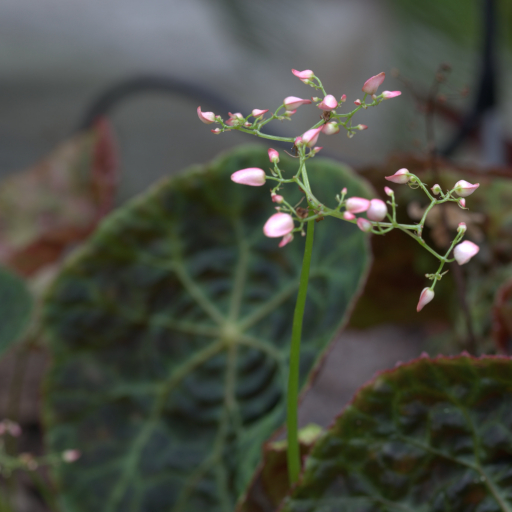
Plant Overview
Commonly known as the "Fire King Begonia" or the "Spider Web Begonia," this Sumatran treasure looks like it was plucked straight from a prehistoric jungle. Its striking, shield-like leaves and intricate metallic patterns make it a crown jewel for collectors who appreciate "living art." While it may look tough, this Indonesian native is a bit of a rainforest diva, demanding specific conditions to keep its dramatic foliage looking its best.
🔍 How to Identify
- 🕸️ Peltate Leaves: The leaves are perfectly round (orbicular) and "peltate," meaning the stem attaches directly to the center of the leaf rather than the edge, resembling a miniature green shield.
- 🎨 Spider-Web Veining: The surface features a deep bronze-green backdrop contrasted by luminous, lime-green veins that radiate from the center like a glowing spider web.
- 🔴 Hidden Colors: If you flip a leaf over, you’ll find a surprising deep mahogany or dull red underside, which helps the plant capture light in the dim forest understory.
🏡 In Your Garden
- ☁️ Humidity is Non-Negotiable: Unlike your average pothos, the Fire King craves high humidity (60% or higher). It thrives best in a terrarium, a glass cloche, or a dedicated "plant room" where the air stays moist and still.
- 💧 The Goldilocks Watering: It grows from a thick rhizome (a horizontal underground stem) that is very prone to rot. You must wait for the top inch of soil to dry out before watering, and never let it sit in a saucer of water.
- 🌑 Low Light Lover: In its natural habitat, it lives on the dark forest floor. In your home, direct sunlight will scorch its intricate patterns; it prefers the soft, dappled light of a north-facing window.
⚠️ Safety & Toxicity
- 🐾 Status: Toxic to pets and humans.
- 👅 Details: Like most Begonias, this plant contains soluble calcium oxalate crystals. If a curious cat or dog nibbles on the leaves or rhizome, it can cause intense oral irritation, drooling, and vomiting. It is best kept on high shelves or inside a glass enclosure.
✨ Fun Fact
The Begonia goegoensis is named after the Goego (Goegoek) district in Sumatra, Indonesia, where it was first discovered. Because it grows so slowly and has such specific humidity needs, it remained a rare "botanical secret" among enthusiasts for decades before becoming a star of the modern houseplant movement!

Detailed Care Instructions
To grow a Begonia Goegoensis plant, follow these steps:
- Obtain a healthy plant: Purchase a Begonia Goegoensis plant from a reputable nursery or online store. Make sure it is a healthy specimen with vibrant leaves and no signs of disease or pests.
- Choose the right pot: Select a pot with drainage holes to ensure proper water drainage. The pot should be slightly larger than the root ball of the plant to accommodate growth.
- Soil selection: Begonia Goegoensis prefers well-draining soil that retains some moisture. Use a mix containing peat moss, perlite, and a small amount of regular potting soil or orchid mix.
- Planting: Gently remove the plant from its container and loosen the roots. Place the plant in the center of the pot and add soil around it, making sure to cover the roots completely. Press down gently to secure the plant.
- Light requirements: Begonia Goegoensis thrives in bright, indirect light. Place the plant in a location that receives ample filtered sunlight or artificial light. Avoid direct sunlight as it can scorch the leaves.
- Temperature and humidity: This plant prefers warm temperatures between 65-75°F (18-24°C). It also appreciates humidity, so consider using a humidifier or placing the pot on a tray filled with water and pebbles.
- Watering: Begonia Goegoensis prefers consistently moist soil but does not like to sit in waterlogged conditions. Water the plant when the top inch of soil feels dry. Allow excess water to drain out of the pot.
- Fertilization: Feed the plant with a balanced houseplant fertilizer diluted to half the recommended strength. Apply every two to four weeks during the growing season (spring and summer).
- Pruning: Trim away any dying or dead leaves to maintain a tidy appearance and promote new growth.
- Propagation: Begonia Goegoensis can be propagated through stem cuttings. Take a cutting from a healthy plant, remove the lower leaves, and place it in a container filled with moist potting mix. Keep it in a warm and humid environment until the roots develop.
With proper care and attention to its needs, your Begonia Goegoensis plant should thrive and grow into a beautiful specimen.

Place in a window with dappled sun or a spot in the middle of a room. Or directly in a window facing west or east.

To properly water Begonia Goegoensis, follow these watering guidelines:
1. Check the soil: Before watering, assess the soil moisture level by inserting your finger about an inch deep into the soil. If it feels dry, it's time to water the plant.
2. Watering interval: Begonia Goegoensis typically prefers evenly moist soil, so water it when the top layer of soil begins to dry out. The frequency of watering may vary depending on factors such as the temperature, humidity, and sunlight conditions.
3. Watering technique: Use a watering can or a small jug to ensure precision while watering. Direct the water towards the base of the plant, near the soil, and avoid wetting the leaves excessively. Pour water evenly and gently until you observe slight runoff from the drainage holes.
4. Adequate drainage: Begonia Goegoensis prefers a well-draining soil medium. Ensure that the pot or container has drainage holes at the bottom to prevent water from pooling at the roots, which can lead to root rot.
5. Avoid overwatering: While moisture is essential, overwatering can be detrimental to Begonia Goegoensis. It's crucial to strike a balance and avoid waterlogging. If the soil consistently feels wet or if the plant exhibits signs of root rot (such as wilting or yellowing leaves), reduce the frequency of watering.
6. Mist occasionally: Begonia Goegoensis appreciates a slightly more humid environment. Consider misting the air around the plant occasionally, particularly during dry seasons or if the indoor humidity is low.
Remember, these watering guidelines serve as a general starting point, and the specific watering needs of your Begonia Goegoensis may vary based on various factors. It's always important to closely monitor your plant's response to the watering routine and adjust accordingly.
To fertilize the Begonia Goegoensis plant, follow the instructions below:
- Choose a balanced, water-soluble fertilizer formulated for flowering plants.
- Dilute the fertilizer according to the package instructions. It is generally recommended to use half the recommended strength to avoid over-fertilization.
- Water the plant thoroughly before fertilizing to ensure the soil is moist.
- Apply the diluted fertilizer to the soil around the plant, avoiding direct contact with the leaves or flowers.
- Use a watering can or sprayer to evenly distribute the fertilizer.
- Repeat the fertilization process every two to four weeks during the growing season (spring to fall).
- When fertilizing, be cautious not to exceed the recommended dosage, as this can lead to fertilizer burn or other harmful effects.
- Monitor the plant's response to the fertilizer and adjust the frequency or concentration if necessary.
- It is a good practice to flush the soil occasionally with plain water to prevent nutrient buildup.
- Always read and follow the instructions provided with the fertilizer for best results.
Begonia goegoensis is a plant that requires well-draining soil. It prefers a neutral to slightly acidic pH level. The soil should have a good mixture of organic matter, such as compost or peat moss, to provide essential nutrients and moisture retention. It is important to avoid heavy clay soils that can retain excessive moisture and lead to root rot.
A suitable soil mix for Begonia goegoensis can include a combination of equal parts perlite or vermiculite and high-quality potting soil. This mixture ensures proper drainage and aeration, preventing waterlogged roots. Adding a small amount of organic matter, such as compost or sphagnum moss, can enhance the soil's nutrient content and moisture-retaining capabilities.
It is advisable to also consider adding a well-balanced slow-release fertilizer to the soil mix during potting or repotting. This will ensure a steady supply of nutrients for optimum growth and flowering. Moreover, Begonia goegoensis generally appreciates regular feedings with a diluted liquid fertilizer throughout the growing season.
Overall, the key factors to consider when selecting soil for Begonia goegoensis are good drainage, adequate aeration, and a balanced nutrient content. By providing these soil requirements, you can create an ideal environment for the plant's healthy growth and development.
To propagate Begonia Goegoensis, you can follow these steps:
- Select a healthy and mature parent plant: Look for a Begonia Goegoensis plant that is at least one year old and is thriving with no signs of disease or pests.
- Prepare the propagation materials: Gather a clean and sharp pair of pruning shears or scissors, a clean container filled with well-draining potting soil or a suitable propagation medium (such as perlite, vermiculite, or a mix of peat moss and sand), and a clean, clear plastic bag or a propagator to create a humid environment.
- Choose a suitable propagation method: Begonia Goegoensis can be propagated through various methods including stem cuttings, leaf cuttings, or division. Select the method that suits your preferences and the plant's characteristics.
- Stem cutting propagation method: Locate a healthy stem with several nodes (joints) and leaves. Make a clean cut just below a node, ensuring the cutting is around 2-4 inches long. Remove any lower leaves that may be close to the base of the cutting.
- Leaf cutting propagation method: Select a healthy leaf with its petiole (leaf stalk) intact. Make a clean cut at the base of the leaf where it attaches to the petiole. It's essential to ensure that the leaf section has a visible vein or vein bud attached, as this will aid in new roots formation.
- Division propagation method: For this method, carefully remove the Begonia Goegoensis plant from its pot or growing area. Gently separate the parent plant into smaller sections, each with healthy roots and foliage. Ensure that each section has enough roots and stems to sustain itself once replanted.
- Prepare the propagation medium: Plant the stem cuttings or leaf cuttings in the prepared potting medium, ensuring that at least one node is buried beneath the soil. For divisions, place each section into its own container with fresh potting soil.
- Provide the right conditions: Place the newly propagated cuttings or divisions in a warm and well-lit location, but away from direct sunlight. Maintain a consistently moist environment by misting or lightly watering the soil whenever it starts to dry out. Cover the plants with a plastic bag or propagator to create a high humidity environment, which aids in root development.
- Monitor and care for the propagations: Keep a regular check on the cuttings or divisions to ensure they remain healthy. Avoid overwatering to prevent rotting, but don't let the soil dry out completely either. Adjust the humidity as needed by occasionally opening the plastic bag or propagator to allow some air circulation.
- Transplanting: After a few weeks to a few months, depending on the propagation method used, the cuttings or divisions should have rooted and developed into young plants. At this stage, they can be gently transplanted into separate pots or a suitable location in the garden with well-draining soil.
Remember to label your newly propagated plants to keep track of their names and any other relevant information.
Common pests of the fire-king begonia include Mealybugs, spider mites, aphids, whiteflies. Make a habit of checking your fire-king begonia frequently for pests so that any infestations can be caught and managed early.








