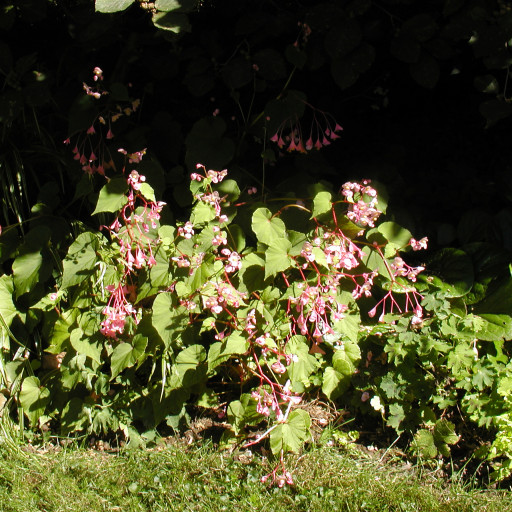
Plant Overview
Often called the "Hardy Begonia," Begonia grandis is the tough-as-nails cousin of the delicate wax begonias found in hanging baskets. Originating from the forest floors of China and Japan, it is one of the few begonias capable of surviving freezing winters. It is a favorite among woodland gardeners for its ability to bring lush, tropical-looking foliage and late-season color to the deepest shadows of the yard.
🔍 How to Identify
- 🍃 Asymmetrical Foliage: The leaves are large, heart-shaped, and "lopsided," featuring a rich olive-green surface and striking ruby-red veins on the underside that glow when backlit.
- 🌸 Pendulous Blooms: From late summer through the first frost, the plant produces airy, branching clusters of nodding pink or white flowers that dangle gracefully above the leaves.
- 🏮 Axil Bulbils: In autumn, tiny pea-sized tubers called bulbils form in the "armpits" of the leaves (where the leaf meets the stem); these fall to the ground to create new plants the following spring.
🏡 In Your Garden
- 🌑 Shadow Specialist: This plant thrives in full to partial shade. It is the perfect solution for "dead zones" under large trees or on the north side of buildings where grass and sun-loving flowers refuse to grow.
- ⏳ Patience is Key: Don't panic in the spring! Begonia grandis is a notorious "late riser" and often won't peek out of the ground until late May or early June, long after other perennials have leafed out.
- 🌱 Self-Sowing Style: Because of its unique bulbils, this plant will slowly "walk" across your garden over several years, creating a beautiful, naturalized groundcover without becoming aggressively invasive.
⚠️ Safety & Toxicity
- 🐱 Pet Warning: This plant contains soluble calcium oxalates, which are toxic to cats and dogs. If ingested, it can cause intense oral irritation, drooling, and difficulty swallowing.
- 🧤 Skin Sensitivity: The succulent stems contain sap that may cause mild skin redness or itching for individuals with sensitive skin; wearing gloves while pruning is recommended.
✨ Fun Fact
- ❄️ The Ice Queen: While almost all other Begonias are tropical and would turn to mush at the first sign of frost, Begonia grandis can survive temperatures as low as -10°F (-23°C) if provided with a thick blanket of mulch or fallen leaves!

Detailed Care Instructions
| Lighting | Part Sun |
| Hardiness Zones | 6A - 9A |
To grow a Begonia Grandis plant, follow these steps:
- Choose a suitable location: Begonia Grandis prefers partial shade to full shade. It thrives in moist and well-draining soil. Select a sheltered spot in your garden that receives filtered sunlight or is shaded for most of the day.
- Prepare the soil: Dig a hole for planting that is slightly larger than the root ball of the Begonia Grandis. Loosen the soil and mix in compost or well-rotted manure to improve drainage and fertility.
- Planting: Place the Begonia Grandis plant into the hole, ensuring that the top of the root ball is level with the soil surface. Backfill the hole with soil and gently firm it around the plant.
- Watering: Begonia Grandis prefers consistent moisture. Water the plant regularly, keeping the soil moist but not waterlogged. Watering deeply once or twice a week should be sufficient, but adjust as needed based on rainfall and temperature.
- Mulching: Apply a layer of mulch around the base of the plant to help retain moisture, suppress weed growth, and regulate soil temperature. Wood chips, shredded leaves, or compost make excellent mulching materials.
- Fertilization: Begonia Grandis doesn't require heavy fertilization. Applying a slow-release or balanced fertilizer, such as a granular 10-10-10 formulation, in spring and midsummer can provide a small boost of nutrients.
- Pruning: Prune the plant in early spring to remove any dead or damaged foliage. This promotes healthy growth and prevents the plant from becoming overcrowded.
- Overwintering: In colder climates, Begonia Grandis is not fully hardy and may require protection during winter. Mulch heavily around the base of the plant or lift the tubers and store them in a cool, dry place until spring.
By following these steps, you can successfully grow a beautiful and healthy Begonia Grandis plant.

Place in a window with dappled sun or a spot in the middle of a room. Or directly in a window facing west or east.

To properly water this plant, it is important to consider the type of soil it is planted in. The soil should be moist but should not be oversaturated as this can lead to root rot. One way to ensure proper watering is to feel the top inch of soil and if it feels dry, it is time to water. When watering, it is important to water at the base of the plant rather than on the leaves to prevent fungal growth. Additionally, be sure to avoid getting water on the foliage during the heat of the day as this can cause the leaves to burn. Finally, it is important to monitor the plant during periods of high heat or humidity as it may require more or less water depending on these conditions.
To fertilize this plant, use a slow-release fertilizer with a balanced NPK ratio, such as 10-10-10 or 20-20-20, following the manufacturer's instructions for application. It is recommended to apply fertilizers during the growing season, about every 4-6 weeks. Avoid over-fertilizing as it can cause damage to the roots.
The ideal soil for Begonia Grandis plants should be well-draining and highly fertile. A mix of loamy soil and organic compost is recommended. The soil should be slightly acidic with a pH level between 6.0-6.5. It is important to avoid heavy or clay-like soil as this can cause poor drainage and root rot. The plants prefer a soil that is moist but not waterlogged, as too much water can lead to fungal diseases. Adding perlite or sand to the soil mix can help improve drainage while a layer of mulch on top can help retain moisture.
To propagate this plant, you will need to carefully separate its rhizomes. Use a sharp and sterilized knife to cut the rhizomes into smaller pieces. Each piece should have at least one healthy shoot and a portion of the rhizome. Then, plant each piece in well-draining soil, burying the rhizome just below the soil surface. Water the new plants and keep them moist but not overly wet. Over time, they will develop into mature plants.
Common pests of the hardy begonia include Mealybugs, spider mites, aphids, whiteflies. Make a habit of checking your hardy begonia frequently for pests so that any infestations can be caught and managed early.








