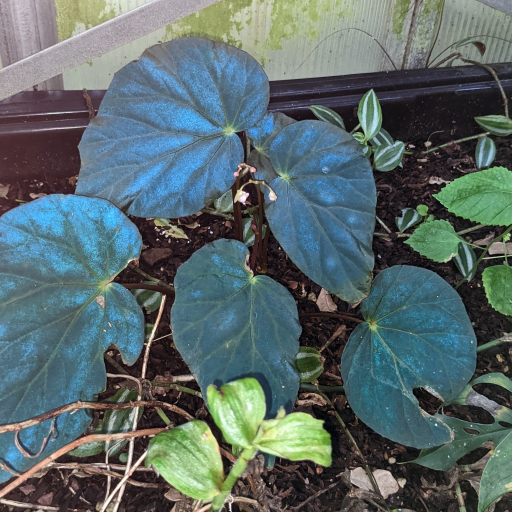
Plant Overview
Often called the "Peacock Begonia," this Malaysian treasure is famous for an ethereal, metallic blue shimmer that appears as if by magic in low light. It thrives deep within the shaded forest floors of the Genting Highlands, evolving a unique way to capture every stray photon of sunlight. It is a true showstopper for terrarium enthusiasts looking for a plant that looks like it belongs in a sci-fi film.
🔍 How to Identify
- ✨ The Electric Glow: The most striking feature is its iridescence. Under low-light conditions, the leaves reflect a brilliant peacock-blue or turquoise sheen.
- 🍃 Leaf Structure: The leaves are heart-shaped and slightly asymmetrical, featuring a dark, velvety green top and a rich, deep burgundy underside.
- 🌸 Delicate Blooms: While grown primarily for its foliage, it occasionally produces dainty, pale pink flowers that contrast beautifully against the dark leaves.
🏡 In Your Garden
- ☁️ Humidity is King: This plant is not a typical windowsill resident; it requires very high humidity (70% or higher) to prevent the leaf edges from crisping. It is most successful when grown in a closed terrarium or a Wardian case.
- 🌑 The Light Paradox: Unlike most plants, the blue color actually fades if the light is too bright. To keep that signature "glow," you must provide deep shade or very diffused, indirect light.
- 💧 Cool Roots: It prefers "cool" feet. Avoid letting the soil get bone-dry, but ensure the potting mix is airy and porous, as stagnant water at the roots will lead to swift decline.
⚠️ Safety & Toxicity
- 🐾 Toxic to Pets: Like most members of the Begonia family, this plant contains calcium oxalate crystals. It is toxic to cats, dogs, and horses if ingested.
- 👄 Irritation Risk: Ingestion can cause intense oral irritation, drooling, swelling of the throat, and vomiting. Keep it tucked away in a glass enclosure or on a high shelf away from curious nibblers.
✨ Fun Fact
The blue color isn't caused by a blue pigment, but by "iridoplasts." These are specialized structures in the leaf cells that slow down light waves, allowing the plant to absorb 10% more energy from the green light that other plants usually reflect. It is a biological "super-panel" for solar energy!

Detailed Care Instructions
To successfully grow Begonia Pavonina plants, follow these steps:
- Lighting: Begonia Pavonina plants prefer bright, indirect light. Place them near a north or east-facing window where they receive partial sunlight. Avoid direct sunlight, as it can scorch their delicate leaves.
- Temperature and humidity: Begonia Pavonina plants thrive in warm temperatures between 65-75°F (18-24°C). Maintain a consistent indoor temperature, avoiding drafts or temperature fluctuations. They also prefer high humidity levels (around 50-60%).
- Watering: Keep the soil consistently moist but not waterlogged. Water thoroughly when the top inch of soil feels dry, allowing excess water to drain away. Begonias are sensitive to overwatering, which can cause root rot. Avoid letting the plant sit in standing water.
- Soil: Use a well-draining potting mix formulated for tropical plants. A mixture of peat moss, perlite, and vermiculite works well. You can also add some compost or organic matter to enrich the soil.
- Fertilizer: Feed your Begonia Pavonina with a balanced, water-soluble houseplant fertilizer once a month during the growing season (spring to fall). Dilute the fertilizer to half the recommended strength to avoid over-fertilization.
- Pruning: Regularly pinch back the tips of the plant to promote bushiness and prevent leggy growth. Remove any yellowing or decaying leaves.
- Repotting: Begonia Pavonina plants appreciate being slightly root-bound, so repotting is only necessary when the plant becomes too large for its current container. Use a slightly larger pot and fresh potting mix when repotting.
- Propagation: Begonia Pavonina can be propagated through leaf or stem cuttings. Take a healthy leaf or stem cutting, dip it in rooting hormone (optional), and place it in a well-draining potting mix. Keep the soil consistently moist until roots develop.
- Pest control: Keep an eye out for common houseplant pests like aphids, mealybugs, and spider mites. If spotted, use appropriate organic pesticides or insecticidal soap to control the infestation.
By following these guidelines, you can successfully grow and care for Begonia Pavonina plants. Enjoy their uniquely iridescent leaves and vibrant colors!

Place in a window with dappled sun or a spot in the middle of a room. Or directly in a window facing west or east.

To water this particular plant, it is important to ensure that the soil remains moist at all times. However, it is also crucial to ensure that the water does not accumulate, as this can lead to root rot. Therefore, it is recommended to water the plant sparingly but consistently, allowing the soil to dry out slightly between waterings. Additionally, it is best to water the plant from the bottom, allowing the roots to absorb the water through holes in the bottom of the pot, rather than pouring water directly on the leaves. Finally, it is important to use water that is room temperature, as cold water can shock the plant and cause damage.
- Use a balanced, water-soluble fertilizer, such as a 20-20-20 formula.
- Dilute the fertilizer according to the package instructions, usually 1-2 teaspoons per gallon of water.
- Only fertilize during periods of active growth, typically in the spring and summer.
- Water the plant thoroughly before applying fertilizer to prevent burning of the roots.
- Apply the fertilizer to the soil around the base of the plant, avoiding getting it on the leaves.
- Repeat fertilization every 4-6 weeks during the growing season.
- Reduce fertilization during the winter months when the plant is in dormancy.
The Begonia Pavonina plant prefers a well-draining soil mixture that is rich in organic matter. The soil should have a pH between 5.5 to 6.5, which is slightly acidic. It is recommended to use a soil mixture that contains peat moss, perlite, and vermiculite or use an African violet soil mix. Avoid using heavy or clay soils that retain moisture for an extended period as this can lead to root rot and cause damage to the plant. Additionally, it is essential to ensure that the soil remains moist and drained well, as the Begonia Pavonina plant is susceptible to over-watering.
To propagate this plant, you can take stem cuttings or leaf cuttings. For stem cuttings, select a healthy stem that is around 4-6 inches long and has a few leaves. Cut the stem below a node, which is where a leaf is attached to the stem. Remove the leaves from the bottom half of the stem, leaving only one or two leaves at the top. Dip the cut end in rooting hormone and plant it in well-draining soil. Keep the soil moist and provide bright indirect light.
For leaf cuttings, choose a healthy leaf and cut it at the stem. Cut the leaf into smaller sections, with each section having at least a part of the stem attached. Dip the cut end in rooting hormone and plant it in a well-draining soil mix. Keep the soil moist and provide bright indirect light.
Propagation can also be done using division, but this may be difficult with Begonia Pavonina as it typically grows as a single, upright stem.
Common pests of the begonia pavonina include Mealybugs, spider mites, aphids, whiteflies. Make a habit of checking your begonia pavonina frequently for pests so that any infestations can be caught and managed early.








