Plant Overview
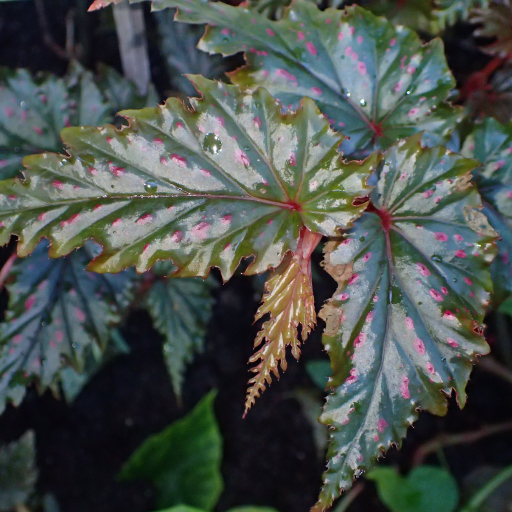
Often called the "Pink Spotted Begonia," this New Guinea native looks like it belongs in a sci-fi forest rather than a windowsill. Its metallic, bronze-green leaves are punctuated by neon pink spots that appear almost three-dimensional. It is a prized specimen for collectors who enjoy high-contrast foliage and the intricate textures of rare tropical species.
🔍 How to Identify
- 🍃 Jagged Foliage: The leaves feature deeply "serrated" or saw-toothed edges, which is exactly how the plant earned its botanical name (serratipetala).
- 🌸 Neon Polka Dots: Each leaf is covered in raised, vibrant pink spots that provide a stunning, glowing contrast against the dark, olive-bronze base color.
- 🌿 Bushy Habit: Unlike trailing or rex begonias, this species grows as a semi-upright shrub with reddish, translucent stems that hold the foliage in a dense, crown-like shape.
🏡 In Your Garden
- ☁️ Humidity is King: Hailing from the misty rainforests of New Guinea, this plant will crisp up quickly in dry indoor air; it truly thrives in a greenhouse cabinet or a large glass terrarium where moisture is trapped.
- 💧 Thirsty but Fragile: While it craves a humid environment, its thin, succulent-like stems are highly prone to rot if the soil stays soggy. It prefers "sip" watering rather than a heavy drench, and it hates having wet leaves overnight.
⚠️ Safety & Toxicity
- 🚫 Toxic to Pets: Like most members of the Begonia family, the Serratipetala contains soluble calcium oxalate crystals.
- 🐱 Irritant Potential: If chewed or ingested by cats or dogs, it can cause intense oral irritation, drooling, and vomiting. The most concentrated toxins are actually found in the underground parts of the plant, though the stems and leaves are still hazardous.
✨ Fun Fact
Despite its delicate, lace-like appearance, this is considered a "shrub-like" begonia. In the wild, it doesn't just crawl along the ground; it can grow into a miniature, pink-spotted thicket up to two feet tall!

Detailed Care Instructions
| Humidity | Normal |
| Lighting | Part Sun |
| Toxicity | Poisonous |
| Difficulty | Medium |
| Temperature | 18°C - 24°C |
| Hardiness Zones | 10 - 10 |
To grow Begonia serratipetala, follow these steps:
- Choose a suitable location: Begonia serratipetala thrives in partial shade, so select a spot in your garden or a pot with bright, indirect sunlight.
- Soil: Use well-draining, loamy soil that is rich in organic matter. The soil should be kept consistently moist but not waterlogged.
- Planting: Dig a hole slightly deeper than the nursery pot and gently remove the plant from its container. Place the plant in the hole and backfill with soil, firming it gently around the base.
- Watering: Keep the soil evenly moist. Water the plant when the top inch of soil starts to dry out. Avoid overwatering, as excessive moisture can cause root rot.
- Fertilizing: Begonia serratipetala benefits from a balanced, water-soluble fertilizer. Apply it every two to four weeks during the growing season, following the package instructions for dilution.
- Pruning: Prune away any dead or damaged leaves to maintain the plant's appearance and overall health. You can also pinch back the stems to encourage bushier growth.
- Propagation: Begonia serratipetala can be propagated through stem cuttings or division. Take stem cuttings with at least two nodes in spring or summer, and place them in a well-draining potting mix. Keep the soil moist and provide indirect light until new growth appears.
- Container care: If growing Begonia serratipetala in a container, ensure the pot has drainage holes to prevent waterlogging. Place a saucer under the pot to catch excess water, but empty it promptly to prevent root rot.
- Winter care: Begonia serratipetala is not frost-tolerant, so if you live in a cold climate, bring the plant indoors before the first frost. Place it in a bright area away from drafts, and reduce watering during the dormant winter period.
- Pest and disease control: Keep an eye out for common pests like aphids, mealybugs, and spider mites. Treat infestations with organic insecticidal soaps or neem oil. Proper watering and good air circulation can also help prevent fungal diseases.
With proper care and attention, your Begonia serratipetala plant should thrive and reward you with its unique foliage and beautiful flowers.

Place in a window with dappled sun or a spot in the middle of a room. Or directly in a window facing west or east.

To water this plant, you should first check the moisture level of the soil by inserting your finger about two inches into the soil. If the top layer of soil feels dry, it's time to water. Slowly pour water onto the soil around the plant, being careful not to wet the leaves or flowers. Make sure the water reaches the roots by watering until it starts to drain out of the bottom of the pot. Avoid over-watering as this can lead to root rot. It's best to water this plant when the soil feels just slightly dry to the touch, rather than waiting until it's completely dry.
To fertilize this plant, use a balanced fertilizer with equal amounts of nitrogen, phosphorus, and potassium. Dilute the fertilizer to half the recommended strength and apply it once a month during the growing season. Avoid over-fertilizing, as it can damage the plant's delicate roots. Water the plant thoroughly before and after fertilizing to prevent any nutrient burn.
Begonia serratipetala is a plant that thrives in a well-draining soil mix that is rich in organic matter, with a slightly acidic pH level. It prefers a soil mix that is moist but not waterlogged, and is able to hold moisture without becoming overly compacted. To create an ideal soil mix for Begonia serratipetala, a blend of loamy soil, perlite or vermiculite, peat moss, and compost is recommended. The loamy soil provides a good base for the mix, while the perlite or vermiculite helps with drainage and aeration. The addition of peat moss and compost improves the organic matter content of the soil and provides essential nutrients for the plant's growth and development. It is important to avoid using heavy, clay-based soils or those that are prone to waterlogging, as these can cause root rot and other issues for the Begonia serratipetala plant.
Propagation of this plant can be accomplished through various means, but the most common method is through division. To divide the plant, one can carefully separate the root ball into two or more sections, making sure each section has a healthy root system and foliage. These sections can then be potted into individual containers or planted directly into the soil.
Another method of propagation is through stem cuttings. Cuttings of 4-6 inches in length can be taken from the parent plant and inserted into soil or placed in water until roots begin to form. The cuttings should be placed in a warm and humid environment to encourage root growth.
Propagation through leaf cuttings or leaf petiole cuttings is also possible. Cut a healthy leaf with its petiole and place the petiole into a mixture of soil and sand, making sure the leaf barely touches the soil. Keep the soil moist and in a warm area, and roots should begin to form within weeks.
Finally, Begonia Serratipetala can also be propagated through seed, though this is less common and requires more patience. Seeds should be sown in a well-draining soil mix and kept moist in a warm and humid environment until germination occurs.
Common pests of the pink spot begonia include Mealybugs, spider mites, aphids, whiteflies. Make a habit of checking your pink spot begonia frequently for pests so that any infestations can be caught and managed early.








