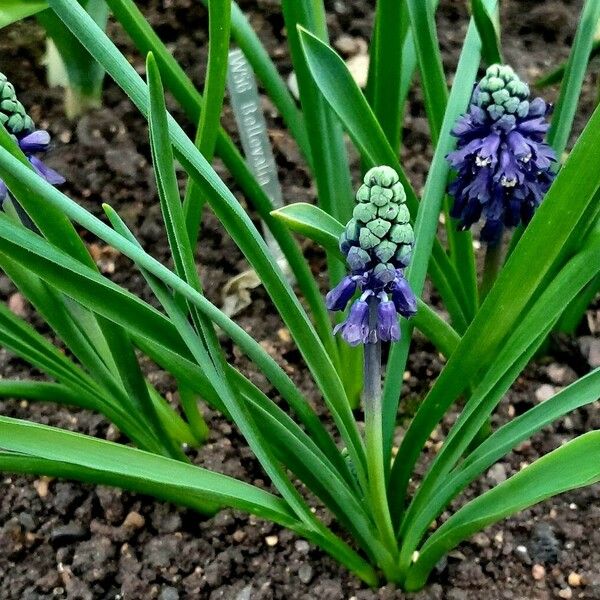
Plant Overview
Known as the Turkestan Bellevalia, this rare bulbous beauty hails from the rocky slopes and high-altitude meadows of Central Asia. While it shares a family tree with the common Grape Hyacinth, it offers a much more "architectural" and moody aesthetic, featuring colors that shift like a desert twilight. It is a tough, cold-hardy survivor that brings a touch of the ancient Silk Road to modern spring gardens.
🔍 How to Identify
- 🌸 The Bloom: A dense, upright spike (raceme) of small, bell-shaped flowers. They typically emerge as pale, lime-tinted buds and mature into a sophisticated smoky violet or metallic blue-grey.
- 🍃 The Foliage: Thick, strap-like leaves that form a basal rosette. The leaves are often broader than those of a standard Hyacinth and have a subtle, waxy grey-green finish.
- 📏 The Stature: A compact plant, usually standing 8 to 12 inches tall. Its flower stems are remarkably sturdy, standing straight even after heavy spring rain.
🏡 In Your Garden
- ⛰️ Mountain Roots: Because it originates from rugged terrain, this plant demands "sharp" drainage. If the soil stays soggy during its winter dormancy, the bulb is likely to rot. Mixing grit or perlite into your planting hole is a must for success.
- 💤 The Summer Vanishing Act: Like many spring bulbs, it is ephemeral. Once the flowering ends in late spring, the foliage will wither and disappear entirely by mid-summer. Don’t worry—it’s not dead; it’s just sleeping underground to escape the heat.
- ☀️ Sun Seeker: To get those deep, metallic flower colors, place it in a spot that receives full morning sun. It can handle partial shade, but the stems may stretch and become floppy.
⚠️ Safety & Toxicity
- 🐾 Mildly Toxic: Like many members of the Asparagus family, the bulbs contain saponins. If ingested by dogs, cats, or curious children, it can cause nausea and digestive upset.
- 🧤 Hand Safety: The sap within the leaves and bulbs can occasionally cause mild skin irritation for those with sensitive skin. It is recommended to wear gloves when dividing the bulbs in the autumn.
✨ Fun Fact
Bellevalia was named in honor of the 16th-century French botanist Pierre Richer de Belleval, who founded one of the world’s oldest botanical gardens. For centuries, these plants were confused with Grape Hyacinths (Muscari), but they were eventually given their own genus because their flowers are open-mouthed bells, whereas Muscari flowers have "pinched" or constricted openings.

Detailed Care Instructions








