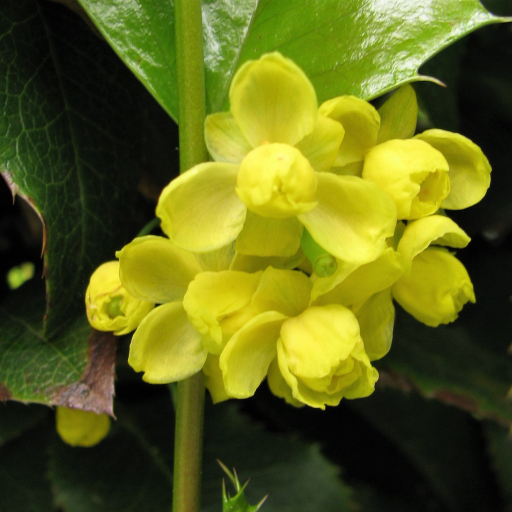
Plant Overview
Often called the "Creeping Mahonia" or "Dwarf Oregon Grape," this low-growing evergreen is a rugged survivor of the American West. It creates a stunning groundcover that shifts colors with the seasons, moving from bright green to deep burgundy as the weather cools. It is a favorite for gardeners who want a "wild" look that requires almost zero maintenance once established.
🔍 How to Identify
- 🍃 The Foliage: The leaves look remarkably like holly—leathery, matte-green, and edged with sharp, spine-like teeth. In winter, these leaves often turn a beautiful bronze or purple hue.
- 🟡 Spring Blooms: In early spring, it produces dense, upright clusters of bright lemon-yellow flowers that have a faint, sweet fragrance.
- 🍇 The "Grapes": By late summer, the flowers give way to clusters of dark, dusty-blue berries that look like tiny frosted grapes.
🏡 In Your Garden
- 🌱 Slow and Steady: Unlike invasive groundcovers, this plant spreads slowly via underground stems (rhizomes). This makes it excellent for stabilizing soil on slopes without it taking over your entire yard.
- 🐝 Wildlife Buffet: It is a vital early-season nectar source for bees and butterflies. Later in the year, the tart berries provide a feast for songbirds like robins and waxwings.
- Shadow Dweller:** It thrives in the "difficult" spots of a garden—dry shade under large trees where most other plants would wither.
⚠️ Safety & Toxicity
- 🟢 Safe for Foraging: The berries are technically edible but very tart; they are best used in jellies or jams rather than eaten raw.
- 🐕 Pet & Human Caution: While not considered "deadly," the roots and stems contain berberine. If ingested in large quantities, it can cause stomach upset or nausea in pets and curious children. The prickly leaves are also a natural deterrent—most animals (and toddlers) will learn to avoid touching them after one poke.
✨ Fun Fact
Indigenous peoples of the West have used the bright yellow inner bark of the roots for centuries to create a vivid yellow dye for baskets and clothing, while the berries were used to produce a deep purple tint.

Detailed Care Instructions
To grow Berberis Repens, also known as the Creeping Oregon Grape, you can follow these steps:
- Choose the right location: Berberis Repens prefers partial shade to full sun, although it can tolerate shade as well. The soil should be well-draining, slightly acidic to neutral, and rich in organic matter. Avoid waterlogged or heavy clay soils.
- Prepare the soil: Before planting, prepare the soil by removing any weeds or grasses and loosening it with a garden fork or tiller. Incorporate compost or well-rotted manure to improve drainage and fertility.
- Planting: Dig a hole that is as deep as the root ball and two to three times as wide. Place the plant in the hole, ensuring that the top of the root ball is level with or slightly above the soil level. Fill in the hole with soil and gently firm it around the plant.
- Watering: Water the plant deeply after planting to help it establish its root system. Keep the soil consistently moist, but not waterlogged. During dry periods, provide additional watering, especially in the first year.
- Mulching: Apply a layer of mulch, such as wood chips or compost, around the base of the plant. Mulching helps to retain moisture, suppress weeds, and regulate soil temperature.
- Pruning: Berberis Repens is a low-growing shrub, so minimal pruning is usually required. However, it can benefit from occasional trimming to maintain its shape and remove any dead, damaged, or overgrown branches. Prune in late winter or early spring before new growth begins.
- Fertilizing: Berberis Repens typically doesn't require much fertilization. However, you can apply a balanced fertilizer in early spring to encourage healthy growth. Follow the package instructions for application rates.
- Pests and diseases: Berberis Repens is generally resistant to most pests and diseases. However, keep an eye out for aphids, leaf miners, and rust. Regularly inspect the plant for any signs of damage or infestation and apply appropriate organic controls if necessary.
- Propagation: Berberis Repens can be propagated through stem cuttings or by dividing mature plants. Take cuttings in late spring or early summer and root them in a potting mix. Division can be done in early spring by carefully separating clumps of the plant.
By following these steps, you can successfully grow Berberis Repens and enjoy its attractive foliage and bright yellow flowers.

Place in a window with dappled sun or a spot in the middle of a room. Or directly in a window facing west or east.

To properly water this plant, one should pour water around the base of the plant until the soil is damp but not completely soaked. It is important to avoid getting water on the leaves as this can lead to disease and damage. It is recommended to water this plant deeply but infrequently, allowing the soil to dry out partially between waterings. Depending on the climate and environment, this plant may require watering once or twice a week. It is important to monitor the soil moisture level and adjust watering frequency accordingly to avoid over- or under-watering.
- Start by choosing a well-draining soil mix suitable for shrubs and perennials.
- Find a sunny location for your Berberis Repens plant, as it thrives in full sun to partial shade conditions.
- Before planting, prepare the soil by loosening it and removing any weeds or debris.
- Dig a hole that is twice as wide and deep as the plant's root ball.
- Gently remove the plant from its container and place it in the hole, ensuring that the top of the root ball is level with or slightly above the soil surface.
- Backfill the hole with the soil mix, pressing firmly to eliminate any air pockets.
- Water thoroughly after planting to settle the soil around the roots.
- Apply a balanced slow-release fertilizer according to the package instructions, ensuring even coverage.
- To promote healthy growth, fertilize your Berberis Repens plant in spring before new growth emerges.
- Water the plant deeply after fertilizing to help incorporate the nutrients into the soil.
- Avoid over-fertilizing, as it can lead to excessive growth and weak branches.
- Monitor the plant's growth and health throughout the growing season, making adjustments to the fertilizer application if necessary.
- Repeat the fertilization process annually for optimum growth and vigor.
The ideal soil for this plant should be well-draining and slightly acidic with a pH level ranging from 5.5 to 6.5. It should also be rich in organic matter and nutrients to ensure the plant's healthy growth and development. Additionally, the soil should not be prone to waterlogging as Berberis Repens is susceptible to root rot. A mix of sandy loam, peat moss, and perlite is recommended for this plant's soil mix.
Berberis Repens, commonly known as __, is a versatile perennial shrub that can be propagated through several methods including cuttings, layering, and division. Here is how you can propagate this plant:
- Propagation by Cuttings:
a. Select a healthy, disease-free branch that is about 4-6 inches long.
b. Using clean and sharp pruning shears, make a clean cut just below a leaf node.
c. Remove the lower leaves from the cutting, leaving a few at the top.
d. Dip the cut end of the stem in a rooting hormone powder to encourage root development.
e. Prepare a pot with a well-draining soil mix, preferably a combination of peat moss and perlite.
f. Create a hole in the soil and insert the cutting, pushing it about an inch deep.
g. Firm the soil around the cutting to ensure good contact.
h. Water the cutting thoroughly but avoid over-saturation, as it may cause rotting.
i. Place the pot in a warm and bright location with indirect sunlight.
j. Keep the soil consistently moist and mist the cutting regularly to maintain high humidity.
k. Within a few weeks, roots should start to form, and once the cutting is well-rooted, it can be transplanted into a larger container or directly into the garden.
- Propagation by Layering:
a. Identify a low-lying branch that can be bent towards the ground easily.
b. Choose a spot where the branch makes contact with the soil without any obstructions.
c. Remove the leaves or twigs from the part of the branch that will be buried in soil.
d. Use a sharp knife to make a small, shallow wound on the underside of the branch, just below a leaf node.
e. Gently bury the wounded section of the branch in a shallow trench filled with moist soil.
f. Secure the branch in place using gardening stakes or wires.
g. Keep the soil consistently moist and provide occasional light fertilization to promote root development.
h. After a few months, the layered branch should have developed sufficient roots.
i. Sever the newly rooted branch from the parent plant, and transplant it to its desired location.
- Propagation by Division:
a. As this method requires an established plant, you will need to have a mature Berberis Repens plant in your garden.
b. Carefully dig up the plant, taking care not to damage the roots.
c. Once the plant is out of the ground, gently separate the root clump into smaller sections, ensuring each division has a healthy portion of roots and shoots.
d. Replant the divisions at the same depth they were previously growing.
e. Water the divisions thoroughly and provide regular care until they become well-established.
With these propagation methods, you can successfully propagate Berberis Repens and expand your collection of these beautiful shrubs.








