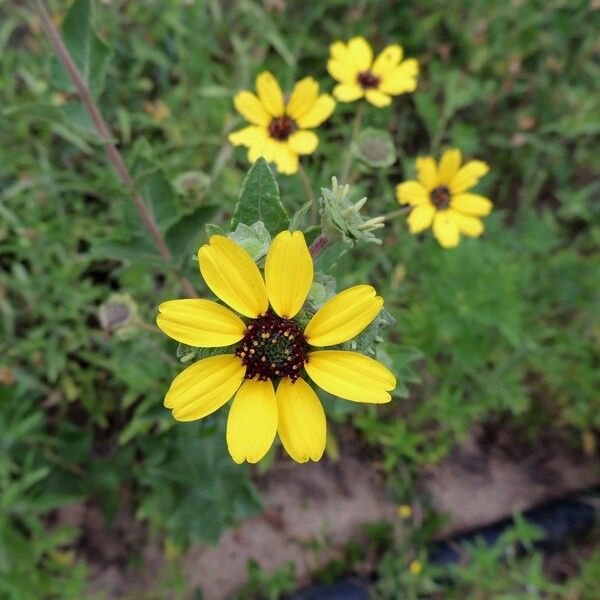
Plant Overview
Known affectionately as the Texas Greeneyes, this resilient wildflower is a hidden gem of the Southern United States. While it might look like a simple daisy at first glance, its striking emerald-green center gives it an "alien" charm that stands out in any prairie or garden. It is a tough-as-nails perennial that has evolved to thrive in the heat, dancing through the winds of open woodlands and grassy fields.
🔍 How to Identify
- 🟢 The "Green Eye": Unlike many daisies with brown or yellow centers, this plant features a prominent, flattened disk of lime-green florets in the middle.
- 🌻 Ray Petals: It typically sports exactly eight bright yellow petals (ray florets) that are widely spaced, giving the flower a star-like appearance.
- 🍃 Velvety Foliage: The leaves are heart-shaped or oblong with scalloped (wavy) edges, often covered in soft, fine hairs that give them a grayish-green, felt-like texture.
🏡 In Your Garden
- ☀️ Sun Seeker: This plant is a sun-lover through and through. It thrives in bright, open spots and actually becomes leggy and "sad" if tucked away in too much shade.
- 🏜️ The Taproot Rule: Texas Greeneyes develops a deep, sturdy taproot. This makes it incredibly drought-tolerant and hardy, but it also means it "hates" being transplanted. Pick its permanent home carefully, as it won't forgive a move!
- 🦋 Pollinator Magnet: If you want a buzzing garden, this is your plant. It is a high-value nectar source for native bees and small butterflies, acting as a reliable refueling station throughout the summer.
⚠️ Safety & Toxicity
- ✅ Safe Status: Berlandiera betonicifolia is generally considered non-toxic to humans, cats, and dogs.
- 🧤 Mild Irritation: While not poisonous, the fuzzy texture of the leaves can sometimes be slightly irritating to very sensitive skin or if ingested in large quantities by curious pets. It’s best used as an ornamental rather than a culinary herb.
✨ Fun Fact
The genus Berlandiera is often called the "Chocolate Flower" genus. While its cousin (Berlandiera lyrata) is famous for smelling exactly like a Hershey’s bar, the Texas Greeneyes occasionally mimics this trait, releasing a faint, sweet cocoa scent on warm, humid mornings!

Detailed Care Instructions
To grow Berlandiera betonicifolia, also known as chocolate flower or chocolate daisy, here are the steps you can follow:
- Climate: Ensure that your region has a suitable climate for growing this plant. Berlandiera betonicifolia is native to the southwestern United States and Mexico and thrives in dry, arid conditions.
- Soil: The plant prefers well-draining soil. You can amend your soil with sand or gravel to improve drainage if needed. It can also tolerate poor soil conditions.
- Sunlight: Provide full sun exposure to the plant. It needs at least 6 hours of direct sunlight daily for optimal growth.
- Planting: Plant the seeds directly in the ground after the last frost date in your area. Alternatively, you can start seeds indoors 4-6 weeks before the last frost and transplant them outdoors after the risk of frost has passed.
- Watering: While Berlandiera betonicifolia is drought-tolerant, it still needs regular watering until it gets established. Water deeply once or twice a week during the first growing season. Afterward, it can tolerate dry conditions but may still benefit from occasional watering during prolonged droughts.
- Fertilizing: This plant does not typically require fertilizer. However, if you feel the need to feed it, apply a low-nitrogen, balanced fertilizer once or twice in the growing season.
- Pruning: Berlandiera betonicifolia doesn't require extensive pruning. However, you can trim it back lightly in early spring to maintain a compact and tidy shape.
- Pests and diseases: These plants are generally resistant to pests and diseases. However, keep an eye out for common garden pests like aphids, slugs, or snails, and treat them accordingly if an infestation occurs.
- Propagation: Besides growing from seeds, you can also propagate Berlandiera betonicifolia through division. Dig up an established plant in early spring, divide it into smaller clumps, and replant them in well-prepared soil.
Remember, it's always important to research and understand the specific growing requirements for any plant to ensure success.
- Check the soil moisture level: Before watering the Berlandiera Betonicifolia, check the soil's moisture level by inserting your finger or a moisture meter into the soil. If the top inch of soil feels dry, it is time to water the plant.
- Choose the right time: Water the Berlandiera Betonicifolia early in the morning or late in the evening when the sun is not too hot. Watering during hotter parts of the day can result in water evaporation, which can leave the plant dehydrated.
- Water the base of the plant: Water the Berlandiera Betonicifolia at the base of the plant rather than overhead. Overhead watering can result in wet foliage, which can lead to fungal diseases.
- Apply water slowly: Apply water slowly, allowing it to soak into the soil gradually, rather than rushing the water. This helps the plant's roots to absorb water efficiently and avoids wastage.
- Use a watering can or hose rather than sprinklers: Use a watering can or hose rather than sprinklers to water the Berlandiera Betonicifolia plant. This enables you to control the water flow and water only the plant's base.
- Water consistently: Water the Berlandiera Betonicifolia plant consistently every four to five days or when the soil's top inch feels dry. Ensure that the soil is consistently moist but not waterlogged.
- Adjust watering during different seasons: Adjust the watering frequency during different seasons. During hot summers, you may need to water the plant more frequently, whereas in cooler months, you may need to water less frequently.
To fertilize this particular plant, scatter a slow-release organic fertilizer evenly around the base of the plant in early spring before new growth appears. Be sure to follow the manufacturer's instructions for the amount of fertilizer to use. For an extra boost of growth, you can also apply a liquid fertilizer every two weeks during the growing season. Avoid over-fertilizing as it can harm the plant.
Berlandiera betonicifolia is best grown in well-draining, nutrient-rich soil that is slightly acidic to neutral in pH. It is important to ensure that the soil has good drainage because the plant does not tolerate standing water or waterlogged soil. A soil mix that includes a combination of sand, loam, and peat moss can provide the ideal growing conditions for this plant. Adding organic matter to the soil can help improve its fertility and water-holding capacity. However, it is important to avoid over-fertilization as excess nutrients can cause problems for the plant. Regular watering can help keep the soil moist without saturating it.
There are a few methods for propagating this plant. One method is by taking stem cuttings. First, choose a healthy stem with several leaves and a node (where the leaves attach to the stem). Make a clean cut just below the node, and remove any leaves from the lower half of the stem. Dip the cut end of the stem in rooting hormone powder, and plant it in a pot filled with moist, well-draining soil. Keep the soil moist and place the pot in a bright, warm location. After a few weeks, you should see new growth, which indicates that roots have formed.
Another method for propagating this plant is by dividing the root ball. This is best done in early spring, before the plant begins to actively grow. Carefully dig up the plant and gently separate the roots into smaller clumps, being careful not to damage the roots. Replant each clump in a new location, making sure to water it well.
A third method for propagating this plant is by collecting and planting the seeds. Wait until the seed pods have turned brown and dried on the plant. Collect the pods and remove the seeds. Plant the seeds in a pot filled with moist, well-draining soil and cover with a thin layer of soil. Keep the soil moist and place the pot in a bright, warm location. The seeds should germinate within a few weeks.








