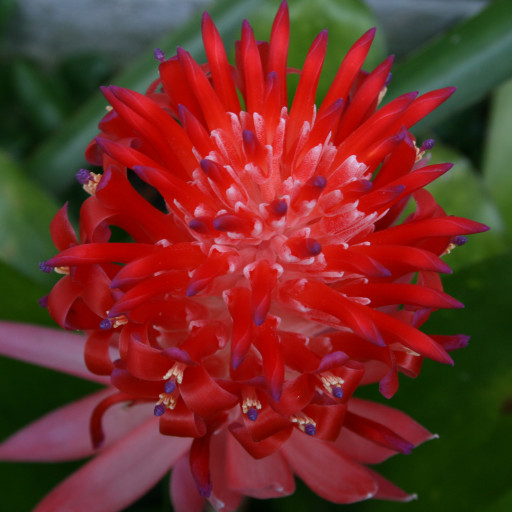
Plant Overview
Known as the Flaming Torch or the Foolproof Plant, Billbergia pyramidalis is a tropical showstopper that looks like a slow-motion explosion of color. Native to the rainforests of Brazil, it has earned its "foolproof" nickname because it survives neglect that would wither most other bromeliads. While the spectacular bloom is relatively short-lived, it provides one of the most intense neon-pink and purple displays in the plant kingdom.
🔍 How to Identify
- 🌿 The Rosette: Stiff, broad, lime-green leaves are arranged in a funnel shape, forming a central "cup" or tank designed to catch and hold water.
- 🔥 The Inflorescence: A stout, upright flower spike emerges from the center, topped with a dense, pyramid-shaped cluster of brilliant scarlet-to-pink bracts.
- 💜 The Flowers: Look closely at the "torch" to see tiny, iridescent purple-tipped flowers peeking out, creating a striking neon contrast against the red.
🏡 In Your Garden
- 💧 The Central Tank: This plant is an epiphyte (air plant) in the wild, meaning it drinks primarily through its "tank." Instead of heavy soil watering, focus on keeping the central cup filled with fresh water, which mimics how it collects rain in tree canopies.
- 🌱 The Colony Builder: While a single plant is beautiful, this species is famous for "clumping." It spreads quickly via underground runners and "pups," eventually forming a lush, architectural carpet of green and fire-red.
⚠️ Safety & Toxicity
- ✅ Non-Toxic: Billbergia pyramidalis is generally considered safe and non-toxic for both curious cats and dogs, as well as children.
- ⚔️ Serrated Edges: While not poisonous, the leaves can have very fine, saw-like teeth along the edges. Handle with care during transplanting to avoid minor skin scratches.
✨ Fun Fact
In its native habitat, the central water tank of the Flaming Torch acts as a miniature ecosystem (a phytotelma), providing a home and a drinking hole for tiny tree frogs and specialized insects!

Detailed Care Instructions
| Lighting | Full Sun |
| Hardiness Zones | 9B - 11 |
Here are some guidelines to help you grow Billbergia pyramidalis:
- Light: Place your plant in bright, indirect light. It can handle some direct sunlight, but too much can scorch the leaves. A north or east-facing window is ideal.
- Temperature: Keep the plant in a temperature range of 65-80°F (18-27°C). It can tolerate slightly cooler temperatures but may show signs of stress if exposed to frost or extreme heat.
- Watering: Billbergia pyramidalis prefers consistent moisture. Keep the soil evenly moist but avoid overwatering, as it can cause root rot. Water when the top inch of soil feels dry, and ensure good drainage to prevent waterlogging.
- Humidity: These plants appreciate humidity levels of around 50-60%. You can increase humidity by misting the leaves regularly or placing a tray of water near the plant.
- Soil: Use a well-draining potting mix rich in organic matter. A mix of peat moss, perlite, and orchid bark can provide good drainage while retaining moisture.
- Fertilizer: Feed your Billbergia pyramidalis with a balanced liquid fertilizer once a month during the growing season (spring to early fall). Dilute the fertilizer to half the recommended strength.
- Repotting: Billbergia pyramidalis doesn't require frequent repotting. However, if the plant becomes crowded, you can repot it in a slightly larger container using fresh potting mix.
- Propagation: You can propagate Billbergia pyramidalis through "pups" or offsets. Wait for the pups to have a few sets of leaves before separating them from the parent plant. Plant the pups in their own pots using the same potting mix as for adult plants.
Remember to keep an eye out for pests, such as aphids or mealybugs, and treat them promptly if detected. Enjoy watching your Billbergia pyramidalis grow and thrive!

Place in a dark room with little light, like a dark bedroom or a spot far away from a window or directly in a north-facing window.

To properly water this plant, you should first ensure that the soil is completely dry before watering. When watering, be sure to pour water directly onto the soil, being careful not to get any water on the leaves as this can cause rot. Water thoroughly, allowing any excess water to drain out of the pot. It is important to maintain proper drainage and avoid letting the plant sit in standing water, as this can also lead to root rot. Watering frequency will depend on factors such as the size of the pot, amount of sunlight and humidity, but once per week is a good starting point.
To properly fertilize this plant, you should choose a balanced fertilizer with equal parts nitrogen, phosphorus, and potassium. This can be in the form of a liquid or slow-release granules. Dilute liquid fertilizers according to the manufacturer's instructions and apply once a month during the growing season. With granules, apply at the beginning of the growing season, and then again midway through the season. Avoid over-fertilizing, as this can lead to damage and reduced growth. Always water the plant thoroughly before and after fertilizing to ensure proper absorption.
Billbergia Pyramidalis plant is a species of plant that require well-draining soil that has good aeration. The soil should be slightly acidic in nature with a pH range of 5.6-6.5. The texture of the soil should be porous and loose to allow good water retention.
The recommended soil for this plant is a mixture of peat moss, perlite, and coarse sand. The peat moss helps the soil retain moisture, perlite aids in drainage, and coarse sand helps to improve the soil’s structure while preventing it from becoming compacted.
It is important to avoid using heavy, nutrient-rich soils that can retain too much moisture, leading to root rot and other fungal diseases. Additionally, regular watering is necessary to keep the soil moist but not soggy.
It is recommended to repot the Billbergia Pyramidalis plant every 2-3 years to replace the old soil with fresh soil mixture.
To propagate this plant, begin by separating the offsets that grow around the base of the mother plant. Use a sharp, clean knife to cut the offsets away from the main plant, making sure that each offset has its own roots and at least two or three leaves.
After separating the offsets, allow them to dry for a few days before planting them in a well-draining potting mix. Water the newly potted offsets sparingly, allowing the soil to dry out slightly between waterings.
It is important to place the newly potted offsets in a warm, bright location and to avoid direct sunlight until they have had a chance to establish themselves. Over time, the offsets will grow into mature plants and begin producing their own offsets, continuing the propagation process.
Common pests of the flaming torch include Scale insect, mealybugs, spider mites. Make a habit of checking your flaming torch frequently for pests so that any infestations can be caught and managed early.








