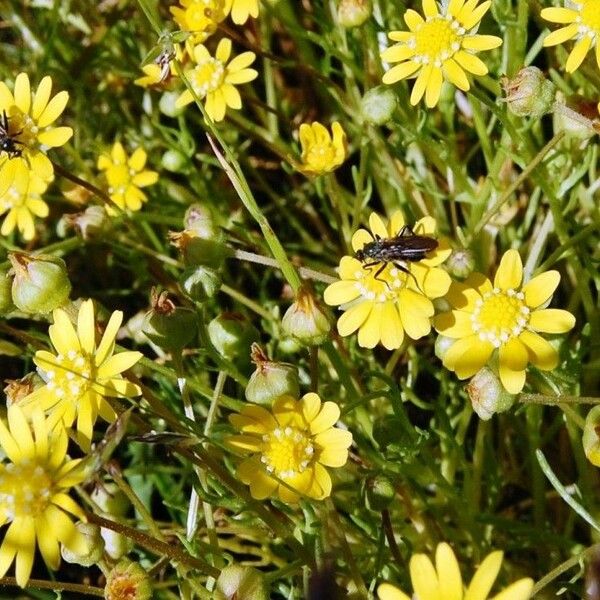
Plant Overview
Known affectionately as Sonoma Sunshine, this rare California native is like a tiny burst of light in the damp meadows of the North Bay. It is a specialized annual herb that tells the story of vanishing vernal pools—temporary seasonal wetlands that host some of the world's most unique life. Finding this gold-colored bloom is a true treat for hikers, signaling that spring has officially arrived in the Santa Rosa Plain.
🔍 How to Identify
- 🌼 Sunny Blooms: The plant features small, daisy-like flower heads with bright yellow ray and disk florets that open wide to soak up the morning sun.
- 🌿 Feathery Foliage: Its leaves are narrow and deeply divided into thin, linear lobes, giving the plant a delicate, almost airy appearance against the mud.
- 📏 Low Stature: It is a modest grower, typically reaching only 4 to 12 inches in height, often forming golden "islands" in drying puddles.
🏡 In Your Garden
- 💧 Vernal Pool Specialist: This plant is a "hydrophytic" specialist, meaning it evolved to live in heavy clay soils that are completely submerged in winter and bone-dry by summer. It cannot survive in standard garden soil or consistent irrigation.
- 🛡️ Endangered Status: Because its habitat is so specific and shrinking, Sonoma Sunshine is a federally endangered species. It is not available for commercial landscaping; instead, it is a plant to be admired in its natural habitat under the protection of conservation laws.
⚠️ Safety & Toxicity
- ✅ Non-Toxic: There are no known toxic compounds in Sonoma Sunshine that pose a threat to curious pets or wandering livestock.
- 🚫 Protection Warning: The primary "safety" concern is for the plant itself. Because it is so rare, disturbing the soil or picking the flowers is illegal in many areas. It is best to stick to the trails and keep dogs on a leash to avoid crushing these fragile survivors.
✨ Fun Fact
The name "Stickyseed" comes from a clever survival trick: when the seeds get wet, they produce a thick, mucilaginous (gooey) coating. This biological glue allows the seeds to hitch a ride on the feet or feathers of migrating ducks, helping the plant "fly" to distant vernal pools!

Detailed Care Instructions
To grow Blennosperma bakeri, also known as Baker's stickyseed, you can follow these steps:
- Seeds: Obtain Blennosperma bakeri seeds from a reputable seed supplier or botanical garden. Make sure the seeds are fresh and viable.
- Planting time: Sow the seeds in early spring, after the threat of frost has passed. Blennosperma bakeri prefers a cool season for germination and establishment.
- Soil: Prepare a well-draining soil mix. Blennosperma bakeri prefers sandy or loamy soil with a pH range between 5.5 and 7.5. If your soil is heavy clay, consider amending it with compost or sand to improve drainage.
- Planting location: Choose a sunny spot in your garden. Blennosperma bakeri requires full sun to thrive and produce abundant flowers.
- Sowing seeds: Scatter the Blennosperma bakeri seeds thinly over the prepared soil surface. Lightly rake in the seeds, ensuring they are covered with a thin layer of soil.
- Watering: Keep the soil consistently moist but not waterlogged. Water the newly sown seeds gently using a watering can or a misting nozzle to avoid displacing the seeds.
- Germination: Blennosperma bakeri seeds typically germinate within 2-4 weeks. Continue to keep the soil moist during this period.
- Thinning: Once the seedlings are large enough to handle, thin them out to maintain a spacing of about 6-8 inches between plants. This will provide enough room for the plants to grow and spread.
- Maintenance: Weed the area regularly to prevent competition for nutrients and water. Water the plants during dry spells and fertilize with a balanced, slow-release fertilizer once a month during the growing season.
- Pests and diseases: Blennosperma bakeri is relatively pest and disease-free. However, watch out for common garden pests such as aphids or slugs. Use appropriate organic pest control methods if necessary.
- Harvesting: Blennosperma bakeri produces delicate, daisy-like flowers in shades of white, yellow, or pink. Enjoy their beauty and consider cutting some for floral arrangements.
With proper care and maintenance, Blennosperma bakeri should thrive and provide you with a lovely display of flowers in your garden.

Place in a bright room that is sun drenched almost all day. Or directly in a south-facing window.

To ensure proper hydration for the plant, it is advised to water the Blennosperma Bakeri using a watering can or a hose with a gentle flow. It is important to avoid overwatering, as this can lead to root rot. The soil should be moist but not waterlogged. The frequency of watering will depend on factors such as the temperature, humidity, and amount of sunlight the plant is receiving, but generally, it is recommended to water the plant once a week. It is also important to check the drainage of the pot or planting area to ensure excess water can escape. Avoid getting water on the leaves or flowers, as this can lead to disease or damage.
To provide adequate nutrients to the Blennosperma Bakeri plant, use a balanced fertilizer with equal parts nitrogen, phosphorus, and potassium. Avoid over-fertilizing as this can lead to excessive growth and reduced plant health. Apply the fertilizer to the soil around the base of the plant, following the manufacturer's recommended dosage. Water the plant immediately after fertilizing to ensure the nutrients are absorbed. It is best to fertilize during the plant's active growth season, typically in the spring or early summer.
Blennosperma Bakeri plant prefers a well-draining soil that is rich in nutrients. It is recommended to use a soil mix that is composed of equal parts of loam, sand, and peat moss. The loam helps to provide a good balance of nutrients and promotes root development, while the sand helps to improve drainage and aeration of the soil. Peat moss helps to retain moisture and improve the overall texture of the soil. It is also important to ensure that the soil pH is slightly acidic, between 6.0 and 6.5, to promote optimal growth and health of the plant. Additionally, adding perlite or vermiculite to the soil mix can also improve drainage and aeration.
Blennosperma Bakeri can be propagated by taking stem cuttings from healthy parent plants. The stem cuttings should be taken from the middle or top part of the plant and should be around 4-6 inches long. The leaves on the lower part of the cutting should be removed and a rooting hormone can be applied to the cut end to encourage rooting. The cutting should then be planted in a well-draining soil mix and kept moist until roots have formed. Once roots have formed, the new plant can be potted up or planted in the ground. It is also possible to propagate Blennosperma Bakeri by dividing mature plants. This should be done in early spring or fall by carefully separating the roots and planting the new divisions in their own containers or in the ground.








