Plant Overview
Known as "Good-King-Henry," "Poor-man's Asparagus," or "Lincolnshire Spinach," this resilient perennial was a staple in European vegetable gardens for centuries before modern spinach took over. It is a rugged, reliable plant that thrives where more delicate greens might fail. Historically, it was a symbol of the "cottage garden," providing a steady source of nutrition from early spring through summer.
🔍 How to Identify
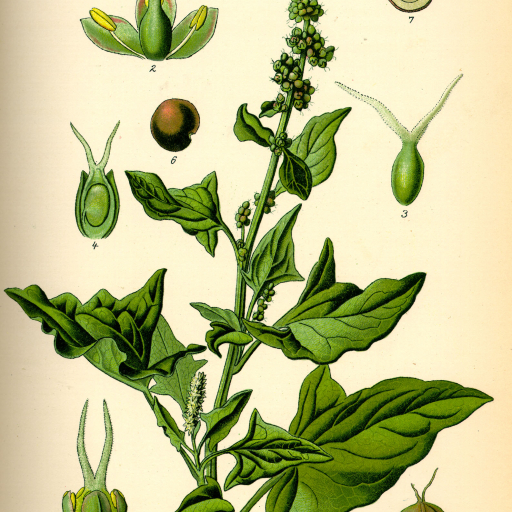
- 🍃 Arrowhead Foliage: The leaves are distinctly triangular or "hastate" (shaped like a spearhead) with slightly wavy margins and long stalks.
- 🌫️ Mealy Texture: The undersides of the leaves often feel slightly waxy or "mealy," as if they have been dusted with a fine white powder.
- 🌾 Green Flower Spikes: It produces upright, leafless spikes covered in tiny, inconspicuous greenish-yellow flowers that resemble miniature, unpolished grains.
🏡 In Your Garden
- 🌱 The Perennial Advantage: Unlike annual spinach that bolts in the heat, Good-King-Henry is a long-lived perennial. It develops a deep, thick taproot that allows it to survive harsh winters and return every spring without replanting.
- 🍴 Soil Preferences: It is a "heavy feeder" and loves nitrogen. In the wild, you’ll often find it growing near old stables or compost heaps where the soil is rich and disturbed. In a garden setting, it performs best in semi-shade and well-manured earth.
⚠️ Safety & Toxicity
- 🥗 Safe for Consumption: The leaves and young shoots are edible and packed with iron. However, like spinach and rhubarb, it contains oxalic acid. People prone to kidney stones or gout should enjoy this plant in moderation.
- 🐾 Pet Caution: While not considered high-risk, the oxalate content can cause stomach upset or drooling in cats and dogs if they ingest a significant amount of the raw foliage.
✨ Fun Fact
The "King Henry" in its name doesn't refer to a British monarch! It likely stems from the German "Guter Heinrich" to distinguish the plant from "Bad Henry" (Wild Mercury), a poisonous weed that looks somewhat similar. In the 16th century, it was also used as a medicinal ointment to treat skin sores.

Detailed Care Instructions
To grow Blitum Bonus-henricus, also known as Good King Henry, follow these steps:
- Choose a suitable location: Good King Henry prefers full sun to partial shade. Select a well-drained area with fertile soil.
- Soil preparation: Prepare the soil by loosening it and removing any weeds or debris. Good King Henry prefers rich, moist soil. If your soil is poor, amend it with compost or well-rotted manure to improve its fertility.
- Sowing the seeds: Blitum Bonus-henricus can be directly sown in the garden or started indoors and then transplanted. Sow the seeds in early spring, usually around March or April, when the soil temperature is around 12-15°C (54-59°F). Plant the seeds 1-2 cm (0.5-1 inch) deep and space them around 30-45 cm (12-18 inches) apart.
- Watering: Keep the soil evenly moist to promote germination and establishment. Water deeply once or twice a week, depending on the weather conditions. Avoid overwatering, as this can lead to fungal diseases.
- Thinning: If you sow the seeds directly in the garden, thin out the seedlings once they reach a few centimeters tall. Space them around 30-45 cm (12-18 inches) apart to give each plant enough room to grow.
- Mulching and weed control: Apply a layer of organic mulch, such as straw or wood chips, around the plants to help retain soil moisture, suppress weed growth, and keep the temperature balanced.
- Fertilization: Good King Henry generally doesn't require excessive fertilization. However, applying a balanced organic fertilizer once or twice during the growing season can enhance growth and yield.
- Harvesting: Harvest the tender young shoots before they become fibrous and tough. You can begin harvesting around 6-8 weeks after sowing. Cut the leaves 5-10 cm (2-4 inches) above the crown to encourage regrowth. Regular harvesting promotes more leaves and prolongs the plant's productivity.
- Pest and disease control: Good King Henry is relatively pest-resistant, but keep an eye out for slugs and snails. If you notice any infestations, use environmentally friendly methods to control them. Additionally, practice good garden hygiene by removing any diseased or fallen leaves to prevent the spread of diseases.
By following these steps, you can successfully grow Blitum Bonus-henricus and enjoy its tasty and nutritious leaves.
Blitum Bonus-henricus can be watered by using a watering can or hose to provide a steady stream of water to the soil around its base. It is important to ensure that the soil is moist but not waterlogged, as this can lead to root rot. Depending on the weather and soil conditions, watering may need to be adjusted throughout the growing season to ensure the plant receives adequate moisture. It is also important to avoid getting water on the leaves or stem of the plant, as this can promote the growth of fungal diseases.
To fertilize this plant, first ensure that the soil pH is between 6.0-7.0. Apply a slow-release 10-10-10 fertilizer, following the package instructions for dosage and frequency. Alternatively, you can use compost or well-rotted manure as a natural fertilizer. Apply the fertilizer or compost after the plant has started to grow and again in mid-summer. Avoid over-fertilizing, as this can lead to excessive foliage growth and reduced fruit production.
Blitum Bonus-henricus plant prefers a well-draining, nutrient-rich soil that is slightly acidic to neutral in pH. The soil should be a combination of organic matter, sand, and loam to ensure proper drainage and moisture retention. It is important to avoid using heavy clay soils as they can hold onto excess water, which can lead to root rot. Additionally, the soil should be fertilized regularly with a balanced fertilizer to provide the necessary nutrients for the plant's growth.
Blitum Bonus-henricus can be propagated through seed starting or division of mature plants. To propagate through seed starting, sow the seeds in a pot or seed tray and cover them lightly with soil. Keep the soil moist and maintain a temperature around 65-70°F. The seeds should germinate in about 10-14 days. Once the seedlings have grown a few sets of true leaves, they can be transplanted into individual pots or the garden.
To propagate through division, wait until the plant has matured and developed several sets of leaves and a strong root system. Carefully dig up the entire plant and use a clean, sharp knife to cut the main stem into several smaller sections, each with a good portion of roots. Replant each section in moist soil at the same depth it was previously growing. Keep the soil moist and protect the new plantings from direct sunlight until they have established.