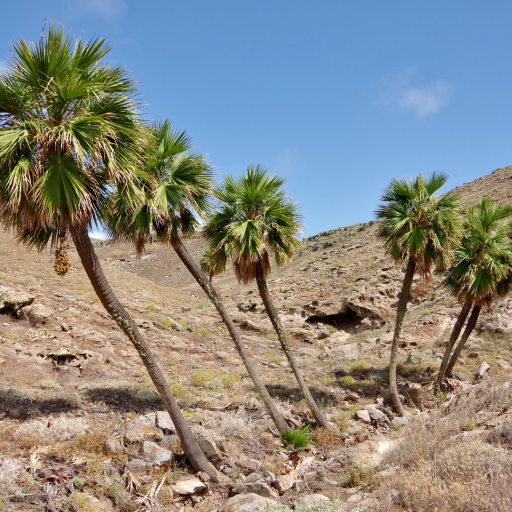
Plant Overview
Known as the Guadalupe Palm, this resilient beauty hails from the rugged volcanic cliffs of Guadalupe Island off the coast of Baja California. It is a true survivor, celebrated by landscapers for its stout, formal appearance and its surprisingly sweet, date-like fruit. Unlike many of its cousins that tower into the clouds, the Guadalupe Palm stays at a manageable height, making it a perfect "stately" addition to smaller Mediterranean-style gardens.
🔍 How to Identify
- 🌿 The Fronds: It features massive, stiff, fan-shaped leaves (costapalmate) that are a distinct light green to slightly glaucous blue-green, lacking the "teeth" found on many other palm stems.
- 🐘 The Trunk: A thick, solitary trunk that starts off "shaggy" with old leaf bases but matures into a clean, smooth, gray column with visible horizontal rings.
- 🍇 The Clusters: It produces spectacular, long-arching flower stalks that transform into heavy, pendulous bunches of round, marble-sized black fruits.
🏡 In Your Garden
- 🏝️ Coastal Warrior: This palm is incredibly tough; it laughs at salt spray and high winds, making it an ideal choice for seaside homes where other plants might wither.
- 🚿 Water Nuance: While it is exceptionally drought-tolerant once established, it is one of the few desert-style palms that actually "pops" with a bit of extra water, growing faster and keeping its lower fronds green for longer.
- ☀️ Sun Lover: It craves direct sunlight to maintain its structural integrity; if grown in too much shade, the beautiful fan leaves can become leggy and weak.
⚠️ Safety & Toxicity
- ✅ Safe Status: The Guadalupe Palm is non-toxic to humans, cats, and dogs.
- 🍴 Edible Fruit: As the name edulis suggests, the pulp of the fruit is edible and quite tasty, often compared to a mild date or a sweet prune, though the large seed inside occupies most of the space.
- 🧤 Handling: While it lacks the vicious thorns of the Washingtonia palm, the leaf edges can still be sharp, so gloves are recommended when pruning old fronds.
✨ Fun Fact
For over a century, the Guadalupe Palm was considered a "living ghost" on its home island. Feral goats introduced by sailors ate every single seedling that sprouted, meaning only the ancient trees survived. Since the goats were removed in the early 2000s, the "silent" forests are finally seeing their first babies in over 100 years!

Detailed Care Instructions
To grow a Brahea Edulis plant, also known as Guadalupe palm, you can follow these steps:
- Choose a suitable location: Guadalupe palm prefers full sun and well-draining soil. Select a location in your garden or yard that receives at least 6-8 hours of direct sunlight per day.
- Prepare the soil: Guadalupe palm thrives in sandy or loamy soil with good drainage. Amend heavy clay soils with sand or organic matter to improve drainage. Avoid waterlogged areas.
- Planting: Dig a hole that is slightly larger than the root ball of the plant. Place the plant in the hole, ensuring that the top of the root ball is level with or slightly above the soil surface. Backfill the hole with soil, gently pressing it down around the roots.
- Watering: Water the newly planted palm deeply and thoroughly, allowing the soil to become evenly moist. After the initial watering, water only when the top inch of soil feels dry. Overwatering can lead to root rot, so be careful not to keep the soil constantly wet.
- Mulching: Apply a layer of organic mulch, such as wood chips or shredded bark, around the base of the palm to help retain moisture, suppress weed growth, and regulate soil temperature. Ensure that the mulch does not touch the trunk of the palm to prevent rot.
- Fertilizing: Guadalupe palm is not a heavy feeder. You can apply a balanced slow-release fertilizer around the base of the plant in early spring. Follow the package instructions for the correct application rate.
- Pruning: Remove any dried or damaged fronds (leaves) as needed. However, avoid excessive pruning, as Guadalupe palms naturally retain their old fronds, which help protect the trunk from sunburn.
- Protection from cold: Guadalupe palm is hardy to USDA zones 9b-11. If you live in a colder climate, protect the plant from frost or freezing temperatures by covering it with a frost cloth or moving it to a sheltered location during the winter.
- Maintenance: Regularly check for pests, such as spider mites or scale insects, and take appropriate measures to control them if necessary. Monitor the soil moisture level and adjust watering accordingly. Guadalupe palms are generally low-maintenance plants.
By following these guidelines, you can successfully grow a Brahea Edulis plant and enjoy its attractive palm-like appearance in your garden.

Place in a bright room that is sun drenched almost all day. Or directly in a south-facing window.

The Brahea Edulis plant requires regular watering to thrive. It is recommended to water it deeply once or twice a week, allowing the soil to dry out slightly between watering sessions. The plant prefers well-draining soil, so ensure that the pot or garden bed has proper drainage. Overwatering may cause root rot and eventual death of the plant. If the leaves begin to turn yellow or droop, it may indicate that the plant is receiving either too much or too little water. It is important to avoid getting water on the leaves as it can lead to fungal growth. Use a watering can or hose with a gentle spray attachment to water the soil around the plant base. During periods of drought, the plant may require more frequent watering.
To fertilize this plant, it is recommended to use a slow-release fertilizer with a balanced NPK formulation. Apply the fertilizer around the base of the plant, being careful not to get it on the foliage or stem. Water the plant thoroughly after fertilizing to help distribute the nutrients evenly. Repeat this process in the spring and fall. Too much fertilizer can cause excessive growth and weaken the plant, so be sure to follow the instructions on the fertilizer package.
The ideal soil for the Brahea Edulis plant is loose, well-draining, and rich in organic matter. It should have a slightly acidic to neutral pH level between 5.5 and 7.5. The plant prefers moist but not waterlogged soil, and it does well in sandy loam or a loamy soil mix. Avoid heavy clay soils or soils with poor drainage, as they can lead to root rot. Adding compost or peat moss to the soil can increase its fertility and drainage. It is also recommended to mulch around the base of the plant to retain moisture in the soil and to provide nutrients as the mulch decomposes.
Brahea Edulis is a type of palm plant that can be propagated through several methods. One way to propagate it is through seed propagation. Collect the ripe fruit from the plant and remove the outer layer to reveal the seed. Soak the seed in water for a few days to soften the outer layer and then plant it in a well-draining soil mixture. Keep the soil moist and place the plant in a warm and bright location.
Another method of propagating Brahea Edulis is by dividing the plant. This can be done by carefully separating the pup from the parent plant and planting it in a pot or directly in the ground. Make sure the soil mixture is well-draining and water the plant regularly until it establishes.
Grafting is another method that can be used to propagate Brahea Edulis. This involves combining the top part of the plant with the rootstock of another plant to create a new plant. This method is typically done by experienced gardeners or horticulturists.
Overall, propagating Brahea Edulis can be done successfully by using any of these methods, as long as proper care and attention is given to the plant during the process.








