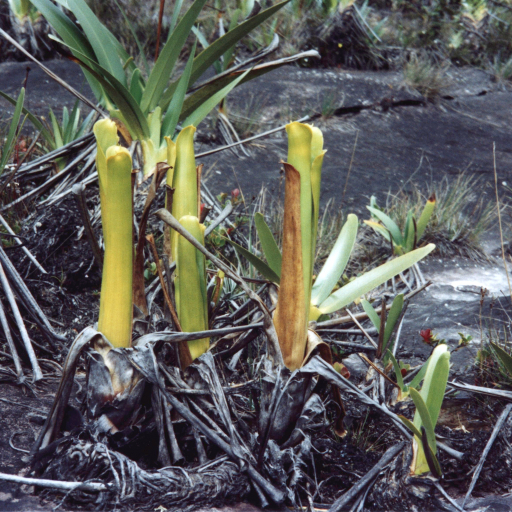
Plant Overview
Often called the "Carnivorous Bromeliad," Brocchinia reducta is a true botanical oddity from the misty, prehistoric "tepuis" (tabletop mountains) of South America. While most of its cousins in the pineapple family are content with soaking up sun and rain, this plant has evolved into a clever predator. It lures unsuspecting insects into a watery pitfall trap, turning the "Lost World" of its native habitat into a dinner plate.
🔍 How to Identify
- 🧪 Growth Habit: Unlike the wide, flared rosettes of common bromeliads, this species grows in a tight, vertical "chimney" or tube shape designed to catch and hold water.
- 🎨 Coloration: The leaves are usually a pale, yellowish-green. This neon-like hue isn't just for show; it acts as a visual lure for insects who mistake it for a giant flower or a source of nectar.
- ✨ The Wax Factor: The inner walls of the central tube are coated in a fine, slippery white powder. This loose wax is so slick that any insect landing on it immediately loses its footing and slides into the liquid below.
🏡 In Your Garden
- ☁️ Atmospheric Needs: Because it originates from high-altitude plateaus, it craves high humidity and very bright, intense light. If the light is too low, the plant will lose its tight tube shape and turn a dull green, losing its ability to "hunt."
- 💧 The Water Trap: Never let the central "tank" go dry. In a home setting, you must use distilled water, rainwater, or reverse osmosis water. These plants are highly sensitive to the minerals and salts found in tap water, which can "burn" their delicate digestive lining.
- 🏜️ Soil & Substrate: Do not plant it in standard potting soil. It requires a very loose, acidic, and nutrient-poor mix, such as long-fiber sphagnum moss and perlite. It gets its nutrients from the bugs it catches, not from its roots!
⚠️ Safety & Toxicity
- ✅ Safe for All: Brocchinia reducta is considered non-toxic to humans, cats, and dogs.
- 🦟 Pest Control: While it won't clear a room of flies, it is a "working" plant that will occasionally snack on stray gnats or small flies that wander into your indoor garden.
✨ Fun Fact
This plant is a master of deception! It reflects ultraviolet (UV) light more strongly than most other plants. Since many insects see in the UV spectrum, the Brocchinia reducta glows like a bright "landing strip" in the middle of the jungle, guiding prey directly into its trap.

Detailed Care Instructions
Brocchinia Reducta is a carnivorous bromeliad native to South America. It requires specific care and conditions to thrive. Here are some steps to help you grow this plant:
- Obtain a healthy plant: Purchase a Brocchinia Reducta from a reputable nursery or specialized online seller. Make sure it is a healthy specimen with no signs of disease or stress.
- Choose the right pot and soil: Brocchinia Reducta prefers a shallow pot with good drainage. Use a well-draining mix composed of sphagnum moss, orchid bark, and perlite. Avoid using regular garden soil, as it is not suitable for these plants.
- Provide the right lighting: Brocchinia Reducta requires bright, indirect light. Place the plant near a north or east-facing window, ensuring it receives at least 4-6 hours of bright light per day. Avoid direct sunlight, as it can scorch the plant.
- Maintain the appropriate temperature and humidity: Brocchinia Reducta prefers warm temperatures between 70-85°F (21-29°C). It also needs high humidity levels, around 50-60%. You can increase humidity by placing a tray with water near the plant or using a humidifier.
- Watering and feeding: Water your Brocchinia Reducta with distilled or rainwater to prevent mineral buildup. Keep the soil evenly moist, but not waterlogged. Ensure there is always a bit of water at the bottom of the pot, but do not let the plant sit in standing water. For feeding, occasional small insects or fish food pellets can be placed in the central rosette.
- Avoid using fertilizers: Brocchinia Reducta is a carnivorous plant, meaning it gains nutrients from capturing and digesting insects. It does not require additional fertilizers. Feeding the plant periodically with small insects or fish food pellets will provide the necessary nutrients.
- Maintain good air circulation: Proper airflow is essential to prevent fungal or bacterial diseases. Ensure the plant is not overcrowded and there is some space between the leaves for good air circulation.
- Pruning and dividing: Remove any dead or decaying leaves to maintain the plant's health and appearance. Brocchinia Reducta can also be divided by carefully separating offsets from the main plant during the growing season.
By following these steps and offering careful attention to its specific needs, you can successfully grow a healthy Brocchinia Reducta plant.

Place in a bright room that is sun drenched almost all day. Or directly in a south-facing window.

Brocchinia Reducta is a type of plant that requires proper watering to thrive. It is important to avoid using its common names while discussing its care. Here are some tips on how to water Brocchinia Reducta:
1. Water the plant regularly: Brocchinia Reducta needs to be watered on a regular basis. However, it is important to avoid overwatering the plant, which can lead to root rot.
2. Use distilled or rainwater: Brocchinia Reducta requires water with very low mineral content. Therefore, it is best to use distilled or rainwater when watering the plant.
3. Allow the soil to dry out between waterings: It is important to allow the soil to dry out between waterings. This will prevent the plant from getting too much water and help keep the roots healthy.
4. Water from the bottom: Brocchinia Reducta can be watered from the bottom. This involves placing the plant in a tray or saucer filled with water for about 20-30 minutes. This allows the plant to soak up water without getting too much.
5. Avoid getting water on the leaves: Brocchinia Reducta is a carnivorous plant that catches insects through its leaves. Therefore, it is important to avoid getting water on the leaves as this can wash away the digestive enzymes that are needed to break down insects.
By following these watering tips, you can keep your Brocchinia Reducta plant healthy and thriving.
- Use a balanced liquid fertilizer with a 10-10-10 NPK ratio.
- Dilute the fertilizer to half strength and apply it to the soil surrounding the plant.
- Apply the fertilizer once a month during the growing season (spring and summer).
- Water the plant thoroughly after fertilizing to ensure the nutrients are distributed evenly.
- Avoid fertilizing during the dormant season (fall and winter) to prevent stress on the plant.
Brocchinia Reducta plant prefers to grow in a well-draining soil that is slightly acidic in nature. The ideal soil for this plant is a mixture of peat moss or sphagnum moss, perlite or coarse sand, and pine bark. This soil mixture will not only provide good drainage but will also retain moisture and nutrients essential for the growth of this plant. It is important to avoid using heavy or compact soils as they can lead to root rot and hinder the growth of the plant. Additionally, the soil should be free of any contaminants or impurities that can harm the plant's health. Proper soil preparation is crucial for the successful growth of Brocchinia Reducta plant.
To propagate this plant, select a healthy and mature specimen and remove any offsets or offshoots that have formed at the base of the plant. These can be gently pulled away from the main plant and either planted directly into soil or placed in a container with water until roots form.
Alternatively, stem cuttings can be taken from healthy portions of the plant and placed in water or soil until they establish roots and begin to grow. Ensure that any cuttings or offsets are planted in well-draining soil and provide the plant with bright, indirect sunlight and adequate moisture.








