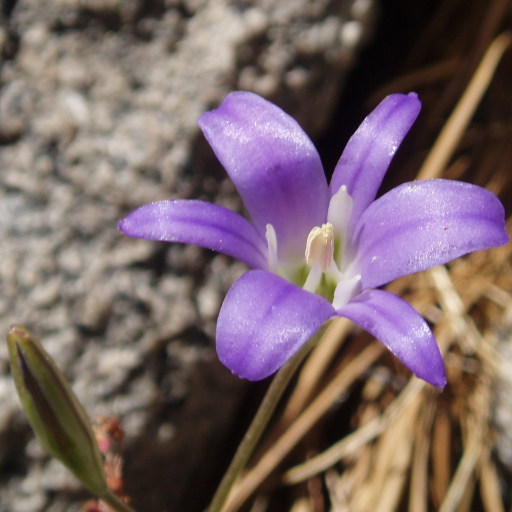
Plant Overview
Known as the Harvest Brodiaea, this California native is a late-season showstopper that paints golden summer hills with splashes of royal purple. Often emerging just as other wildflowers begin to fade, it serves as a vibrant bridge between spring and the heat of summer. Its delicate, trumpet-shaped blooms look like miniature lilies scattered across the grassland, earning it the "elegant" title it carries in its Latin name.
🔍 How to Identify
- 🌸 The Blooms: Clusters of 3 to 15 funnel-shaped flowers that range from deep violet to blue-purple. Each "petal" (technically a tepal) has a darker mid-vein running down the center.
- 🌿 The Foliage: The leaves are long, narrow, and grass-like. A key identifying trait is that the leaves often begin to wither and turn brown just as the flowers start to open.
- 🍦 Inner Details: If you look closely inside the flower, you will see three white, pointed "staminodes" (sterile stamens) that lean inward, standing in contrast to the purple petals.
🏡 In Your Garden
- ☀️ The Summer Nap: This plant is a master of the "summer dry" strategy. It grows from an underground corm and requires a strictly dry period during its summer dormancy. Overwatering during this time is the most common cause of failure, as the corms are prone to rot.
- 🦋 Pollinator Power: It is a vital nectar source for native bees and butterflies. Because it blooms later than many other wildflowers, it provides a crucial food source when the landscape is starting to dry out.
- 🌱 Tough Roots: It is remarkably adaptable to soil types, often found in heavy clay or rocky areas where other delicate bulbs might struggle to break through.
⚠️ Safety & Toxicity
- 🛡️ General Status: Brodiaea elegans is generally considered non-toxic to humans and has a long history of being used as a food source.
- 🐾 Pets & Kids: While the plant is not known to be poisonous, the underground corms can cause mild digestive upset if eaten in large quantities by curious pets. As with any ornamental bulb, it’s best to keep it out of reach of "diggers."
✨ Fun Fact
The corms (the bulb-like bases) of the Brodiaea were once a staple food for many Native American tribes. They were nicknamed "Indian Potatoes" and were often roasted in earth ovens, which transformed their texture into something creamy and sweet, similar to a roasted chestnut.

Detailed Care Instructions

Place in a bright room that is sun drenched almost all day. Or directly in a south-facing window.

Some plants require more regular watering than others, which should be done every few days. It's critical to maintain the soil moist all of the time. The water requirements of the same plant placed in pots with varying sizes will differ. Because the water in the smaller pot evaporates faster than the water in the larger pot, it will require more watering. Regardless of pot size, the surface should constantly be maintained moist.








