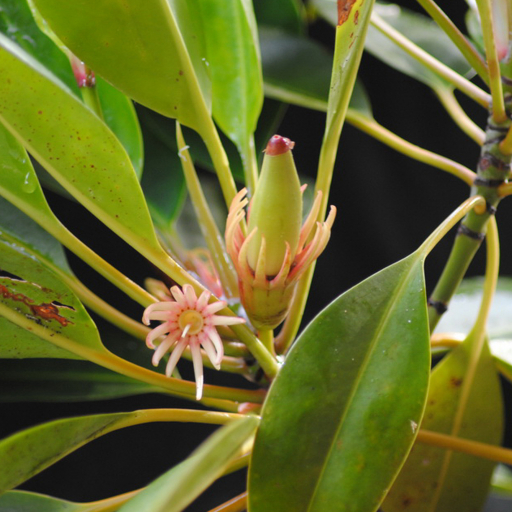
Plant Overview
Known widely as the Upriver Orange Mangrove, this resilient coastal architect is a master of the brackish tides. Unlike many of its saltwater cousins, it prefers the "sweet" water found further inland along riverbanks. With its distinctive bright orange flowers and strange, knee-like roots, it acts as a vital guardian of tropical shorelines, preventing erosion and providing a nursery for marine life.
🔍 How to Identify
- 🦵 Knee Roots: Look for unusual, knobby roots that loop out of the mud like bent elbows. These specialized structures help the plant breathe in oxygen-poor, waterlogged soil.
- 🍃 Leathery Foliage: The leaves are thick, glossy, and elliptic, typically arranged in opposite pairs. They have a waxy coating to help conserve fresh water in salty environments.
- 🏮 Lantern Flowers: The most striking feature is the flower, which boasts a stiff, bell-shaped calyx that ranges from yellowish-orange to a deep, rusty red.
- 🥖 Cigar Propagules: Instead of traditional seeds, it produces long, green, cigar-shaped "propagules" that germinate while still attached to the parent tree.
🏡 In Your Garden & Ecology
- 💧 The Brackish Specialist: While not a common houseplant, it is a staple in coastal restoration and large-scale "mangrove aquariums." It thrives in mud that is consistently wet and can tolerate a mix of salt and fresh water.
- 🏗️ Coastal Architect: In the wild, its complex root system traps sediment and debris, slowly building new land. It acts as a natural shock absorber against storm surges and high tides.
- 🍼 Viviparous Nature: This plant "gives birth" to live seedlings. The propagules drop vertically into the mud to take root immediately, or float away to colonize new banks.
⚠️ Safety & Toxicity
- 🟢 Non-Toxic: Bruguiera sexangula is generally considered safe to handle and is not known to be poisonous to humans or pets.
- 🛶 Traditional Use: In some cultures, the fruit and bark have been used for tannins or traditional medicine, but they are not considered a standard food source and can be very astringent.
✨ Fun Fact
The Orange Mangrove is a "pioneer species." Because its seedlings are weighted at the bottom, they fall like botanical darts, stabbing into the soft mud to ensure they aren't washed away by the receding tide before they can grow!

Detailed Care Instructions
To grow a Bruguiera sexangula plant, you can follow these steps:
- Obtain seeds or seedlings: You can obtain Bruguiera sexangula seeds from a reputable nursery or online supplier. Alternatively, you can collect seeds from mature mangrove plants if it is legally allowed in your area. Seedlings can be purchased or propagated from seeds at home.
- Choose a suitable container: Bruguiera sexangula plants can initially be grown in a container before they are transplanted outdoors. Choose a container with drainage holes to allow excess water to drain out and avoid waterlogged roots.
- Prepare the soil: Use a soil mix that is suitable for mangrove plants. It should be slightly acidic and rich in organic matter. You can create a mix by combining equal parts of peat moss, sand, and loamy soil. Fill the container with this soil mix.
- Plant the seeds or seedlings: If using seeds, soak them in water for 24 hours before sowing. Plant the seeds about 1 inch deep in the prepared soil. If using seedlings, make a small hole in the soil and gently place the roots in it. Firmly press the soil around the seed or seedling, ensuring it is stable.
- Provide suitable conditions: Bruguiera sexangula plants require a warm and humid environment. Place the container in a location that receives partial sunlight. The ideal temperature range is between 25 to 30°C (77 to 86°F). Maintain the humidity level by misting the leaves regularly or placing a tray of water near the plant.
- Watering and fertilizing: Keep the soil consistently moist but not waterlogged. Water the plant whenever the top inch of soil feels dry. Avoid overwatering as it can lead to root rot. During the growing season, provide a balanced fertilizer once or twice a month to support healthy growth.
- Transplanting: As the Bruguiera sexangula plant grows, it will eventually outgrow its container. Once it reaches a suitable size, it can be transplanted into a larger container or directly into the ground in a suitable coastal or wetland area. Ensure the new location has access to brackish or saltwater.
- Maintenance: Regularly monitor and manage pest infestations, such as scale insects and spider mites. Prune the plant if needed to maintain its shape and remove any dead or diseased parts. Monitor the soil moisture and address any issues promptly.
Remember, Bruguiera sexangula is a mangrove plant that requires suitable coastal or wetland conditions to thrive. Ensure you have the necessary permissions and knowledge about local regulations before planting them in natural environments.

Place in a bright room that is sun drenched almost all day. Or directly in a south-facing window.

Bruguiera Sexangula is a plant that belongs to a species of mangrove. When it comes to watering the plant, it is essential to keep it moist and avoid drying out the roots. The best way to achieve that is by watering the plant regularly without over-saturating the soil.
It is recommended to water the plant at least once a week, depending on the climate and humidity levels of the area. The plant prefers to be watered with fresh, clean water that is free of any chemicals or toxins. The best way to deliver water to the plant is by using a watering can or a sprinkler.
When watering the plant, it is important to avoid getting the leaves wet, as it can lead to damage and disease. Instead, direct the water around the base of the plant, allowing it to absorb into the soil.
During periods of heavy rain or high humidity, it may not be necessary to water the plant as frequently. However, it is still important to check the soil regularly to ensure that it remains moist.
In summary, watering Bruguiera Sexangula involves regular watering, using fresh water, avoiding wetting the leaves and checking soil moisture levels regularly.
To fertilize this coastal plant, use a slow-release type of nitrogen-rich fertilizer. Sprinkle the fertilizer around the plant's drip line and then water the soil thoroughly to allow the nutrients to penetrate. Fertilize the plant two to three times a year, ideally during the growing season, to encourage healthy growth and development. However, avoid over-fertilizing as this can cause salt build-up in the soil and damage the plant.
The most suitable soil for the Bruguiera Sexangula plant is a mixture that is well-draining and has good aeration. The pH of the soil should range between slightly acidic to slightly alkaline. The soil should be rich in organic matter, such as compost or leaf mold, to provide the plant with the necessary nutrients. The plant prefers a slightly moist soil, but not waterlogged, as it is adapted to the fluctuating tides of coastal regions. The soil should be able to retain some moisture while allowing excess water to drain away. Sand can be added to the soil mixture to improve drainage. The plant can also thrive in brackish water or saltwater conditions, but the soil should not be too salty. Overall, the soil should be able to support the growth of the Bruguiera Sexangula plant and provide it with the necessary nutrients and moisture required for healthy growth.
To propagate this plant species, you can start by collecting mature seeds from healthy parent plants. Soak the seeds in clean water for a day to soften the hard exterior. Afterward, carefully remove the seeds from the water and plant them in a mixture of nutrient-rich soil and sand. The seeds should be placed about 1 inch deep in the soil mixture.
Cover the seed pot with a plastic wrap to prevent moisture loss and place it in a warm and humid place. After a few weeks, the seeds will start to germinate and develop into seedlings. Once the seedlings have grown to about 2 inches tall, they can be carefully transplanted into individual pots or into a suitable location outdoors.
To ensure that the new plants take root successfully, provide them with enough water and nutrients. It is also important to protect the young plants from extreme temperatures, pests, and diseases. With proper care, your newly propagated Bruguiera sexangula plants will thrive and grow into mature trees.








