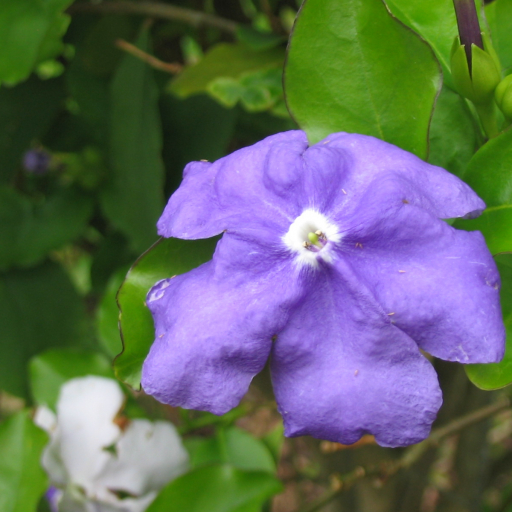
Plant Overview
Commonly known as the compact "Yesterday-Today-and-Tomorrow" or the sweet-scented "Kiss-me-Quick," this Brazilian native is a true storyteller of the garden. It is famous for its magical floral display where flowers change color over three days, representing the passage of time. This shrub is a favorite for those who love fragrant evening gardens and a splash of shifting colors.
🔍 How to Identify
- 🌸 The Color-Shift Flowers: The most distinct feature is the five-petaled flowers that emerge deep violet (Yesterday), fade to pale lavender (Today), and finally turn pure white (Tomorrow).
- 🍃 Leathery Foliage: Its leaves are dark green, elliptic, and slightly leathery to the touch, providing a dense, lush backdrop for the bright blooms.
- 📏 Compact Growth: Unlike some of its sprawling relatives, Brunfelsia latifolia stays relatively small and rounded, usually reaching about 3 to 4 feet in height.
🏡 In Your Garden
- 🌱 Soil Sensitivity: This plant is an "acid-lover." It thrives in camellia or azalea potting mix. If the leaves start turning yellow while the veins stay green, it’s likely a sign that the soil is too alkaline.
- 🌬️ Fragrance and Placement: The blooms release a heavy, sweet perfume, especially at night. Plant it near a window or a patio, but keep it sheltered from harsh, drying winds which can shrivel the delicate petals.
- ✂️ Pruning Nuance: It prefers to be pruned immediately after the main flowering flush in spring. This encourages a bushier habit and more "bud sites" for the next season’s color show.
⚠️ Safety & Toxicity
- 🚫 High Toxicity: Every part of this plant contains toxic alkaloids (specifically brunfelsamidine and hopeanine). It is considered a high-risk plant for households with curious residents.
- 🐾 Pet Warning: The "berries" or seed pods that follow the flowers are particularly dangerous. If ingested by dogs or cats, it can cause tremors, vomiting, and even life-threatening seizures. Keep it in a fenced area or a large pot out of reach of pets.
✨ Fun Fact
The genus Brunfelsia was named in honor of Otto Brunfels, a 16th-century German monk and botanist who is often called one of the "Fathers of Botany" for his early work on herbal medicine!

Detailed Care Instructions
| Humidity | Normal |
| Lighting | Part Sun |
| Difficulty | Medium |
| Hibernation | Cold Period |
| Hardiness Zones | 9 - 12 |
The most effective way to water this plant is to remember to water it deeply and thoroughly, making sure that the water is penetrating deep into the soil. Avoid frequent, light watering, as this can lead to shallow root growth and possible root rot. It is best to water the plant early in the morning or during the evening to avoid evaporation and heat stress. When watering, make sure to avoid getting water on the foliage, as this can lead to leaf spot and fungal issues. Additionally, it is important to take note of any signs of overwatering, such as yellowing leaves or drooping foliage, as this can indicate a need to adjust the watering schedule.
Brunfelsia Latifolia is a highly recommended plant for ornamental and landscaping purposes. Proper soil for this plant should be rich in organic material, well-draining, but also able to retain sufficient moisture. It needs a soil with a pH level of around 5.5 to 6.5.
A good soil mix for this plant would contain a mix of organic compost, peat moss, and perlite/gravel/vermiculite for better drainage. Also, a soil pH test kit may be used to confirm the acidity level of the soil before planting.
It is crucial to avoid using soil that is too heavy or compact since this can hinder root growth and lead to standing water, which can eventually cause root rot. Regular watering, keeping the plant away from direct sunlight, and frequent feeding with a fertilizer can help the Brunfelsia Latifolia plant thrive and produce beautiful blooms.








