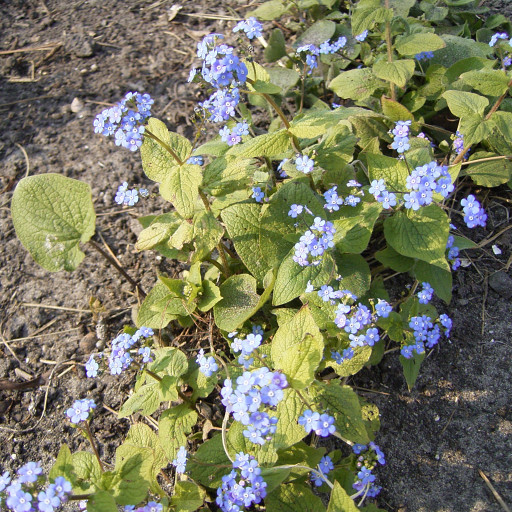
Plant Overview
Often called the "Siberian Bugloss" or "False Forget-Me-Not," this woodland beauty is a cherished star of the shade garden. While it looks delicate with its airy clouds of tiny blue flowers, it is a rugged survivor originally hailing from the Caucasus mountains. It is the perfect solution for those tricky, dark corners of the yard where most flowering plants struggle to thrive.
🔍 How to Identify
- 🍃 Heart-Shaped Foliage: The most striking feature is its large, dramatic leaves that are perfectly heart-shaped and can grow up to 6 inches wide.
- 💎 Jewel-Tone Blooms: In early spring, it produces tiny, five-petaled sky-blue flowers with yellow centers that look almost identical to Forget-Me-Nots.
- ☁️ Velvety Texture: The leaves have a distinctive "rough" or hairy texture, which gives the plant a matte, frosted appearance in the sunlight.
🏡 In Your Garden
- ⛅ The Shade Specialist: This plant is a master of the understory. It uses its broad leaves like solar panels to catch limited light, making it an ideal companion for Hostas, Ferns, and Bleeding Hearts.
- 💧 Moisture Consistency: Because it has a relatively shallow root system, it doesn't handle drought well. It prefers soil that feels like a wrung-out sponge—consistently moist but never swampy.
- 🐌 Slug Resistance: Unlike many other large-leafed shade plants, the hairy texture of Brunnera leaves acts as a natural deterrent for slugs and snails, keeping your garden looking tidy without chemicals.
⚠️ Safety & Toxicity
- 🐾 Pet Friendly: Great news for animal lovers—Brunnera is generally considered non-toxic to dogs, cats, and horses.
- 🖐️ Skin Sensitivity: While not poisonous, the stiff hairs on the leaves can occasionally cause very mild skin irritation for people with sensitive skin during heavy pruning or handling.
✨ Fun Fact
The common name "Bugloss" comes from the Greek words bous (ox) and glossa (tongue), referring to the rough, rasping texture of the leaves which supposedly feels like an ox's tongue!

Detailed Care Instructions
| Color | Blue |
| Soil Ph | No Preference |
| Humidity | Normal |
| Lighting | Part Sun |
| Soil Type | Medium Moisture, Well-Drained Soil |
| Bloom Time | April To May |
| Difficulty | Medium |
| Plant Type | Herbaceous Perennial |
| Hibernation | Cold Period |
| Mature Size | 12 To 18 Inches; 18- To 30-Inch Spread |
| Native Area | Caucasus Region Of Eurasia |
| Temperature | 15°C - 18°C |
| Sun Exposure | Part Shade To Full Shade |
| Hardiness Zones | 3 To 8 (Usda) |
To grow Brunnera Macrophylla plants, you can follow these steps:
- Select a suitable location: Choose a spot that receives partial to full shade, as Brunnera prefers not to be exposed to direct sunlight. The soil should be moist and well-draining.
- Prepare the soil: Amend the soil with organic matter such as compost or well-rotted manure to improve its texture and fertility. Brunnera prefers slightly acidic to neutral soil with a pH between 6.0 and 7.0.
- Planting: Dig a hole that is slightly larger than the root ball of your Brunnera. Place the plant in the hole and ensure the crown, where the stem meets the roots, is level with or slightly above the soil surface. Backfill the hole and gently firm the soil around the plant.
- Watering: Water the newly planted Brunnera thoroughly and keep the soil consistently moist throughout the growing season. Avoid overwatering or allowing the soil to become waterlogged.
- Mulching: Apply a layer of organic mulch around the plants to help conserve moisture, suppress weeds, and insulate the soil.
- Fertilizing: In early spring, before new growth emerges, you can apply a balanced, slow-release fertilizer according to the manufacturer's instructions. This will provide the necessary nutrients for healthy growth.
- Pruning: Deadhead any spent flowers to encourage additional blooms. Cut back the foliage to ground level after it dies back in the fall to maintain a tidy appearance.
- Pests and diseases: Brunnera plants are relatively pest and disease-free. However, slugs and snails can sometimes be problematic. Use organic or chemical slug control methods if necessary.
- Propagation: Brunnera can be propagated by division in early spring or early fall. Dig up the plant, carefully separate the clumps, and replant in suitable locations.
- Winter care: Brunnera is generally hardy, but in colder regions, it is recommended to provide a layer of mulch to protect the roots during winter.
By following these steps, you can successfully grow and maintain Brunnera Macrophylla plants.

Place in a window with dappled sun or a spot in the middle of a room. Or directly in a window facing west or east.

To water this plant, wait until the top inch of soil is dry before giving it a good watering. Be sure to water the plant deeply, so the water reaches the roots. Make sure not to overwater the plant, as this can lead to root rot. Water the plant in the morning or early afternoon, so the soil has a chance to dry out before nightfall. If the plant is grown in a container, make sure the container has drainage holes, so excess water can drain out.
- Obtain a high-quality, balanced fertilizer specifically formulated for shade-loving perennials.
- Apply the fertilizer in early spring, just as the plant begins to emerge from dormancy.
- Follow the manufacturer's instructions for application rates and methods.
- Water the plant thoroughly after fertilizing to help distribute the nutrients throughout the root zone.
- Avoid over-fertilizing, as this can lead to excessive vegetative growth and reduced flowering.
- Monitor the plant throughout the growing season for signs of nutrient deficiency or excess, and adjust fertilization as needed.
The ideal soil for this plant is a well-draining, moist soil that is rich in organic matter. It should have a slightly acidic to neutral pH level (pH 6-7). Adding compost or other organic matter to the soil can improve the soil structure and provide essential nutrients for the plant. The soil should also be able to retain moisture but not become waterlogged, as this can cause root rot. It is important to avoid sandy or rocky soils, as well as heavy clay soils, which can impede root development. Overall, the soil should be fertile and provide adequate drainage and moisture retention for the healthy growth of the Brunnera Macrophylla plant.
To propagate this plant, first select a healthy mature plant with a good root system. Cut a few stem cuttings from the plant, making sure that each cutting has at least 2-3 nodes. Remove the lower leaves and dip the cut end in rooting hormone. Plant the cuttings in well-draining soil and keep them moist. Cover with plastic to create a humidity dome and place in a warm, bright location. After a few weeks, new growth should appear. Once the cutting has established roots, transplant it into a larger pot or into the garden. It is recommended to propagate in the spring or fall when the plant is actively growing.
Common pests of the siberian bugloss include Aphids, snails. Make a habit of checking your siberian bugloss frequently for pests so that any infestations can be caught and managed early.








