Plant Overview
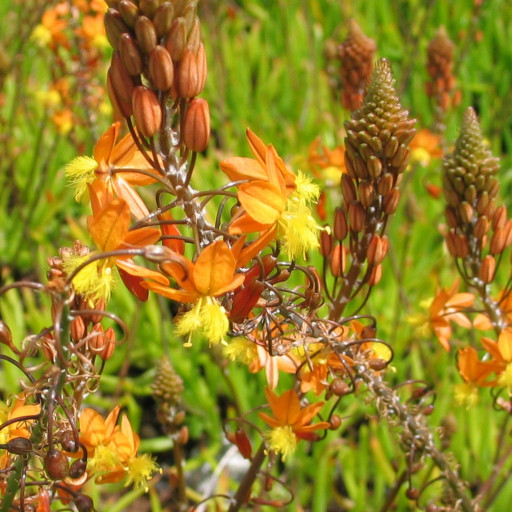
Often called the Burn Jelly Plant or Snake Flower, this South African native is the ultimate "hard-to-kill" beauty. While it looks like a delicate ornamental grass from a distance, it is actually a hardy succulent that stores water in its fleshy, straw-like leaves. It has earned a reputation as a "living first-aid kit" because the soothing gel inside its leaves is used similarly to Aloe Vera.
🔍 How to Identify
- 🌿 The Foliage: Look for long, succulent, bright green leaves that are cylindrical and hollow, resembling thick chives or spring onions.
- 🌼 The Flowers: It produces tall, arching stalks topped with clusters of star-shaped flowers, usually in vibrant orange or sunny yellow.
- ☁️ The "Beard": If you look closely at the center of each tiny flower, you’ll see distinctively fuzzy, feathery yellow stamens that look like a miniature beard.
🏡 In Your Garden
- ☀️ Drought Warrior: This plant thrives on neglect. It features a specialized root system that allows it to survive long periods without water, making it perfect for rock gardens or "fire-wise" landscaping.
- 🌱 Spreading Habit: It grows in clumping mounds. While it isn't invasive, it will slowly colonize an area via rhizomes, making it an excellent, low-maintenance groundcover for sunny spots.
- ✂️ Blooming Cycle: To keep the "fireworks" going, snip off the flower stalks once they fade; this encourages the plant to put energy into new blooms rather than seed production.
⚠️ Safety & Toxicity
- ✅ General Safety: Bulbine frutescens is considered non-toxic to humans and is widely used topically for skin relief.
- 🐾 Pets: It is generally listed as non-toxic to dogs and cats. However, as with any succulent, if a pet eats a large amount, they might experience mild stomach upset or vomiting.
- ✋ External Use Only: While the sap is great for burns or insect bites, it should not be ingested in significant quantities.
✨ Fun Fact
In its native South Africa, the plant is a traditional remedy for more than just burns; it is nicknamed "Snake Flower" because some believe it can help soothe the discomfort of certain stings and bites found in the wild!

Detailed Care Instructions
| Lighting | Full Sun |
| Hardiness Zones | Min 8B |
Here are some steps to help you grow Bulbine Frutescens plant:
- Choose the right location: Bulbine Frutescens thrives in full sun to part shade. Make sure the location receives at least 6 hours of direct sunlight each day.
- Soil preparation: The plant prefers well-draining soil. Add organic matter such as compost or peat moss to improve the soil's texture and drainage.
- Planting: Dig a hole slightly larger than the root ball of the plant. Place the plant in the hole, ensuring that the top of the root ball is level with the soil surface. Fill the hole with soil and lightly press it around the plant.
- Watering: Water the plant thoroughly after planting and keep the soil consistently moist, especially during the first few weeks. After establishment, Bulbine Frutescens is drought-tolerant and requires less frequent watering.
- Fertilizing: Apply a balanced, slow-release fertilizer once a year during the growing season. Follow the instructions on the fertilizer packaging for proper dosage and application.
- Pruning: To encourage bushier growth and remove dead or damaged foliage, you can prune Bulbine Frutescens. Cut back spent flower stalks and trim any leggy or overgrown branches.
- Mulching: Apply a layer of organic mulch around the plant to help retain moisture, suppress weeds, and moderate soil temperature. Leave a gap around the plant's stem to prevent it from rotting.
- Pests and diseases: Bulbine Frutescens is relatively resistant to pests and diseases. However, keep an eye out for aphids, spider mites, and snails. If necessary, treat them with organic insecticides or remove them manually.
- Propagation: Bulbine Frutescens can be propagated from seeds or through division. Collect mature seeds and plant them in a well-prepared seed bed. To divide the plant, carefully separate the clumps and replant them in suitable locations.
Remember to check local gardening guidelines as specific care may vary depending on your region's climate and conditions.

Place in a bright room that is sun drenched almost all day. Or directly in a south-facing window.

The Bulbine Frutescens plant requires frequent watering during the growing season. However, it is important not to overwater the plant, as this can cause root rot.
To water the plant, first, check the soil for dryness by inserting your finger about an inch into the soil. If it feels dry, it is time to water.
When watering, use a watering can or hose and direct the water at the soil around the base of the plant, avoiding getting water on the leaves. Water the plant thoroughly until the soil is moist but not saturated.
During the dormant season, reduce watering to once or twice a month, or when the soil feels dry.
In addition to regular watering, ensure that the plant is growing in well-draining soil and receives adequate sunlight for optimal growth.
To fertilize this plant, use a balanced fertilizer with equal amounts of nitrogen, phosphorus, and potassium. Apply the fertilizer in early spring and again in late summer. Use approximately one tablespoon of fertilizer per square foot of soil around the plant's root zone, and apply it evenly over the soil. Water the plant thoroughly after fertilizing. Avoid fertilizing during the winter months when the plant is dormant.
When planting the Bulbine Frutescens plant, it is important to use a soil that is well-draining and nutrient-rich. The soil should be composed of a mixture of organic matter, such as compost or peat moss, and sand or perlite to improve drainage. The soil should have a pH level between 6.0 and 7.5, which is slightly acidic to neutral.
It is also important to choose a soil that is appropriate for the growing conditions of the Bulbine Frutescens plant. If the plant is being grown in a container, a potting mix designed specifically for container gardening should be used. If the plant is being grown in a garden bed, the soil should be amended with organic matter before planting.
To prevent disease and pests, it is recommended to use sterile soil, which can be achieved by baking the soil in an oven at 180 degrees Fahrenheit for 30 minutes. The soil should also be watered regularly to prevent it from becoming too dry or too wet, which can cause the roots to rot.
To propagate this plant, select a healthy and mature parent plant with multiple stems. Obtain cuttings by taking stem sections about 3-4 inches in length from the parent plant using a sharp and sterilized pruning tool. Ensure that the cutting has at least two leaves and no flowers.
Dip the cuttings in rooting hormone powder and shake off any excess powder. Place the cuttings in a well-draining and moist potting mix or soil mix. Water the soil and cover the cutting with a plastic bag or a clear tray to help retain moisture.
Place the cutting in bright, indirect sunlight and mist the soil regularly to keep it moist. After a week or two, check if the cutting has rooted by gently tugging at the stem; if there is resistance, then rooting has occurred. Gradually acclimate the cutting to the environment by opening the plastic bag for about an hour every day.
Once the cutting has rooted, transplant it to a larger pot or garden soil and continue to water it regularly while it establishes its root system. The plant can be fertilized every three months during the growing season to encourage growth.








