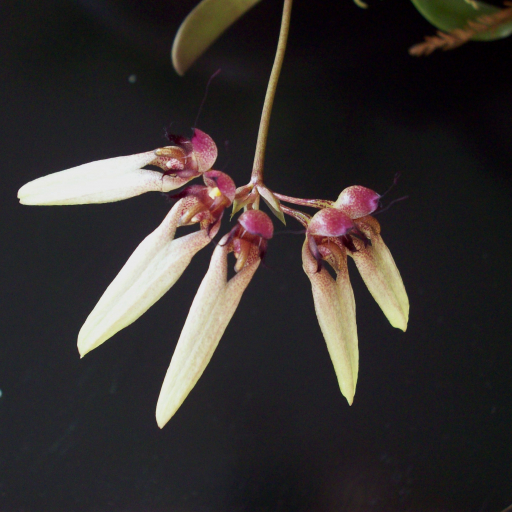
Plant Overview
Known as the Pale Umbrella Orchid, Bulbophyllum longiflorum is a botanical acrobat with a truly global reach, stretching from the forests of Africa to the tropical islands of the Pacific. It is famous for its "umbel" flower structure, where multiple blossoms radiate from a single point like the ribs of a tiny, floral parasol. While some members of this genus smell like rotting meat to attract flies, this species is much more polite, often carrying a faint, spicy scent.
🔍 How to Identify
- 🌂 The Floral Fan: The flowers grow in a circular cluster at the top of a thin stem, creating a distinctive fan or umbrella shape.
- 🎋 Trailing Sepals: Each individual flower features two very long, ribbon-like sepals that hang downward, giving the cluster a fringed, "bearded" appearance.
- 🟢 Egg-Shaped Bulbs: The plant grows from smooth, pale green pseudobulbs that sit along a creeping rootstock (rhizome), each topped with a single, leathery leaf.
🏡 In Your Garden
- 🧗 The Creeping Habit: This orchid is a "wanderer." Because its roots like to travel along the surface, it often performs better mounted on a piece of cork or tree fern fiber rather than sitting in a traditional pot.
- 🌬️ Fresh Air Fanatic: While it loves high humidity (think tropical rainforest), it absolutely requires moving air. Stagnant, damp air is the quickest way to cause crown rot in this delicate species.
- 💧 Watering Nuance: Because it has smaller pseudobulbs than some other orchids, it doesn't store water for long periods. It prefers to stay "evenly moist" rather than cycling between bone-dry and soaking wet.
⚠️ Safety & Toxicity
- ✅ Safe Status: Bulbophyllum longiflorum is considered non-toxic to humans and common household pets like cats and dogs.
- 🌱 Handle with Care: While not poisonous, the plant is physically delicate. Ingesting the fibrous leaves or bulbs can cause minor stomach upset in pets, and the plant itself will not recover easily from being chewed.
✨ Fun Fact
The "lip" (labellum) of this orchid is delicately hinged. When a small fly lands on it, the lip tips backward like a seesaw, physically bumping the insect against the plant’s pollen-bearing parts to ensure the next generation of orchids!

Detailed Care Instructions
| Humidity | High |
| Lighting | Full Sun |
| Difficulty | Medium |
| Temperature | 18°C - 29°C |
Here are some general steps to grow a Bulbophyllum Longiflorum:
- Choose the right pot and medium: Bulbophyllum Longiflorum is an epiphytic orchid that thrives best in a small pot with a well-draining medium. Use a mix of bark, sphagnum moss, and perlite or charcoal to create a suitable growing medium.
- Provide proper lighting: Bulbophyllum Longiflorum prefers bright indirect light. Place the plant in an area where it receives bright, filtered light, such as an east or west-facing window. Avoid direct sunlight, as it may scorch the leaves.
- Maintain the right temperature: This orchid prefers warm and humid conditions. The ideal temperature range is between 60-85°F (15-29°C). Avoid placing the plant in an area with temperature fluctuations or drafts.
- Water properly: Bulbophyllum Longiflorum requires consistent moisture but should not be overwatered. Water the plant thoroughly when the top inch of the potting medium feels dry. Ensure that excess water drains out of the pot to prevent root rot.
- Provide humidity: Maintain a humid environment around the plant by using a humidity tray, misting the leaves regularly, or placing the pot on a tray with water and pebbles. This will help simulate the orchid's natural habitat.
- Fertilize regularly: Use a balanced orchid fertilizer diluted to half strength during the growing season (spring and summer). Apply the fertilizer every 2-3 weeks to provide essential nutrients.
- Repot when necessary: Repot the Bulbophyllum Longiflorum when its growth exceeds the pot size or the potting medium breaks down. Spring is usually the best time for repotting, using a fresh growing medium.
- Pay attention to pests: Monitor the plant regularly for pests such as aphids, mealybugs, and spider mites. Treat any infestations promptly using appropriate methods or insecticides.
- Be patient: Bulbophyllum Longiflorum can be slow-growing, so be patient while waiting for growth and eventual blooming.
Remember that the specific care requirements may vary slightly depending on your location and the specific conditions in your home.

Place in a window with dappled sun or a spot in the middle of a room. Or directly in a window facing west or east.

Bulbophyllum Longiflorum is a plant that requires specific watering techniques to thrive. When watering this plant, it is essential to use room-temperature water that is free from chemicals such as chlorine or fluoride. It is recommended to water this plant at least once a week during its growing season, which typically begins in the spring and ends in the fall. During its dormant period, which is typically during the winter months, watering should be reduced.
To ensure proper watering, the soil should be gently watered until it is moist but not waterlogged. It is important to allow the top layer of soil to dry out before watering again. This will prevent overwatering, which can cause the plant to rot and die.
Additionally, it is important to avoid wetting the leaves and pseudobulbs of the plant, as this can lead to disease and rot. Instead, it is best to water the soil directly, allowing the plant to absorb moisture through its roots.
Overall, Bulbophyllum Longiflorum requires careful watering to thrive, with a focus on using high-quality water, avoiding overwatering, and protecting the leaves and pseudobulbs from moisture. With these techniques in mind, this plant can thrive and produce beautiful, long-lasting blooms.
Here are some fertilizing instructions for Bulbophyllum Longiflorum:
- Fertilize once a month during the growing season (spring and summer).
- Use a balanced fertilizer with equal amounts of nitrogen, phosphorus, and potassium.
- Dilute the fertilizer to half strength before applying to the plant.
- Water the plant thoroughly before and after fertilizing to prevent root burn.
- Avoid fertilizing during the dormant season (fall and winter) as the plant does not actively grow during this time.
Bulbophyllum Longiflorum is a plant that requires a well-draining soil mix that is rich in nutrients. The ideal soil mix should consist of a blend of sphagnum moss, perlite or coarse sand, and bark pieces. The sphagnum moss provides moisture retention, while the bark pieces and perlite allow for adequate drainage. It is important to avoid using heavy soils or soils that retain too much moisture as this can lead to root rot and other issues. Additionally, the soil mix should have a slightly acidic to neutral pH level, typically between 5.5 to 7.5. It is recommended to repot the plant every two years to ensure the soil remains fresh and provides proper drainage.
To propagate this plant, first prepare a clean and sharp gardening shear or knife. Identify a healthy mature plant and identify a bulb that has not yet bloomed. Cut the bulb from the plant, ensuring that the cut is clean and the bulb is undamaged.
Next, prepare a small pot of well-draining soil. The soil should be light, airy, and well-draining to prevent waterlogging. Make a small hole in the soil and gently place the bulb in the hole, ensuring that it is covered with soil. It is important not to bury the bulb too deep, as it needs access to air to produce new growth.
Water the newly planted bulb lightly, but avoid overwatering as this can cause root rot. The soil should be kept slightly moist, but not waterlogged. Place the pot in a warm, well-lit area but avoid direct sunlight. The bulb should begin to produce new growth and eventually develop into a mature plant.
Propagation can also be achieved through division of mature plants. Carefully separate the bulbs or pseudobulbs from the parent plant, making sure each division has at least one healthy bulb and set of roots. Plant the bulbs as described above.








