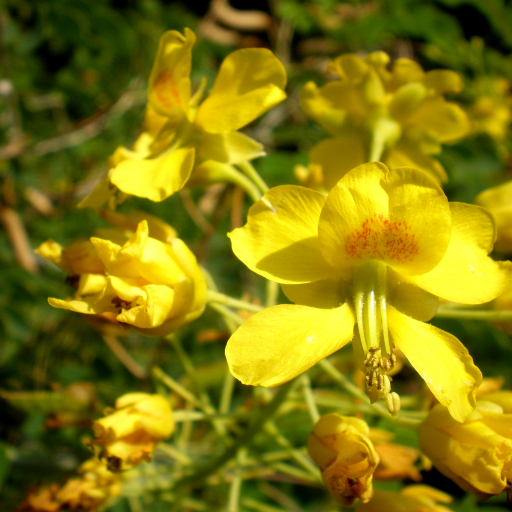
Plant Overview
Known as the Mexican Bird of Paradise or Mexican Holdback, this sun-loving shrub turns arid landscapes into a sea of gold. It is prized for its "firework" blooms and delicate, airy foliage that mimics the grace of a fern. Native to the warm regions of Northern Mexico and Texas, it is the tougher, elegantly yellow cousin of the more common red-and-orange variety.
🔍 How to Identify
- 🌼 The Blooms: Features upright clusters (racemes) of brilliant, lemon-yellow flowers. Unlike its relatives, the petals are solid yellow without the dark red centers.
- 🌿 Lace-like Foliage: Its leaves are "bipinnately compound," meaning they are divided into many small, oval leaflets that give the plant a soft, feathery appearance.
- 📏 Structure: Typically grows as a multi-trunked large shrub or a small tree, reaching up to 15 feet if left unpruned.
🏡 In Your Garden
- ☀️ Sun Worshipper: This plant thrives in intense heat and full sun. If planted in the shade, it will become "leggy" and produce significantly fewer flowers.
- 💧 Drought Specialist: Once established, it is incredibly water-wise. It prefers well-draining soil and hates "wet feet," so avoid low spots in the garden where water collects.
- ✂️ Pruning Style: It responds beautifully to pruning. You can train it into a single-trunk tree or keep it as a dense hedge to provide privacy and a burst of color.
⚠️ Safety & Toxicity
- 🚫 Status: Mildly to moderately toxic if ingested.
- 🐾 Details: The seed pods and seeds contain tannins and other compounds that can cause digestive upset (vomiting or diarrhea) in dogs, cats, and curious children. It is best to plant it in areas where pets won't be tempted to chew on the fallen pods.
✨ Fun Fact
When the seed pods dry out on the branch, they eventually "explode" with a faint popping sound, launching the seeds several feet away from the mother plant to ensure the next generation has plenty of space to grow!

Detailed Care Instructions
Caesalpinia Mexicana, also known as Mexican bird of paradise, can be grown successfully in a variety of environments. Here are some tips to help you grow this plant:
- Climate: Caesalpinia Mexicana thrives in warm climates and is drought-tolerant once established. It can be grown in USDA hardiness zones 8 to 11.
- Sunlight: Plant your Caesalpinia Mexicana in a location that receives full sun for most of the day. It requires at least 6 hours of direct sunlight to thrive.
- Soil: The plant prefers well-draining soil that is slightly acidic to neutral. Add organic matter such as compost to improve soil fertility and drainage.
- Watering: In the initial stages of growth, water your Caesalpinia Mexicana regularly to help establish its root system. Once established, reduce watering frequency as the plant is drought-tolerant.
- Fertilizing: Apply a balanced fertilizer during the growing season to encourage healthy growth and flowering.
- Pruning: Prune your Caesalpinia Mexicana to shape it and remove any dead or damaged branches. Pruning also helps to promote flowering.
- Propagation: Caesalpinia Mexicana can be propagated from seeds or cuttings. Seeds can be collected from the plant's seed pods and sown in well-draining soil.
- Pests and diseases: Keep an eye out for pests such as aphids, caterpillars, and scale insects. Treat infestations promptly with insecticidal soap or neem oil. Watch out for fungal diseases such as powdery mildew and treat with fungicides if necessary.
By following these tips, you can successfully grow and care for your Caesalpinia Mexicana plant.

Place in a bright room that is sun drenched almost all day. Or directly in a south-facing window.

Caesalpinia Mexicana is a plant that prefers to be watered consistently, but not excessively. It is important to allow the soil to dry out slightly between waterings to prevent root rot. When watering, thoroughly saturate the soil until water begins to drain from the bottom of the pot. It is also beneficial to water the plant at the base to avoid getting the leaves wet, which can lead to disease. During the growing season, typically spring and summer, the plant may require more frequent watering. In the winter months, reduce the frequency of watering to avoid overwatering. Pay attention to the plant's watering needs and adjust accordingly based on environmental conditions and the plant's growth stage.
To fertilize the Caesalpinia Mexicana plant, use a balanced fertilizer with an N-P-K ratio of 10-10-10. Apply the fertilizer in early spring before new growth appears and again in mid-summer. Mix the fertilizer with water according to the package instructions and water the plant thoroughly after application. Avoid over-fertilizing, as this can lead to nutrient imbalances and damage to the plant. Be sure to also provide regular watering and proper sunlight for optimal growth.
Caesalpinia mexicana plants thrive in well-draining soil with a slightly acidic to neutral pH level. A sandy loam or loamy soil mixture is ideal for these plants, providing good drainage to prevent waterlogging while retaining enough moisture for healthy root development. Adding organic matter such as compost or peat moss can help improve soil structure and fertility for Caesalpinia mexicana plants. Additionally, incorporating perlite or vermiculite into the soil mixture can enhance aeration and drainage for optimal growth. Overall, using a well-balanced soil mix that is rich in nutrients and promotes good drainage will support the healthy growth and development of Caesalpinia mexicana plants.
To propagate Caesalpinia Mexicana plant, you can use seeds or cuttings.
To propagate using seeds, start by collecting mature pods from the plant. Remove the seeds from the pods and soak them in water for 24 hours to soften the seed coat. Plant the seeds in a well-draining soil mix and keep the soil consistently moist until germination occurs, which can take a few weeks to a few months. Once the seedlings have grown large enough, they can be transplanted into individual pots or directly into the garden.
To propagate using cuttings, select a healthy stem from the plant and cut a piece that is around 4-6 inches long. Remove the leaves from the bottom of the cutting and dip the cut end in a rooting hormone to encourage root growth. Plant the cutting in a well-draining potting mix and keep it moist until roots have formed, which can take several weeks. Once roots have developed, the cutting can be transplanted into a larger pot or directly into the garden.
Both methods of propagation require patience and care to ensure the success of the new plants. Keep the soil consistently moist, provide adequate sunlight, and protect the new plants from extreme temperatures or stress to help them establish and thrive.








