Plant Overview
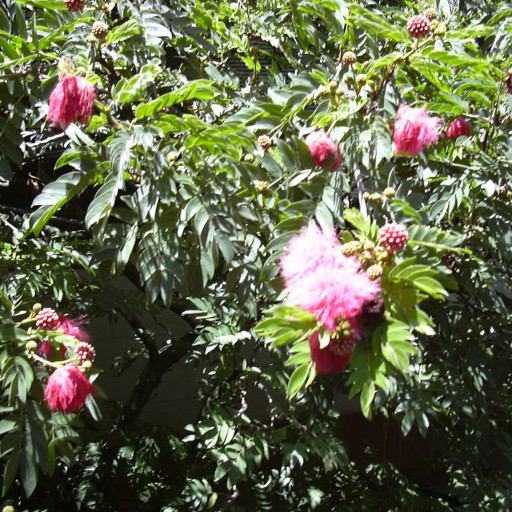
Often called the "Red Powder Puff," this Bolivian beauty is famous for its explosive, silky crimson blooms that look like something pulled from a Victorian vanity set. While it starts as a modest shrub, it can grow into a grand, spreading specimen that acts as a vibrant beacon for tropical wildlife. It is particularly beloved by gardeners for its "sleepy" foliage and its ability to provide year-round color in warm, frost-free climates.
🔍 How to Identify
- 🌸 The "Powder Puff" Bloom: The flower isn't actually made of petals; instead, it consists of hundreds of long, silky red stamens clustered into a soft, spherical pom-pom.
- 🍇 Berry-like Buds: Before opening, the flower buds are tightly packed and look remarkably like small, bumpy red berries or raspberries.
- 🌿 Feathery Foliage: The dark green leaves are bipinnate (divided like a fern), giving the plant a soft, airy texture even when it isn't in bloom.
- 🌓 Nyctinastic Movement: One of its most distinct traits is that the leaflets fold together tightly at night or during heavy rain, "sleeping" to protect themselves.
🏡 In Your Garden
- ☀️ Sun Worshipper: This plant craves bright light to produce those iconic puffs; if kept in too much shade, the branches will become "leggy" and sparse, and flowering will stop.
- ✂️ Pruning Strategy: It is a vigorous grower that can quickly take over a space. It responds very well to heavy pruning, which encourages new growth—and since flowers appear on new wood, more pruning often means more "puffs."
- 🦋 Pollinator Magnet: In its native habitat and warm gardens, it is a primary destination for hummingbirds and butterflies, who are drawn to the nectar hidden at the base of the stamens.
⚠️ Safety & Toxicity
- 🟢 General Status: Calliandra haematocephala is generally considered non-toxic to humans and common household pets.
- 🐾 Pet Context: While it doesn't contain known deadly toxins, ingesting any plant material can cause mild gastrointestinal upset in curious cats or dogs. It is best kept as an ornamental rather than a snack.
- 🚫 Choking Hazard: The berry-like buds may look tempting to toddlers; ensure they are taught not to pick or eat the "berries."
✨ Fun Fact
The Red Powder Puff is a "living clock." Its leaves are so sensitive to light levels that they begin to fold shut at almost the exact same time every evening, a phenomenon called "nyctinasty" that helps the plant conserve water and heat.

Detailed Care Instructions
| Humidity | Normal |
| Lighting | Full Sun |
| Difficulty | Medium |
| Hibernation | Cold Period |
| Temperature | 18°C - 27°C |
| Hardiness Zones | 9 - 11 |
Calliandra Haematocephala, also known as Powder Puff Tree or Red Powder Puff, is a beautiful flowering plant that can be grown both indoors and outdoors. Here are some steps to help you grow and care for the Calliandra Haematocephala:
- Choose the right location: Calliandra Haematocephala thrives in bright, indirect sunlight. If you are growing it indoors, place it near a window that receives bright, filtered light. If growing outdoors, select a spot with partial shade, especially during the hottest part of the day.
- Soil requirements: The plant prefers well-draining soil that is slightly acidic. Use a potting mix that includes organic matter such as peat moss or compost. If growing outside, amend the soil with organic matter to improve drainage.
- Planting: If growing outdoors, dig a hole slightly larger than the root ball of the plant. Place the plant in the hole, making sure the top of the root ball is level with the soil surface. Backfill the hole with soil, gently firming it around the roots. If growing indoors, choose a container with drainage holes and fill it with the potting mix. Place the plant in the container, ensuring it is at the same level as it was in the nursery pot.
- Watering: Calliandra Haematocephala prefers regular, moderate watering. Water the plant deeply when the top inch of soil feels dry. Avoid over-watering, as it can lead to root rot. In winter, reduce watering frequency.
- Fertilization: Feed the plant with a balanced, slow-release fertilizer during the growing season. Follow the label instructions for the correct dosage. Apply the fertilizer every 2-3 months.
- Pruning: Prune Calliandra Haematocephala to maintain its shape and size. It can be trained into a small tree or kept as a shrub. Remove dead, damaged, or crossing branches to maintain good air circulation and promote healthy growth. Pruning is best done after the plant has finished flowering.
- Pests and diseases: Watch out for common plant pests such as aphids, mealybugs, and spider mites. Regularly inspect the plant for any signs of these pests and take appropriate measures to control them. Ensure good air circulation to prevent diseases such as powdery mildew.
- Propagation: Calliandra Haematocephala can be propagated from seeds or stem cuttings. For seeds, collect the pods when they are fully dry and break them open to retrieve the seeds. Soak the seeds in warm water for 24 hours before planting them in well-draining soil. For stem cuttings, take a 4-6 inch cutting from a healthy branch and remove the lower leaves. Dip the cut end in a rooting hormone and plant it in a pot with moist soil.
Remember to provide regular care and attention to your Calliandra Haematocephala plant, and it should reward you with beautiful fluffy red flowers.

Place in a window with dappled sun or a spot in the middle of a room. Or directly in a window facing west or east.

When watering this particular species of plant, it is important to do so in a manner that promotes optimal growth and health. First, be sure to check the soil moisture level before watering, which can be done by inserting a finger into the soil about one inch deep. If the soil feels dry at this depth, it's time to water.
When watering, aim to saturate the soil evenly without allowing it to become waterlogged. To achieve this, water slowly and evenly, allowing the water to soak in rather than running off the surface of the soil. Be sure not to wet the leaves or flowers, as excess moisture can lead to fungal growth and disease.
It's important to note that the frequency and amount of watering required will depend on a variety of factors including the size of the pot, the humidity of the environment, and the amount of sunlight the plant receives. As a general rule, it's better to underwater rather than overwater, as too much moisture can lead to root rot and other issues.
In addition to watering, be sure to fertilize your Calliandra Haematocephala plant regularly to ensure it has all the necessary nutrients for optimal growth. Finally, monitor your plant closely for any signs of stress or disease, as early intervention is often the key to preventing serious damage.
To keep your plant healthy and thriving, you should fertilize it every two weeks during its growing season. Use a balanced liquid fertilizer with equal parts nitrogen, phosphorous, and potassium. Dilute the fertilizer to half its recommended strength, and apply it to the soil around the base of the plant. Be careful not to get any fertilizer on the leaves or flowers, as it can damage them. Additionally, make sure to water the plant thoroughly after fertilizing.
Calliandra Haematocephala is a plant species that requires well-drained, nutrient-rich soil to thrive. It is recommended to use loamy soil with a pH level between 5.5 to 7.5 for optimal growth. The ideal soil type for Calliandra Haematocephala must have a good balance of sand, silt, and clay particles to ensure proper water retention and aeration. Additional organic matter may also be incorporated into the soil, such as compost or aged manure, to enhance soil fertility further. It is important to avoid using heavy soil, as this can cause root rot and other growth problems.
To propagate this plant, first select a healthy and mature specimen. Take a cutting of about 6 inches in length from a stem that is not flowering. Strip off the lower leaves and dip the cut end into rooting hormone to promote the growth of roots. Plant the cutting in a well-draining soil mixture and water it lightly until the soil is slightly moist. Cover the cutting with a clear plastic bag to retain moisture and place it in a bright area, but not in direct sunlight. Once roots have formed and new growth appears, the young plant can be transplanted into a larger pot or outdoors in suitable conditions.
Common pests of the powderpuff-tree include Mealybugs, spider mites, thrips, whiteflies, larvae. Make a habit of checking your powderpuff-tree frequently for pests so that any infestations can be caught and managed early.








